
Counseling for Sexual Side Effects from Medications: What You Need to Know

Antidepressant Sexual Side Effect Calculator
How to Use This Tool
Select your current antidepressant medication to see its sexual side effect risk level, compare alternatives with lower risk, and learn what to discuss with your provider.
When you start a new medication for depression, anxiety, or another mental health condition, you expect relief - not a breakdown in your sex life. Yet for 58% to 70% of people taking antidepressants, sexual side effects are not just possible - they’re common. Loss of desire, trouble getting or keeping an erection, delayed or absent orgasm, and even painful sex aren’t rare side effects. They’re expected outcomes for many. And yet, most patients never hear about them until they’re already struggling.
Why does this happen? Because doctors often assume patients won’t bring it up. And patients assume their doctor won’t care. The result? A silent crisis. People stop taking life-saving meds because they’re too embarrassed to talk about what’s going on - or because no one offered a solution.
What Sexual Side Effects Actually Look Like
Sexual dysfunction from medications doesn’t look the same for everyone. For men, the most common issues are:
- Loss of sexual desire (62% of cases)
- Erectile problems (48% of cases)
- Delayed or absent orgasm (up to 50% on SSRIs)
- Painful, prolonged erections (priapism, rare but serious - especially with trazodone)
For women, symptoms often include:
- Low libido (57% of cases)
- Pain during sex (dyspareunia, 38% of cases)
- Inability to reach orgasm (anorgasmia, at least 30% on serotonergic drugs)
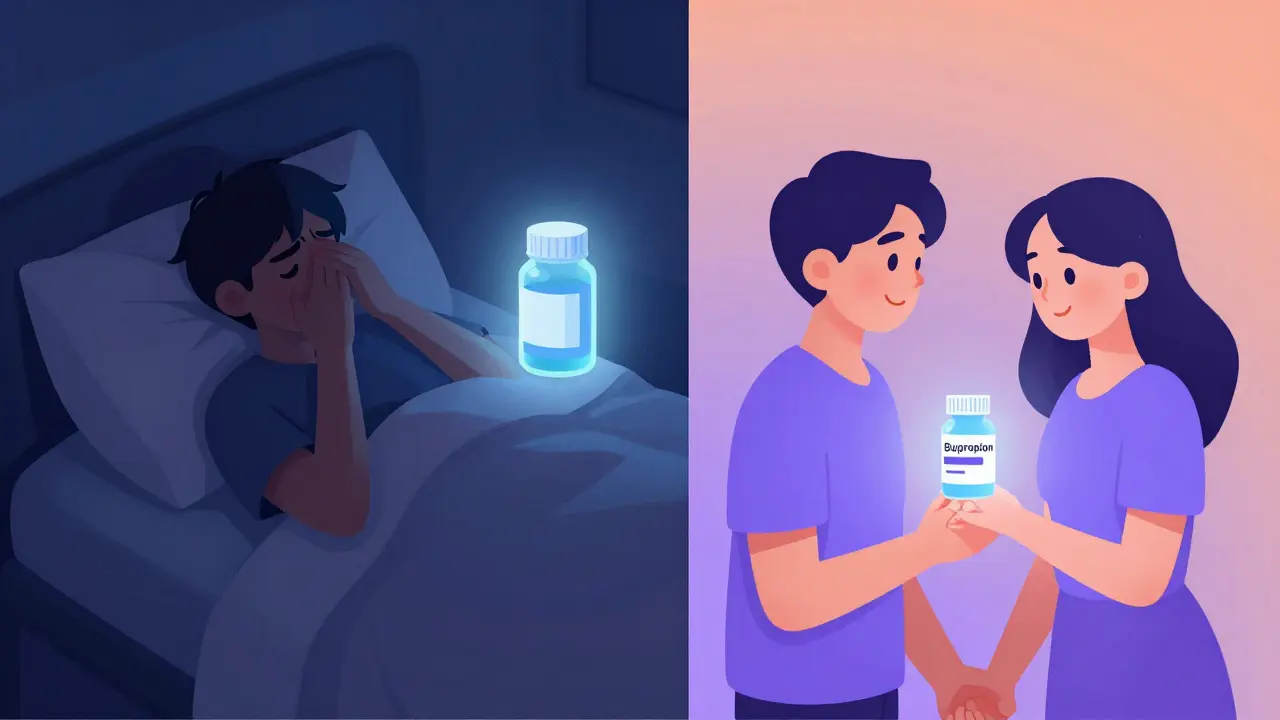
Not all drugs are equal. SSRIs like fluoxetine, sertraline, and paroxetine carry the highest risk - 50% to 70% of users report sexual side effects. But some medications like bupropion (Wellbutrin) and mirtazapine (Remeron) affect sex drive far less - only 5% to 10% of users. That’s not a coincidence. It’s a clue.
And here’s the twist: up to 50% of people with untreated depression already have sexual problems before they even start medication. So is it the drug? Or the illness? Often, it’s both. That’s why simply blaming the medication misses the point. The goal isn’t to avoid drugs - it’s to manage the side effects without losing the benefits.
Why Counseling Makes All the Difference
Most patients never get a real conversation about this. A 2023 Reddit survey of over 1,200 people found that 68% said their doctor never mentioned sexual side effects before prescribing. That’s not negligence - it’s silence. And silence leads to abandonment.
Here’s what happens when no one talks about it:
- Patients stop taking their meds because they think it’s their fault.
- They feel ashamed, isolated, or broken.
- Relationships suffer. Trust erodes.
- Depression comes back - harder than before.
But when providers bring it up early, something shifts. A 2023 study found that patients whose doctors discussed sexual side effects upfront were 82% more likely to stay on treatment. Why? Because they felt seen. Because they knew they weren’t alone. Because they had options.
One patient on HealthUnlocked shared: “When my doctor switched me to bupropion after I mentioned sexual problems at our 6-week check-in, my sex life improved within 2 weeks and I’ve stayed on treatment for 18 months now.”
That’s the power of a simple conversation.
What Effective Counseling Looks Like
Good counseling isn’t a one-time warning. It’s a plan. And it has four clear parts.
1. Start with a baseline
Before prescribing, ask: “How’s your sex life been lately?” Not in a clinical tone - just naturally. You don’t need fancy tools, but standardized scales like the AZS Sexual Experience Scale (ASEX) can help. It takes 5 to 7 minutes. It tells you if the problem was there before the meds - and how bad it is now.
2. Talk about risk - clearly
Don’t say, “Some people have side effects.” Say: “About 6 out of 10 people on this medication notice changes in their sex life. It’s not you. It’s the drug.”
Use numbers. Use facts. Normalize it. When patients hear, “This happens to most people,” they stop feeling broken. They start feeling supported.
3. Schedule follow-ups - specifically
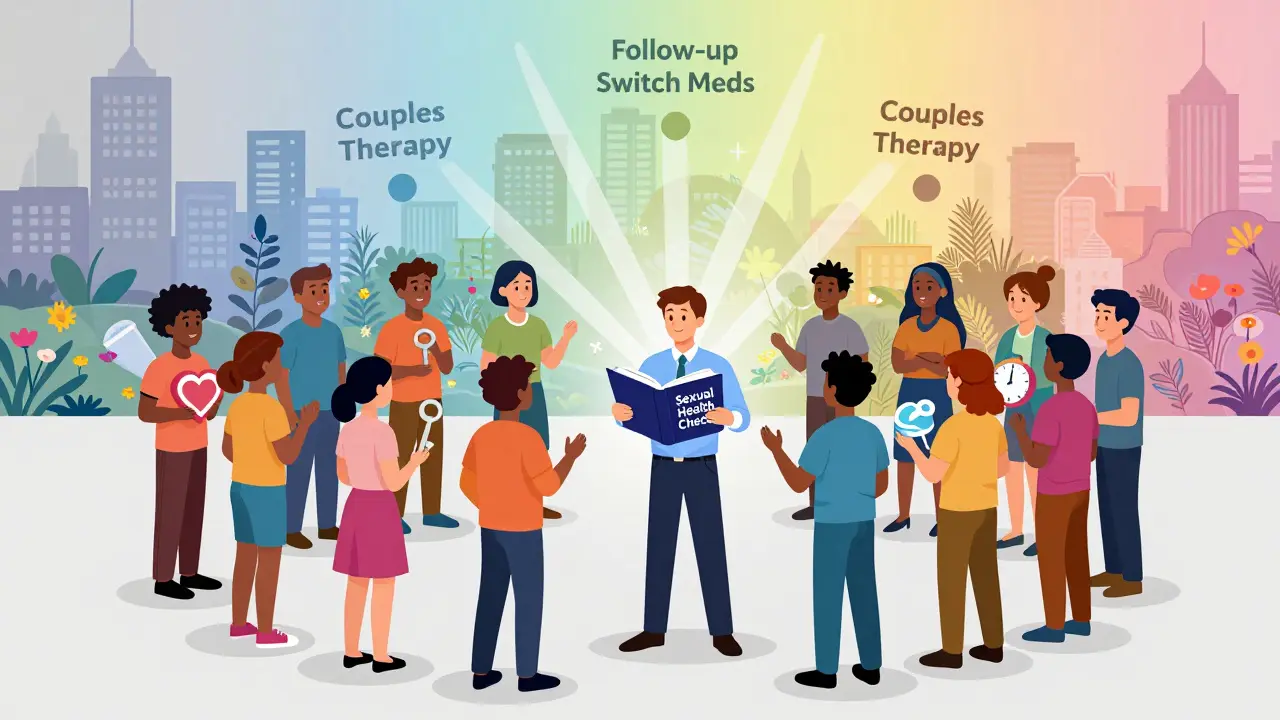
Don’t wait for them to bring it up. At the 2-week, 4-week, and 6-week check-ins, ask: “How’s your libido? Any trouble with arousal or orgasm?” Make it part of the routine, like checking for nausea or drowsiness.
Studies show that routine follow-up reduces self-discontinuation by 32%.
4. Have a backup plan
If side effects show up, don’t panic. Don’t say, “It’ll pass.” Offer solutions:
- Dose reduction - works for 25-30% of people.
- Drug holiday - skip the pill for 2-3 days before sex. Works for 40%, but risky if the drug has a short half-life (like paroxetine).
- Switch meds - moving from an SSRI to bupropion or mirtazapine helps 65-70% of people.
- Add a rescue drug - sildenafil (Viagra) helps with erections in 55-60% of men, but doesn’t fix low desire or orgasm problems.
- Couples therapy - if the side effect is straining your relationship, this helps 50% of couples.
For women, options are fewer - but not nonexistent. Topical estrogen, testosterone patches (off-label), and non-pharm approaches like sexual scheduling (planning intimacy when drug levels are lowest) can help.
Who’s Responsible? Everyone.
This isn’t just the psychiatrist’s job. Pharmacists are often the first to notice. A 2022 study found that pharmacists trained in sexual health counseling were 35% more confident talking to patients about side effects. And they’re the ones handing out the pills.
But here’s the problem: 78% of psychiatric clinics have no standard protocol for asking about sexual function. Most visits are 15 minutes. Doctors are overwhelmed. And many - 64% of residents - feel uncomfortable bringing it up.
That’s why change needs to be systemic. The American Psychiatric Association now requires “routine inquiry about sexual function” as part of standard care. Health systems are starting to build screening tools into electronic records. Telehealth platforms like Ro and Hims are now offering specialized sexual side effect consultations - 45% of their 2022 cases involved antidepressant-related dysfunction.
The Hidden Gaps
Not everyone gets equal care. LGBTQ+ patients report 28% fewer discussions about sexual side effects than heterosexual patients. Women’s sexual health is still understudied - only 12% of clinical trials focus on female-specific issues. And insurance? Only 38% of U.S. plans cover sex therapy.
Meanwhile, new tools are emerging. The MoodFX app (launched in 2022) lets patients track mood and sexual function side by side. Over 127,000 people are using it. And a new drug - a 5-HT2C receptor antagonist - is in phase 3 trials. It’s designed to block SSRI-induced sexual dysfunction without dulling the antidepressant effect. Results expected in 2024.
What You Can Do Right Now
If you’re on medication and noticing changes:
- Don’t suffer in silence. Write down your symptoms: what changed, when, and how it’s affecting you.
- Bring it up at your next appointment. Say: “I’ve noticed changes in my sex life since starting this med. Can we talk about what to do?”
- Ask: “Is there a different medication with fewer sexual side effects?”
- Ask: “Can we try a lower dose or a drug holiday?”
- Ask: “Can you refer me to someone who specializes in sexual health?”
If you’re a provider:
- Ask about sex at the first visit - before prescribing.
- Use plain language: “This happens to most people.”
- Don’t wait for them to ask. Check in at 2, 4, and 6 weeks.
- Have a list of alternatives ready.
What’s Next?
Experts predict that by 2030, medication-induced sexual dysfunction will be treated as routinely as weight gain or dizziness. We’re not there yet - but we’re closer than ever. The tools exist. The data is clear. The solutions work.
The only thing missing is the conversation.
Are sexual side effects from antidepressants permanent?
No, they’re not permanent. For most people, sexual side effects improve or disappear once the medication is adjusted - whether by lowering the dose, switching to a different drug, or adding a treatment like sildenafil. In rare cases, symptoms persist after stopping the drug (a condition called PSSD), but this affects less than 1% of users and is still being studied. The vast majority recover fully with proper management.
Can I just stop taking my medication if I’m having sexual side effects?
Stopping abruptly can cause withdrawal symptoms and make your original condition worse. Never stop without talking to your provider. Instead, ask for alternatives. Many people switch to bupropion or mirtazapine, which have far lower rates of sexual side effects. Others use drug holidays or add-on treatments. Discontinuing isn’t the only option - and it’s rarely the best one.
Why don’t doctors talk about this more?
Many providers feel uncomfortable discussing sex - it’s not taught well in medical school. Others assume patients won’t bring it up, so they don’t either. Time constraints also play a role. But research shows that when providers do talk about it, patients are more likely to stick with treatment. The field is changing, but progress is slow. You have the right to ask - and your provider should be ready to answer.
Do all antidepressants cause sexual side effects?
No. SSRIs and SNRIs have the highest rates - 50-70% of users. But bupropion (Wellbutrin) and mirtazapine (Remeron) cause sexual side effects in only 5-10% of users. Some older antidepressants like tricyclics also have lower rates than SSRIs. It’s not about the class of drug being “bad” - it’s about matching the right drug to the right person. Your provider can help you find one that works for your mood and your body.
Can therapy help with sexual side effects?
Yes - especially if the side effect is affecting your relationship. Couples therapy helps 50% of couples where sexual dysfunction has created tension or emotional distance. Individual therapy can also help address shame, anxiety, or body image issues that come with these side effects. Therapy doesn’t fix the drug’s effect on your body, but it can help you cope with its impact on your life.
Is there a pill I can take to fix this?
For men with erectile issues, drugs like sildenafil (Viagra) or tadalafil (Cialis) help about 55-60% of the time. But they don’t help with low desire or delayed orgasm. For women, there are no FDA-approved medications specifically for SSRI-induced sexual dysfunction, though off-label options like testosterone patches or flibanserin are sometimes used. The best approach is often a combination - adjusting the antidepressant, adding a targeted treatment, and using behavioral strategies.
about author


Scott Smith
It’s wild how often doctors treat sexual side effects like a taboo. I was on sertraline for two years and never heard a word about this until I brought it up myself. By then, my relationship was already strained. The fact that 68% of patients aren’t warned upfront isn’t an oversight-it’s systemic neglect. I switched to bupropion and my libido came back within weeks. Why isn’t this standard practice?
tamilan Nadar
in india we dont talk about this at all. my doctor just said 'wait and see' when i mentioned low desire. no numbers, no alternatives. just silence. i stopped the med. depression came back harder. now i take low dose bupropion and i dont even mention sex to anyone. its just how it is.
Adam M
Stop blaming doctors. They’re overworked. If you can’t bring up sex with your own partner, why expect them to?
Rosemary Chude-Sokei
While I appreciate the clinical thoroughness of this piece, I must emphasize the profound psychological toll of unaddressed sexual dysfunction. The shame spiral is real-patients internalize these side effects as personal failure rather than pharmacological inevitability. A standardized, empathetic protocol isn’t just beneficial; it’s ethically imperative. The data is clear: normalization saves lives.
Noluthando Devour Mamabolo
As a clinician in Cape Town, I’ve seen this firsthand. The term ‘SSRI-induced anorgasmia’ is now part of our intake screening. We use the ASEX scale religiously. What’s missing? Access. Most of my patients can’t afford sildenafil or therapy. We’re pushing for public health integration-because if you’re treating depression but crippling intimacy, are you really healing?
Leah Dobbin
Let’s be honest: this entire conversation is a product of over-medicalized, hyper-aware modernity. In the 80s, people just… lived with it. Now we’ve turned a common, manageable side effect into a crisis narrative. Some folks just need to stop treating their bodies like broken machines.
Ali Hughey
THIS IS A GOVERNMENT AND PHARMA CONSPIRACY. Did you know? The FDA knew about PSSD since 1998. They buried the studies. Big Pharma profits from people staying on SSRIs because they’re addicted to the side effects-literally. They don’t want you switching to bupropion because it’s generic and cheap. And don’t get me started on how they silence patients who speak out. I’ve got screenshots. I’ve got emails. I’ve got whistleblowers. This isn’t about sex-it’s about control. And the truth? They’re watching you right now.
Alex MC
Thank you for writing this. I’ve been on mirtazapine for 3 years now. No sexual side effects. Zero. My wife and I finally feel like ourselves again. I wish I’d known sooner. I’m not saying everyone should switch-but if you’re struggling, ask. Just ask. It’s okay. You’re not alone. And it’s not your fault.
rakesh sabharwal
Pathetic. You people treat your libido like a premium feature. Medication is for healing minds, not optimizing pleasure. If you can’t handle a little side effect, maybe you never needed the drug in the first place. Also, why are we letting pharmaceutical marketing dictate our intimate lives? This is nonsense.
Aaron Leib
Hey, I’m a therapist. I’ve had clients who quit meds because they felt broken. I’ve also had clients who switched to bupropion and got their sex life back. The key isn’t the drug-it’s the conversation. If you’re reading this and you’re struggling: you’re not weird. You’re not alone. And you deserve to talk about it. I’ve got resources. DM me. No judgment. Just support.