
Therapeutic Interchange: What Providers Really Do When Substituting Medications Within the Same Class

Therapeutic interchange sounds like it might mean swapping one type of drug for another entirely - like switching from a blood pressure medication to a diabetes pill. But that’s not what it is. In fact, it’s the opposite. Therapeutic interchange happens when a provider or pharmacist replaces a prescribed drug with a different one within the same class - same purpose, same mechanism, different brand or chemical structure. This isn’t a random swap. It’s a carefully planned, evidence-based decision made to save money without sacrificing safety or effectiveness.
What Therapeutic Interchange Actually Means
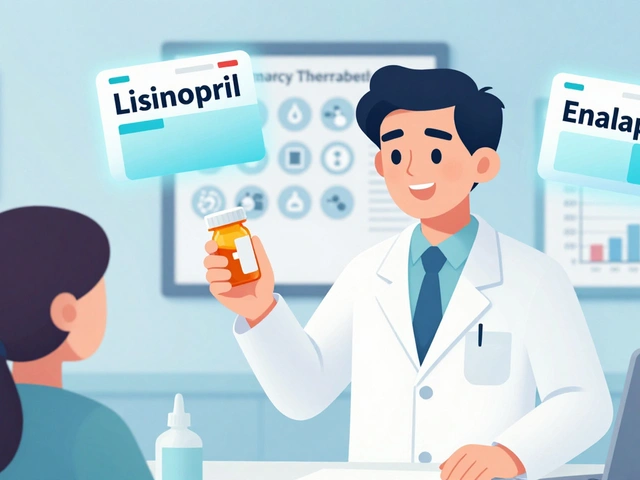
Let’s clear up the biggest misunderstanding right away: therapeutic interchange does not mean switching between different therapeutic classes. If a doctor prescribes lisinopril (an ACE inhibitor) for high blood pressure, therapeutic interchange would mean swapping it for another ACE inhibitor like enalapril - not switching to a calcium channel blocker like amlodipine. The American College of Clinical Pharmacy defines it clearly: it’s substituting one drug for another that’s therapeutically equivalent but chemically different - and always within the same class.
This distinction matters because mixing classes can lead to serious risks. A beta-blocker and a diuretic both treat hypertension, but they work differently. One slows the heart rate, the other flushes out fluid. Swapping them without careful review could cause blood pressure to spike or drop too low. Therapeutic interchange avoids that by sticking to drugs that act the same way. Think of it like swapping one brand of running shoes for another - same support, same sole design, just a different label.
Who Decides and How It Works
Therapeutic interchange doesn’t happen because a pharmacist feels like it. It’s governed by formal policies created by a Pharmacy and Therapeutics (P&T) Committee. This group includes pharmacists, physicians, nurses, and sometimes even patients. They review clinical data, cost studies, and side effect profiles to build a facility’s formulary - a list of approved medications.
When a drug on that list gets replaced, it’s because the committee found a better option. Maybe the new drug costs 40% less. Maybe it has fewer side effects in elderly patients. Maybe it’s easier to take once a day instead of three times. The decision isn’t made lightly. It’s backed by studies, real-world outcomes, and often years of data.
Once the formulary is set, pharmacists can swap medications according to those rules - but only if the prescriber has agreed to it in advance. In hospitals and nursing homes, prescribers often sign a Therapeutic Interchange (TI) letter that says, “I’m okay with substituting Drug A for Drug B in this situation.” That letter stays on file. When the pharmacy sees a prescription for Drug A, they automatically fill it with Drug B, unless the patient objects.
Why Hospitals and Nursing Homes Use It
Cost is the biggest driver. Drug prices keep rising - an 8% increase was projected in 2018, and trends haven’t slowed. In skilled nursing facilities, where residents take an average of 8-10 medications daily, pharmacy bills can eat up 30% of operating costs. One facility reported saving over $40,000 a month just by switching to lower-cost alternatives within the same class.
But it’s not just about money. Standardizing medications helps reduce errors. If every patient on a unit takes the same brand of metoprolol, nurses don’t have to double-check every pill. Pharmacists can spot potential interactions faster. And if a drug has a recall or shortage, having pre-approved alternatives means care doesn’t stop.
Studies show therapeutic interchange improves outcomes, too. One 2018 review found hospitals using formal interchange programs saw fewer adverse drug events. Why? Because the replacements were chosen for better safety profiles - not just lower price tags.

Where It Doesn’t Work - and Why
Therapeutic interchange is rare in community pharmacies. Why? Because state laws vary, and most require the pharmacist to call the prescriber before making any change. That adds time, paperwork, and delays. A patient walks in for a prescription for atorvastatin, and the pharmacist wants to switch them to rosuvastatin - same class, same effect, cheaper. But without a signed TI letter on file, the pharmacist can’t swap it. They have to call the doctor, wait for approval, and hope the patient doesn’t leave.
It also doesn’t work for patients with complex conditions. Someone with heart failure who responds perfectly to a specific dose of furosemide might not do as well on another diuretic. Or a patient with a history of allergic reactions to sulfa drugs can’t be switched to a sulfa-containing drug, even if it’s in the same class. That’s why formularies always include exceptions. The P&T Committee builds in flexibility - because real patients aren’t just data points.
State Laws and the Patchwork Rules
There’s no national standard for therapeutic interchange. In some states, pharmacists can make substitutions automatically if the prescriber has authorized it in writing. In others, every single change requires a new prescription - even if the drug is on the approved list. In Texas, for example, a prescriber can sign a blanket authorization for all patients on a formulary. In New York, each substitution needs a separate order.
This inconsistency creates headaches for pharmacy chains that operate across state lines. A nurse in a nursing home in Pennsylvania might be used to automatic swaps. When that same patient moves to a facility in Florida, the rules change. The pharmacist has to re-educate the staff. Prescribers have to re-sign forms. It’s inefficient - and risky if someone assumes the rules are the same.

What Patients Need to Know
If you’re on a medication and suddenly get a different pill, don’t panic. Ask: “Is this a therapeutic interchange?” If yes, ask why. Was it cheaper? Safer? Easier to take? You have the right to know. You also have the right to refuse.
Many patients assume a generic drug is the only option. But therapeutic interchange isn’t about generics. It’s about choosing between two brand-name drugs - or two generics - that do the same thing. One might be better tolerated. One might not interact with your other meds. That’s the point.
Some patients worry switching means lower quality. But the drugs used in therapeutic interchange are held to the same FDA standards. They’re not knockoffs. They’re just different versions of the same treatment. In fact, many are more effective than the original - which is why they were chosen in the first place.
The Bottom Line
Therapeutic interchange is a smart, proven tool. It saves money. It reduces errors. It improves consistency of care. But it only works when it’s done right - within the same drug class, with clinical evidence, and with clear communication between providers, pharmacists, and patients.
It’s not a loophole. It’s not a cost-cutting trick. It’s a structured, collaborative approach to better care. And when it’s implemented well, patients get the same - or better - results, at a lower cost, with fewer surprises.
Is therapeutic interchange the same as generic substitution?
No. Generic substitution means replacing a brand-name drug with its exact chemical copy - like swapping Brand X lisinopril for Generic lisinopril. Therapeutic interchange swaps one drug for another that’s chemically different but works the same way - like switching from lisinopril to enalapril. Both are cost-saving, but therapeutic interchange involves more clinical judgment and happens within a formulary system.
Can a pharmacist make a therapeutic interchange without asking the doctor?
In institutional settings like hospitals or nursing homes, yes - if the prescriber has signed a Therapeutic Interchange (TI) letter authorizing it. In community pharmacies, almost always no. Most states require the pharmacist to contact the prescriber first, even if the drug is on the approved formulary. The rules vary by state.
Does therapeutic interchange lower the quality of care?
Not when done properly. Studies show that when therapeutic interchange follows evidence-based formularies and includes patient input, it maintains or even improves outcomes. The key is using drugs that have been proven to have substantially equivalent effects. If a patient responds poorly to the swap, the change is reversed. It’s not a one-size-fits-all policy.
Why don’t all doctors support therapeutic interchange?
Some doctors worry about losing control over treatment decisions. Others have had bad experiences with poorly implemented programs. But many support it - especially when they’re part of the Pharmacy and Therapeutics Committee that creates the rules. The best programs involve prescribers from the start, so they trust the choices being made.
Can therapeutic interchange be used for any medication?
No. It’s only used for medications where clinical evidence supports equivalent outcomes. Drugs with narrow therapeutic windows - like warfarin or lithium - are rarely swapped. So are drugs used for conditions that require individualized dosing, like epilepsy or psychiatric disorders. The P&T Committee carefully selects which drugs are eligible based on safety data.
about author

Heidi Thomas
Therapeutic interchange is just pharmacy greed dressed up as science.
zac grant
Actually, this is how formulary management works in real hospitals. P&T committees don't just pick cheaper drugs-they analyze real-world outcomes, ADE rates, adherence data. The goal isn't cost-cutting, it's risk mitigation. If you're on a stable regimen, you won't get swapped. If you're on a high-cost, high-risk med with a safer, cheaper alternative? That's clinical stewardship, not greed.
Jenny Rogers
One must observe, with due diligence, that the very notion of therapeutic interchange presupposes a hierarchical epistemology wherein clinical authority is delegated not to the individual patient’s phenomenological experience, but to the aggregated, statist calculus of institutional formularies. This is not medicine-it is bureaucratic pharmacology, a technocratic reduction of human physiology to a spreadsheet row.
Chase Brittingham
I’ve seen this in action at my mom’s nursing home. They switched her from one statin to another and her muscle pain disappeared. No drama, no phone calls, just better care. The system works when it’s done right. Not every swap is a gamble-some are upgrades.
Jake Deeds
Oh wow, someone actually wrote a thoughtful piece about pharmacy policy? How quaint. I suppose next you’ll tell me that insulin isn’t $1,000 because Big Pharma is evil, but because formularies and rebates create this… beautiful, nuanced mess. Please, let me weep for the dignity of clinical decision-making.
Carolyn Ford
So… you’re saying it’s fine to swap meds without the patient’s consent? And you call that ethics? You’re not a pharmacist-you’re a corporate agent. And don’t even get me started on how these "evidence-based" formularies ignore real-life side effects that only patients notice. You think a study says it’s safe? My aunt had a stroke after they swapped her blood pressure med. You’re not saving money-you’re gambling with lives.
Benjamin Sedler
So let me get this straight-pharmacists are now the new doctors? Next they’ll be writing prescriptions in crayon while singing show tunes. I mean, I get the cost thing, but swapping lisinopril for enalapril like it’s a game of musical chairs? What’s next? Trading antibiotics for probiotics because the latter is cheaper? This isn’t innovation-it’s pharmaceutical whack-a-mole.
Alex Piddington
For those unfamiliar with the system: therapeutic interchange is not a blanket substitution. It’s a protocol-driven, committee-reviewed, prescriber-authorized process designed to reduce polypharmacy risks. In institutional settings, it’s standard practice-like using standardized IV fluid bags or barcode scanning. It’s not about control. It’s about safety through consistency.
Libby Rees
In the UK, we don’t have this system. We use generic prescribing by default. If a drug is on the formulary, it’s already the cheapest option. We don’t swap brand to brand. We just prescribe the generic. Simpler. Fewer rules. Fewer headaches. Maybe we’re doing it right.
Martyn Stuart
Let’s not forget the human factor. I’ve worked in a long-term care facility where they switched 12 patients from metoprolol tartrate to metoprolol succinate because the latter is once-daily. Compliance jumped from 68% to 92%. That’s not a cost saving-it’s a quality-of-life win. And yes, every patient was consulted. The P&T committee didn’t just pick a cheaper pill-they picked a better one.
Jordan Wall
Therapeutic interchange? More like therapeutic circus. 🎪💸 We’ve got pharmacists playing doctor, formularies acting like Netflix algorithms, and patients treated like inventory. And you call this "evidence-based"? Bro, I’ve seen more rigorous decision-making in a Fortnite lobby. Also, I just got switched from atorvastatin to rosuvastatin and now I’m sleepy AF. #PharmaGamble
Gillian Watson
Interesting. In the NHS, we rarely do this because we don’t have brand-name options in most cases. But when we do, it’s always with clinician input. I think the key is transparency-if a patient knows why they’re getting a different pill, they’re more likely to trust it. It’s not the swap that’s the problem. It’s the silence around it.