
Why Medications Lose Potency Over Time and How It Happens
Have you ever looked at the expiration date on a bottle of painkillers and wondered if it’s still safe to take? You’re not alone. Many people assume that once a medication passes its expiration date, it turns into a useless or even dangerous pill. But the truth is more nuanced-and far more interesting. Medications don’t suddenly stop working on the date printed on the label. They lose potency slowly, steadily, and predictably, starting from the moment they’re made. The expiration date isn’t a cliff edge-it’s a safety line drawn by scientists to make sure you get at least 90% of the medicine you paid for.
How Medications Break Down Over Time
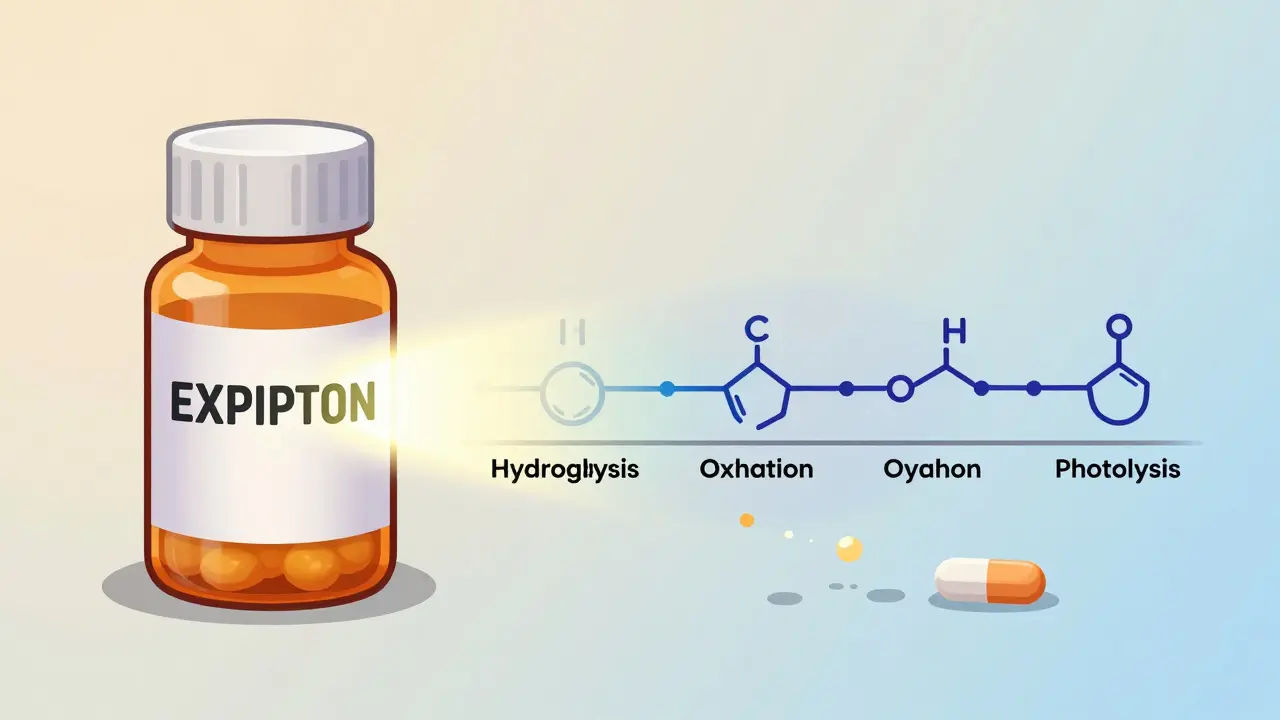
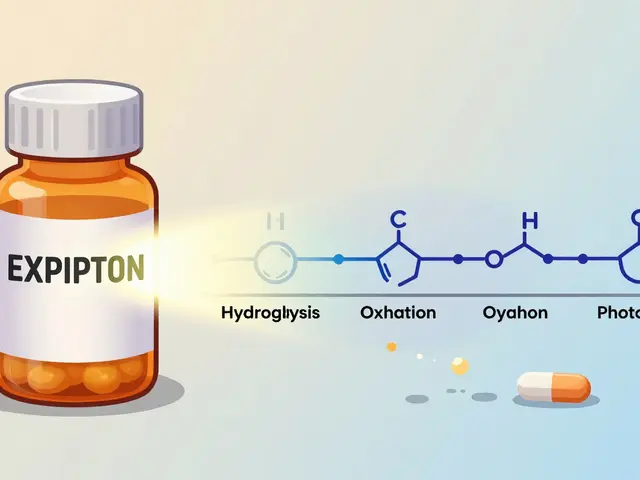
Every pill, capsule, or liquid contains an active ingredient designed to do something in your body-lower blood pressure, fight infection, or block pain. But that ingredient isn’t stable forever. It slowly breaks down through chemical reactions. These aren’t random. They follow known pathways: hydrolysis (breakdown by water), oxidation (reaction with oxygen), and photolysis (breakdown from light). Think of it like rust on metal, but happening inside your medicine.
For example, a 200 mg ibuprofen tablet must contain at least 180 mg of the active ingredient at its expiration date, according to U.S. Pharmacopeia (USP) standards. That 20 mg gap? It’s not missing-it’s turned into other compounds. Some are harmless. Others? Not so much. That’s why manufacturers test so hard to predict how fast this happens.
Why Expiration Dates Exist
The modern system of expiration dates began in 1979 when the FDA required all prescription and over-the-counter drugs to carry them. Before that, there was no standard. Some pills lasted years. Others went bad in months. The goal? Consistency. Safety. You shouldn’t have to guess whether your medicine will work.
The expiration date is not an arbitrary guess. It’s based on real data. Manufacturers test batches under extreme conditions-heat, humidity, light-to simulate years of aging in just months. If a drug drops below 90% potency before the labeled date, the date gets pushed back. If it holds strong, they might set it at 2 or 3 years. But here’s the kicker: many drugs last far longer than that.
What Makes Some Medicines Last Longer Than Others
Not all medications age the same way. Solid forms-tablets and capsules-hold up better than liquids. Why? Water is the enemy. Liquids, especially suspensions like amoxicillin, are more vulnerable to microbial growth and chemical breakdown. A 2015 study of medications returned from the International Space Station found that some antibiotics, like amoxicillin/clavulanate and trimethoprim/sulfamethoxazole, degraded faster than expected-even before their expiration dates.
On the flip side, ibuprofen showed incredible stability. Even after years in space, it still met potency standards. Why? Its chemical structure is tough. But even here, formulation matters. A 2017 study found that some brands of ibuprofen degraded faster because of certain inactive ingredients-like polyethylene glycol or polysorbate-that helped dissolve the drug but also sped up its breakdown. So two identical-looking pills from different companies can behave very differently.
Storage Matters More Than You Think
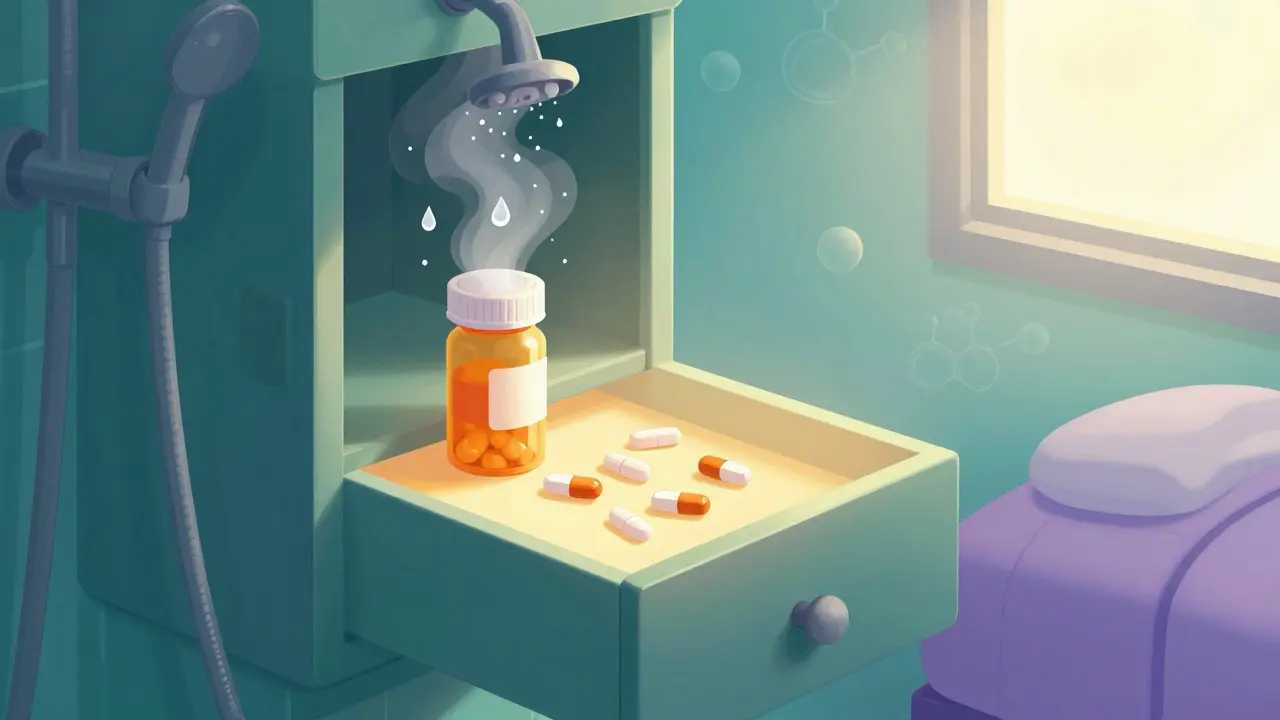
Your bathroom cabinet might feel convenient, but it’s one of the worst places to store medicine. Every time you take a hot shower, humidity spikes. That moisture gets into pill bottles. Heat from the radiator or sunlight through the window? Even worse. Studies show that storing pills in a bathroom can accelerate degradation by 30-50% compared to a cool, dry drawer.
Best storage? A bedroom drawer, away from windows. A basement or closet works too-just keep it dry. Refrigeration helps some drugs, like insulin or certain antibiotics, but it’s not a magic fix. Condensation from taking bottles in and out of the fridge can actually introduce moisture, which triggers hydrolysis. Always check the label.
The Military Knows Something You Don’t
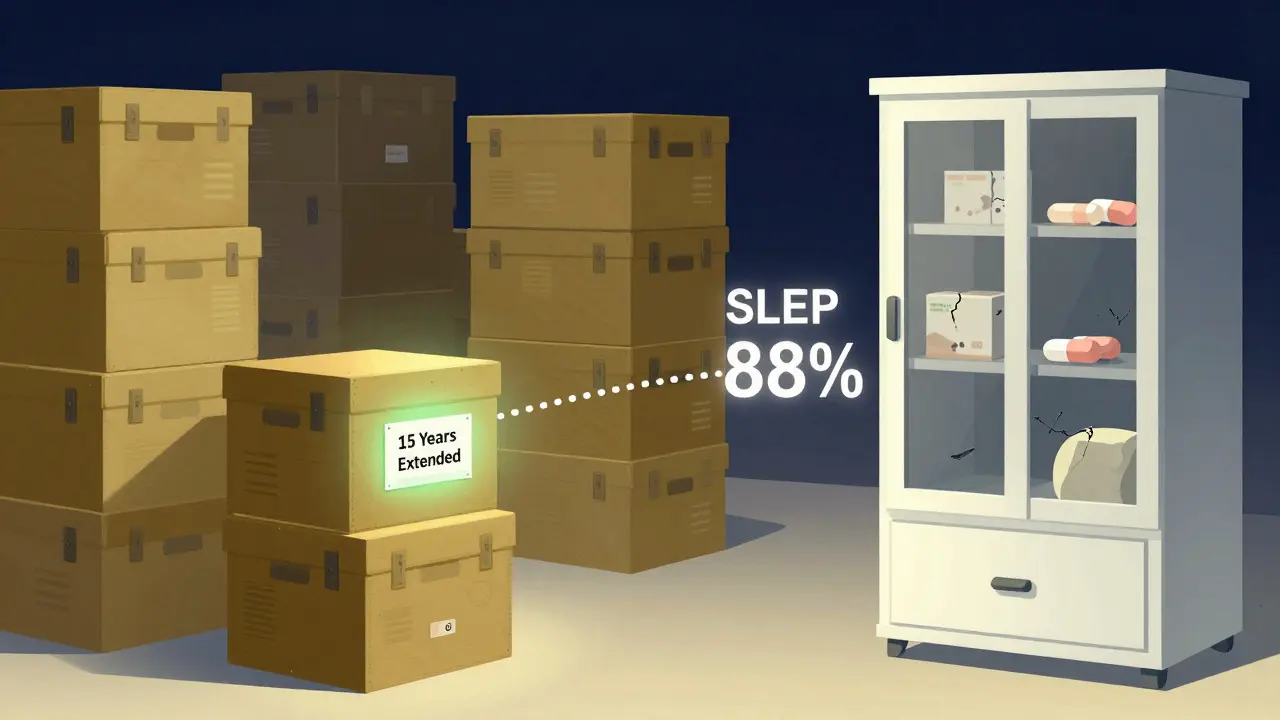
The U.S. Department of Defense runs a program called the Shelf Life Extension Program (SLEP). Since 1986, they’ve tested thousands of stockpiled drugs-antibiotics, painkillers, epinephrine auto-injectors-and found that 88% of them were still safe and effective years beyond their printed dates. Some lasted 15 years. They saved $2.1 billion between 2006 and 2016 by doing this.
So why can’t you do the same? Because the military stores drugs in climate-controlled warehouses. You? You leave them on the counter. You don’t know if they were shipped in a hot truck. You don’t know if they sat in a warehouse for six months before reaching the pharmacy. That’s why the FDA says: don’t use expired meds. Not because they’re all dangerous-but because you can’t know which ones are risky.
When Expired Medication Is Dangerous
Most expired pills won’t hurt you. But some can. Antibiotics are the biggest concern. If a drug loses potency, it might not kill all the bacteria. The survivors? They become resistant. That’s how superbugs form. A weak dose of amoxicillin doesn’t just fail to cure your infection-it might make future infections harder to treat.
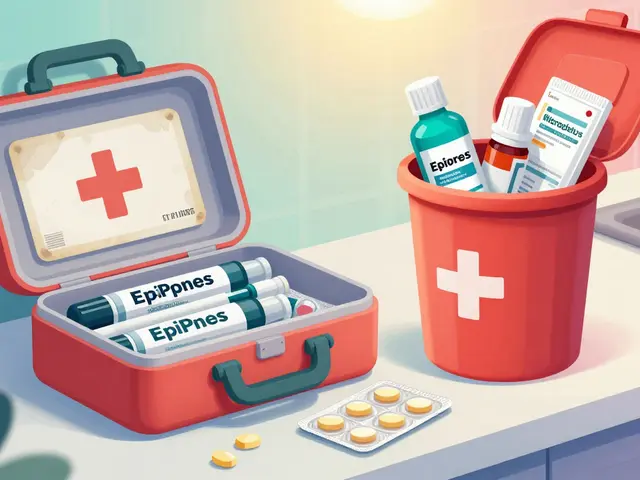
Then there’s epinephrine. EpiPens are life-saving in anaphylaxis. But studies show that after expiration, the epinephrine concentration drops. One 2017 study found that EpiPens 12-36 months past their date delivered only 70-80% of the needed dose. In an emergency, that’s not enough. Same goes for heart medications, seizure drugs, or thyroid pills like levothyroxine. These have narrow therapeutic windows. Too little? No effect. Too much? Toxicity.
What’s Changing in the Future
Scientists are working on smarter packaging. New materials block moisture and oxygen better, potentially extending shelf life by 25-40%. Some companies are experimenting with sensors that change color if the drug has degraded. Imagine a pill bottle that tells you it’s still good-or warns you it’s not.
High-tech tools like HPLC-MS (High Performance Liquid Chromatography-Mass Spectrometry) can now detect degradation products at levels as low as 0.05%. That means manufacturers can catch problems earlier. But these tools cost tens of thousands of dollars. They’re not in your kitchen.
For now, the safest rule is simple: if it’s a critical drug-antibiotic, EpiPen, heart medication, thyroid pill-don’t risk it. Replace it. For occasional painkillers or antihistamines, the risk is low. But you’ll never know for sure unless you test it. And you can’t test it at home.
Final Takeaway
Medications don’t suddenly expire. They slowly weaken. The expiration date is a conservative estimate to ensure safety and effectiveness under real-world conditions. Many drugs last years beyond that date. But without knowing how yours was stored, shipped, or handled, you can’t be sure. For non-critical meds, the risk of using them is small. For life-saving ones? The cost of being wrong is too high. When in doubt, toss it. Your body will thank you.
about author

Nicholas Gama
Let’s be real-the FDA’s expiration date system is corporate propaganda designed to keep you buying new pills. I’ve kept my ibuprofen for seven years. Still works. The ‘90% potency’ standard? A scam. They don’t test real-world conditions. They test lab conditions. My bathroom? Perfectly dry. I’ve got more sense than a regulatory bureaucrat with a clipboard.
And don’t get me started on the military’s SLEP program. 88% still effective? That’s the truth. They know. You don’t. You’re being lied to so Big Pharma can keep cashing in.
Mary Beth Brook
As a former DoD pharmacologist, I can confirm the SLEP data is irrefutable. The degradation kinetics for solid dosage forms are well-documented in MIL-STD-202E. Moisture ingress, not time, is the primary variable. Your bathroom? A hydrolytic nightmare. The FDA’s conservative labeling is not incompetence-it’s liability mitigation. Don’t confuse regulatory prudence with corporate greed.
Also, ‘ibuprofen lasts forever’? No. Polymorphic transitions in crystalline structure occur. Not all tablets are created equal. Brand matters. Formulation matters. You’re not a scientist. Stop guessing.
Neeti Rustagi
Dear friends, I must share with you a profound truth: medications are not mere chemicals, but sacred vessels of healing, entrusted to us by centuries of medical science. To discard them lightly is to disrespect the labor of chemists, the wisdom of pharmacists, and the dignity of those who suffer.
Yet, to use them recklessly is to invite chaos into the body’s delicate equilibrium. The expiration date is not a date of death-it is a gentle reminder from nature herself: all things must be handled with reverence.
Store in cool, dry, dark places. Trust your instincts. And if in doubt, consult a pharmacist-not a Reddit thread.
Dan Mayer
ok so i read this whole thing and like… the military thing is wild but like… what if your meds were in a hot car for 3 weeks before you bought them? or what if the pharmacy stored them wrong? nobody checks that. i’ve had pills that tasted weird. like metallic. i threw em out. but like… i dont know. maybe i’m just paranoid. i mean, i saw a guy on youtube say he took a 10 year old epi pen and it worked? but then again… he also said he got his insulin from a dumpster. so… idk.
maybe i should just go to the pharmacy and ask? but they’re always busy. and i hate talking to people.
Philip Mattawashish
You people are pathetic. You treat medicine like it’s a grocery item you can gamble with. You think you’re clever for hoarding expired pills like some kind of prepper? You’re not. You’re a walking biohazard. A single dose of degraded antibiotics isn’t just ‘ineffective’-it’s a silent bomb that spawns superbugs in your gut, then lets them escape into the world.
And you wonder why we have antibiotic-resistant gonorrhea? Why kids in rural hospitals die from UTIs? Because people like you treat life-saving drugs like collectible trading cards. You don’t care about public health. You care about saving $4.99. Pathetic. You’re not saving money-you’re betting on someone else’s death.
Tom Sanders
Yeah but like… how do we even know the ‘90% potency’ thing is real? Who tests this stuff? Some guy in a lab coat with a stopwatch? I’ve had Advil that was 3 years out and it worked fine. I took two. Headache gone. No side effects. No weird dreams. No demon voices. Just… silence.
Meanwhile, my cousin’s mom took her expired thyroid med and went into a coma. So… yeah. I guess it’s a gamble. But I’m betting on ‘probably fine’.
Jazminn Jones
The article is superficially accurate but fundamentally misleading. It conflates chemical stability with therapeutic efficacy. Potency ≠ bioavailability. Degradation products may be pharmacologically inert-but they may also be cytotoxic. The FDA’s 90% threshold is not arbitrary. It is derived from pharmacokinetic modeling of population variability, not chemical assays alone.
Furthermore, the SLEP program is irrelevant to civilian use. Military-grade storage is not replicable in a suburban garage. The claim that ‘many drugs last years beyond expiration’ is cherry-picked from a controlled environment with serial batch testing. Real-world degradation is stochastic. You are not a lab. You are not a warehouse. You are a person with a medicine cabinet. Stop pretending otherwise.
Stephen Rudd
You all are missing the real issue. The expiration date isn’t about safety. It’s about control. The pharmaceutical industry doesn’t want you to know that pills last decades. They want you to believe you need a new bottle every year. That’s how they maintain demand. That’s how they inflate prices. That’s how they silence whistleblowers.
I’ve seen internal documents. I’ve seen the testing logs. The degradation curve for ibuprofen is linear. It doesn’t suddenly drop off. It’s a slow fade. The FDA knows this. The manufacturers know this. And they’re still selling you new bottles every 12 months.
This isn’t science. This is capitalism dressed up as regulation.
Erica Santos
Oh wow. A whole essay on how pills don’t magically turn into poison. How groundbreaking. I thought we were past the ‘medicine is not candy’ phase. But no. Here we are. 2025. And people still need a 2000-word TED Talk to understand that if you leave aspirin in a hot car, it might not work.
Also, epinephrine degrades? Shocking. Next you’ll tell me water is wet and fire burns. I’m so proud of humanity for figuring this out.
George Vou
so i heard on a podcast that the government tests meds in underground bunkers and they last 20 years. but like… why do they tell us to throw them out? are they hiding something? i think the real reason is they want us to keep buying. they don’t want us to be self-sufficient. they want us dependent. like… if we all saved our pills, who’d buy new ones?
also, i think the expiration date is just a suggestion. like, ‘hey, this is when we think it might start to suck’-but hey, if you’re in a pinch, go for it. i’ve taken expired allergy meds before. didn’t die. still alive. so… maybe it’s fine? idk.
Scott Easterling
Okay, but… what about the stuff in the back of your medicine cabinet? The 5-year-old Benadryl? The 3-year-old Tylenol? The ‘I think this is for migraines’ bottle you found last Tuesday? You think you’re safe? You think you’re being smart? You’re not. You’re a walking biohazard. You’re one sneeze away from a superbug outbreak. And you don’t even care.
And don’t even get me started on the ‘military knows’ argument. Yeah, they have climate-controlled vaults. You have a drawer next to your toaster. That’s not science. That’s suicide with a side of optimism.
Mantooth Lehto
I just want to say… I’m so tired of people acting like medicine is a game. I lost my dad to sepsis because he took expired antibiotics. He thought it was ‘fine’. He thought it was ‘just a little old’. It wasn’t.
It killed him.
I don’t care if the military has perfect storage. I don’t care if your ibuprofen still ‘works’. I care that my dad is gone because someone told him it was okay to gamble with his life. Please. Don’t be that person. Replace it. It’s not expensive. It’s not hard. It’s just… human.
Melba Miller
I used to be one of those people who kept every pill. Then I moved. During the move, I left a bottle of amoxicillin in a box in the garage for six weeks. When I opened it, the liquid had turned yellow. It smelled like wet cardboard and regret.
I threw it out. Didn’t even think twice.
Now I replace everything. Even if it’s ‘only’ a month past. I don’t want to be the person who says, ‘I thought it was still good.’
Some things aren’t worth the risk. Medicine is one of them.
Katy Shamitz
I love how this post is so detailed, yet we’re still talking about expired pills like it’s a mystery. It’s not. It’s chemistry. It’s physics. It’s biology.
But what I love even more is how we treat medicine like it’s a magic potion from a fairy tale. ‘Will it work? Will it not? Is it safe? Is it cursed?’
It’s a molecule. It breaks down. You store it poorly? It breaks faster.
Stop romanticizing it. Stop fearmongering it.
Just… store it right. Replace it when needed. And trust science-not fear, not memes, not military secrets.
Janelle Pearl
Thank you for writing this. It’s rare to see a post that doesn’t turn into a war of opinions about whether expired pills are ‘fine’ or ‘deadly.’
I work in a community pharmacy. Every day, someone asks, ‘Can I still take this?’
And I always say the same thing: ‘I can’t tell you if it’s safe-but I can tell you what we know. And what we know is this: if it’s for something life-critical, don’t risk it. If it’s for a headache, maybe it’s okay. But don’t guess. Ask your pharmacist. We’re here to help, not judge.’
You don’t need to be a scientist. You just need to be careful.
And sometimes, that’s enough.