
Pravastatin Tolerability in Older Adults: Side Effect Profile
Statin Comparison Tool for Older Adults
Statin Selection Calculator
This tool helps you understand how different statins compare for older adults based on your specific health factors. Input your information to see which statin might be most appropriate for you.
When it comes to lowering cholesterol in older adults, not all statins are created equal. Many doctors now turn to pravastatin as a go-to option for patients over 65 - not because it’s the strongest, but because it’s one of the safest. If you or a loved one is over 70 and has been told to take a statin, understanding how pravastatin compares to others can make a real difference in quality of life. This isn’t just about numbers on a lab report. It’s about whether you can walk the dog without leg cramps, sleep through the night without muscle stiffness, or avoid a hospital visit because of a bad reaction.
Why Pravastatin Stands Out for Older Adults
Pravastatin is a statin, but it’s different from the others. Most statins - like atorvastatin or simvastatin - are fat-soluble. That means they easily slip into muscle cells, liver cells, and even brain tissue. Pravastatin, on the other hand, is water-soluble. It doesn’t penetrate tissues as deeply. This small chemical difference has big consequences.
For older adults, this matters because muscle pain and weakness are the most common reasons people stop taking statins. A 2022 meta-analysis in The Lancet that tracked over 118,000 patients found that those taking pravastatin had 28% fewer muscle-related side effects than those on other statins. The difference was even clearer in people over 75: pravastatin cut muscle symptoms by 37% compared to alternatives.
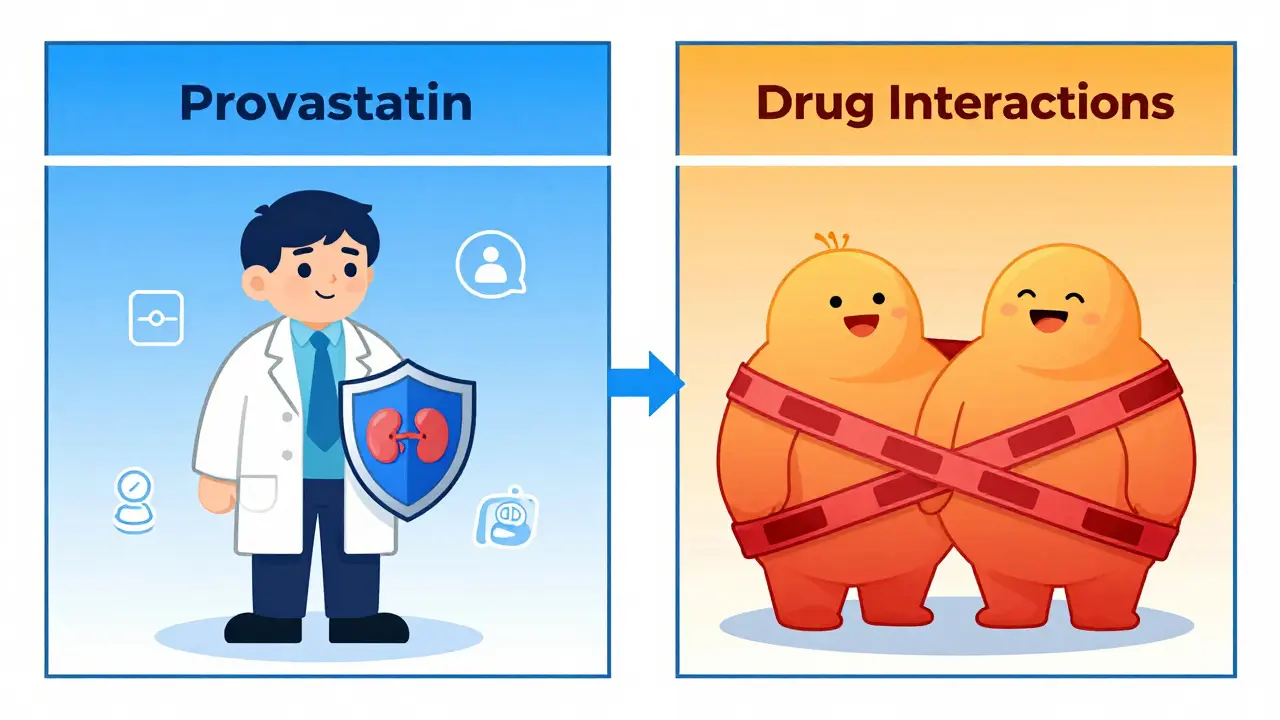
Another major advantage? Drug interactions. The average American over 65 takes nearly five prescription medications. That’s a recipe for dangerous clashes. Pravastatin is cleared mostly by the kidneys (about 70%), not the liver. Most other statins rely on liver enzymes - especially the CYP3A4 system - which are easily disrupted by common drugs like antibiotics, antifungals, or blood pressure pills. Pravastatin has just 15 known drug interactions. Atorvastatin? Over 55. That’s why the American College of Cardiology and the American Heart Association specifically recommend pravastatin for elderly patients on multiple medications.
The Real Side Effects - What to Watch For
Pravastatin is generally well-tolerated, but it’s not side effect-free. The most common complaints from older adults are mild and often temporary:
- Nausea or stomach upset - About 37% of elderly patients on WebMD reported this early on. For most, it faded within two to four weeks.
- Mild muscle aches - Not the same as serious muscle damage. This is more like the soreness you get from gardening or walking more than usual. If it’s localized, constant, or worse at night, talk to your doctor.
- Headaches or dizziness - Rare, but reported in a few percent of users.
More serious risks are rare, but still possible:
- Myopathy - Muscle inflammation or damage. The risk is low, especially with pravastatin, but it increases if you’re also taking fibrates (like gemfibrozil) or have kidney disease.
- Increased blood sugar - All statins slightly raise diabetes risk. For older adults, that risk is about 18% higher than non-users, according to a 2018 JAMA study. Pravastatin has the lowest risk among statins for this side effect.
- Cognitive changes - Some people report memory fog or confusion. Studies show this is extremely rare with pravastatin, and often resolves after stopping the drug.
The FDA updated its labeling in May 2023 to reinforce that these side effects are uncommon, especially when dosed correctly. For people with kidney issues (creatinine clearance under 30 mL/min), the max dose is 40 mg daily. Going higher doesn’t help - it just increases risk.
How It Compares to Other Statins
Pravastatin isn’t the most powerful statin. That’s its trade-off. Here’s how it stacks up:
| Statin | LDL Reduction (40mg dose) | Muscle Side Effect Risk | Drug Interactions | Preferred for Polypharmacy? |
|---|---|---|---|---|
| Pravastatin | 26% | Lowest (5.2%) | 15 | Yes |
| Atorvastatin | 38% | High (8.9%) | 55 | No |
| Simvastatin | 35% | Highest (11.7%) | 48 | No |
| Rosuvastatin | 45% | Moderate (7.1%) | 32 | Conditionally |
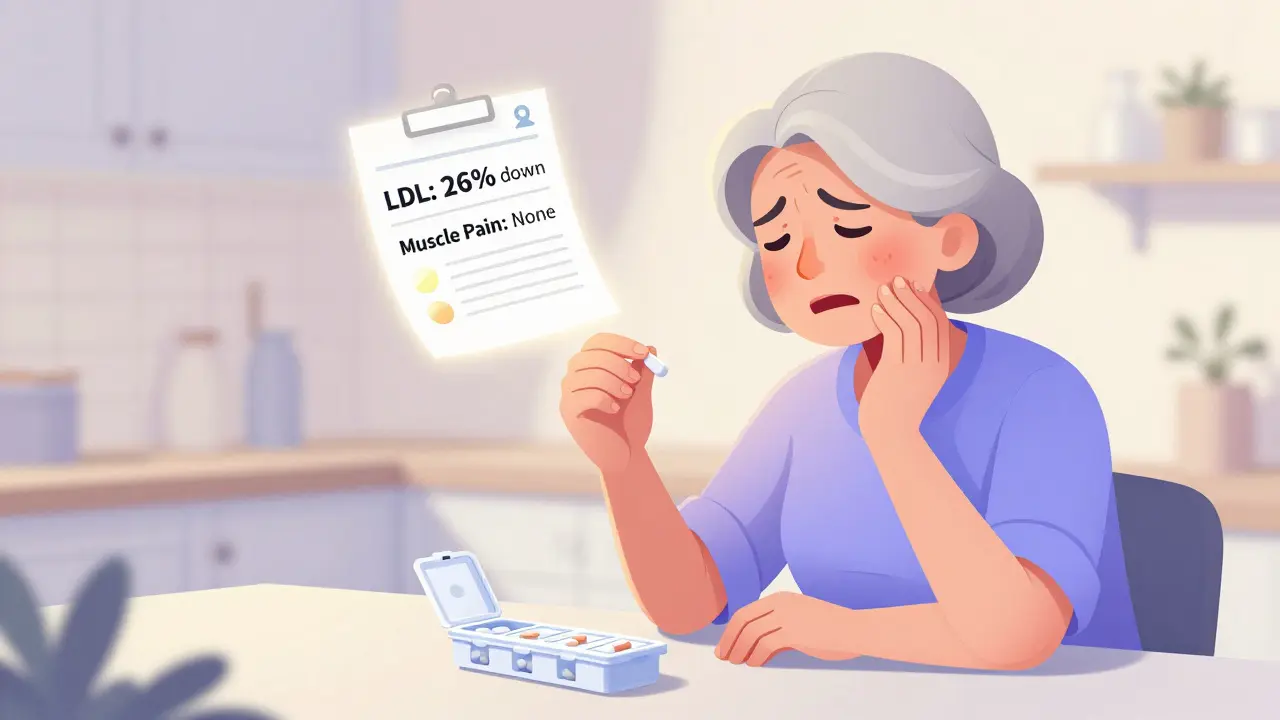
Pravastatin’s 40 mg dose reduces LDL by about 26%. That’s fine for someone with moderate risk. But if your cholesterol is sky-high or you’ve had a heart attack, you might need more. That’s where doctors sometimes add ezetimibe - a non-statin pill that blocks cholesterol absorption. Many older adults who switched from Lipitor to pravastatin say their muscle pain vanished… but then their cholesterol didn’t drop enough. So they added ezetimibe. That combo is now common in geriatric care.
What Patients Are Saying
Real-world feedback paints a clear picture. On Drugs.com, pravastatin has 1,247 reviews from people over 65. The most common positive comment? “My muscle aches disappeared after switching from Lipitor.” One 72-year-old wrote: “I couldn’t climb stairs without pain on simvastatin. Pravastatin? I’m gardening again.”
But there’s a flip side. About 89 negative reviews from elderly users mention the drug didn’t lower their cholesterol enough. One 78-year-old said: “Pravastatin 40mg didn’t help. My doctor had to add another pill.” Reddit threads on r/elderly show similar patterns: 62% of comments praise muscle safety, while 41% say efficacy was too low.
It’s not that pravastatin doesn’t work. It’s that it works differently. It’s not a sledgehammer - it’s a scalpel. It’s safer, but you might need help from another drug to get the job done.
How to Start and Monitor It Safely
If you’re starting pravastatin, here’s what works:
- Start low - Most guidelines recommend 20 mg daily. Even 10 mg is fine for very frail patients.
- Check kidney function - A simple blood test for creatinine and estimated glomerular filtration rate (eGFR) should be done before starting.
- Review all your meds - Your doctor should check for interactions. Fibrates, certain antibiotics, and even grapefruit juice (though less risky than with other statins) should be flagged.
- Follow up in 6-8 weeks - This is critical. Many doctors skip this. But a 2023 study in Annals of Internal Medicine found that patients who had a follow-up within two months were 40% less likely to stop the drug.
- Monitor for muscle pain - If you feel new, unexplained soreness, especially in thighs or shoulders, tell your doctor. Don’t wait. A simple creatine kinase (CK) blood test can rule out serious muscle damage.
The American Geriatrics Society’s Beers Criteria - the gold standard for safe prescribing in older adults - lists pravastatin as a preferred statin. Simvastatin above 20 mg? It’s flagged as potentially inappropriate. That’s how strong the evidence is.
When Pravastatin Might Not Be Right
Pravastatin isn’t perfect for everyone. It’s not the best choice if:
- Your LDL is very high (above 190 mg/dL) and you need a 50%+ reduction.
- You’ve had a recent heart attack or stroke and need aggressive lowering.
- You’re already on multiple medications and your doctor wants to minimize pills - pravastatin’s lower potency might mean adding another drug, which could be counterproductive.
For those cases, doctors may choose rosuvastatin or a combo pill with ezetimibe. But if your goal is to stay on the medication long-term without side effects, pravastatin still leads.
The Future: What’s Next?
Researchers are now looking at ways to make pravastatin even better for older adults. The NIH-funded SPRINT-AGE trial (NCT04873456) is testing dosing in people over 80 with multiple health issues. Results are expected in 2024.
Also in the pipeline: fixed-dose combos of pravastatin with ezetimibe - one pill, two actions. Esperion is testing a new combo that could replace two separate pills. That’s huge for older adults who struggle with pill boxes.
With the global population over 65 set to hit 1.6 billion by 2050, drugs like pravastatin aren’t just helpful - they’re essential. The challenge isn’t finding a stronger statin. It’s finding one that older adults can actually live with.
Is pravastatin safe for people over 80?
Yes, pravastatin is considered one of the safest statins for people over 80. Its kidney-based clearance reduces the risk of drug interactions and muscle damage, which are major concerns in very elderly patients. Studies show it has the lowest rate of side effects among statins in this age group. However, kidney function should be checked before starting, and the maximum recommended dose is 40 mg daily for those with reduced kidney function.
Does pravastatin cause muscle pain like other statins?
Pravastatin causes muscle pain far less often than other statins. Clinical studies show only 5.2% of older adults on pravastatin report muscle symptoms, compared to 8.9% with atorvastatin and 11.7% with simvastatin. This is because pravastatin doesn’t penetrate muscle tissue as deeply. If you’ve had muscle pain on another statin, switching to pravastatin often resolves it.
Can pravastatin raise blood sugar?
Yes, like all statins, pravastatin can slightly raise blood sugar levels, increasing diabetes risk by about 18% in older adults. But among statins, pravastatin has the lowest risk for this side effect. If you’re prediabetic or have risk factors for diabetes, your doctor should monitor your fasting glucose annually.
How much does pravastatin cost for seniors?
Generic pravastatin costs between $4 and $12 per month in the U.S. as of 2023. It’s one of the most affordable statins available. Many Medicare Part D plans cover it with low copays. This affordability makes it a practical choice for long-term use, especially since it’s often taken for life.
Should I take pravastatin at night?
It’s best to take pravastatin in the evening. Cholesterol production peaks at night, and pravastatin works best when taken then. It reaches peak levels in 1-2 hours and has a half-life of about 1.5-2 hours. Taking it at bedtime aligns with its mechanism. But if you forget, taking it at any time is better than skipping it.
Can I take pravastatin with other medications?
Pravastatin has far fewer drug interactions than other statins. It’s safe with most blood pressure, diabetes, and heart medications. The main caution is with fibrates (like gemfibrozil) and high-dose niacin - these can increase muscle risk. Always review your full medication list with your doctor or pharmacist. If you’re on five or more drugs, pravastatin is often the safest statin choice.
Final Thoughts
Pravastatin doesn’t try to be the strongest. It tries to be the smartest. For older adults, that’s exactly what you need. It’s not about lowering cholesterol the most - it’s about lowering it safely, consistently, and without wrecking your muscles or your schedule. If you’ve been on another statin and had side effects, switching to pravastatin might be the best decision you’ve made for your health in years. And if you’re just starting out? It’s still a top choice. The data doesn’t lie: fewer side effects, fewer interactions, and more people staying on it long-term. That’s not just good medicine. It’s good living.
about author

Jesse Lord
Been on pravastatin for 3 years now since I switched from Lipitor. My legs stopped aching within a week. I can finally walk to the mailbox without groaning. No more midnight cramps. My doc said I'm lucky to have such a clean bill of health at 71. Just take it at night like they say. Easy.
Patrick Jarillon
Oh please. They’re all lying to you. Statins are a pharmaceutical scam designed to keep old folks docile. Pravastatin? It’s just the new placebo with a fancy label. My cousin died after taking it for 6 months. They called it 'natural decline.' I call it poison disguised as prevention. The FDA? They’re owned by Big Pharma. Read the real studies - the ones they bury. They don’t want you to know cholesterol isn’t the enemy. It’s your body’s repair crew.
And don’t get me started on the 'kidney clearance' nonsense. That’s just a marketing gimmick to make you think it’s 'safer.' It’s still a synthetic molecule your liver doesn’t recognize. Your body treats it like a toxin. They’re just better at hiding the damage until it’s too late.
My neighbor took it for 8 years. Now he’s on dialysis. Coincidence? I think not. Wake up. You’re being sold a myth wrapped in a clinical trial.
Amit Jain
LOL at the 'lowest risk' nonsense. I’m 68, took pravastatin for 8 months, and my CK levels were through the roof. My doctor said 'it’s normal for elderly' - yeah right. I switched to red yeast rice and now I feel like a 25-year-old. Why are we trusting Big Pharma’s math? They’re not even consistent between studies. One paper says 5.2%, next says 9%. Which one’s real? I say none of them. And why’s there no long-term data past 5 years? Hmm.
Also - 'affordable'? At $12/month? That’s what they tell you on the website. My pharmacy charged me $87. Medicare doesn’t cover it unless you’re on a specific plan. They lie to make you feel better. Classic.
Natasha Bhala
My mom started pravastatin last year after a scary scare with simvastatin. She couldn’t even hold her coffee cup without shaking. Now she’s gardening again, dancing at family dinners, and actually sleeping through the night. It’s not magic - but it’s gentle. And that matters more than numbers. I’m so glad we switched.
Catherine Wybourne
Interesting how the article calls pravastatin a 'scalpel' - I think it’s more like a quiet neighbor. Doesn’t make a fuss, doesn’t knock on your door at 3am, just quietly does its thing. I love that metaphor. Also - yes, the cost point is huge. In the UK, it’s £2.50 a month. No one should be choosing between meds and groceries. This is one of those rare wins in modern medicine.
Ashley Hutchins
I just read this and I’m horrified. How many elderly people are being pushed into this without knowing the real risks? I had a friend who got diabetes after taking pravastatin for 2 years. She didn’t even know it could do that. Doctors don’t warn you. They just say 'it’s safe' and move on. What kind of care is this? We’re treating people like numbers not humans. And now we’re telling them to take it at night? Like it’s a bedtime story? Wake up. This isn’t safety. It’s negligence.
Mayank Dobhal
Pravastatin? My uncle took it. Died of rhabdo. End of story.
Eric Knobelspiesse
Look I get why people love pravastatin - it’s the quiet achiever. But here’s the thing nobody talks about: efficacy isn’t just about LDL. It’s about plaque regression. And pravastatin? It’s weak on that. I’ve seen scans. People on atorvastatin have actual shrinkage. Pravastatin? Just slows growth. For someone with a 70% stenosis, that’s not enough. You need firepower. Safety doesn’t matter if you’re still having a heart attack. Just saying.
Mary Carroll Allen
I’m a nurse and I’ve seen this play out so many times. Elderly patient on 7 meds. Doctor says 'try pravastatin.' They switch. No muscle pain. No confusion. No hospital trips. They live better. I’ve had patients cry because they could finally hold their grandkids without wincing. It’s not perfect. But for so many? It’s the gift of dignity. Don’t let the noise drown out the quiet wins.
Gouris Patnaik
India has been using pravastatin for decades - and we’ve never seen the side effect panic you Americans have. Why? Because we don’t over-medicalize aging. You treat every ache as a crisis. We treat it as part of life. Pravastatin works because it respects the body, not because it’s 'safe.' It doesn’t fight nature - it works with it. Your fear of statins? It’s not science. It’s cultural anxiety. We’ve known this for generations. You’re just catching up.