
Medication Safety for Non-English Speakers: How to Get Clear Prescription Instructions
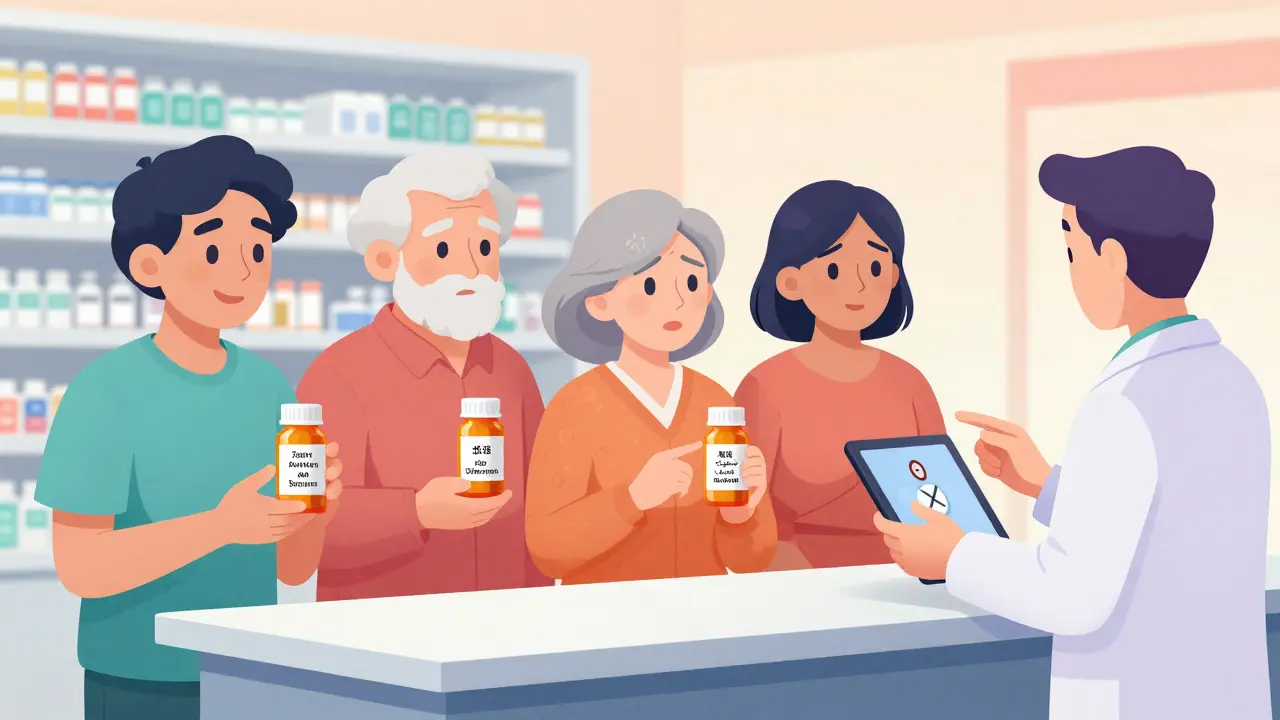
Every year, thousands of people in the U.S. take the wrong dose of their medicine-not because they’re careless, but because they can’t read the label. For non-English speakers, prescription instructions often feel like a puzzle written in a language they don’t know. The result? Mistakes that lead to hospital visits, dangerous side effects, or even death. This isn’t rare. In fact, medication safety for non-English speakers is one of the most overlooked problems in American pharmacies today.
Why Language Barriers Put Lives at Risk
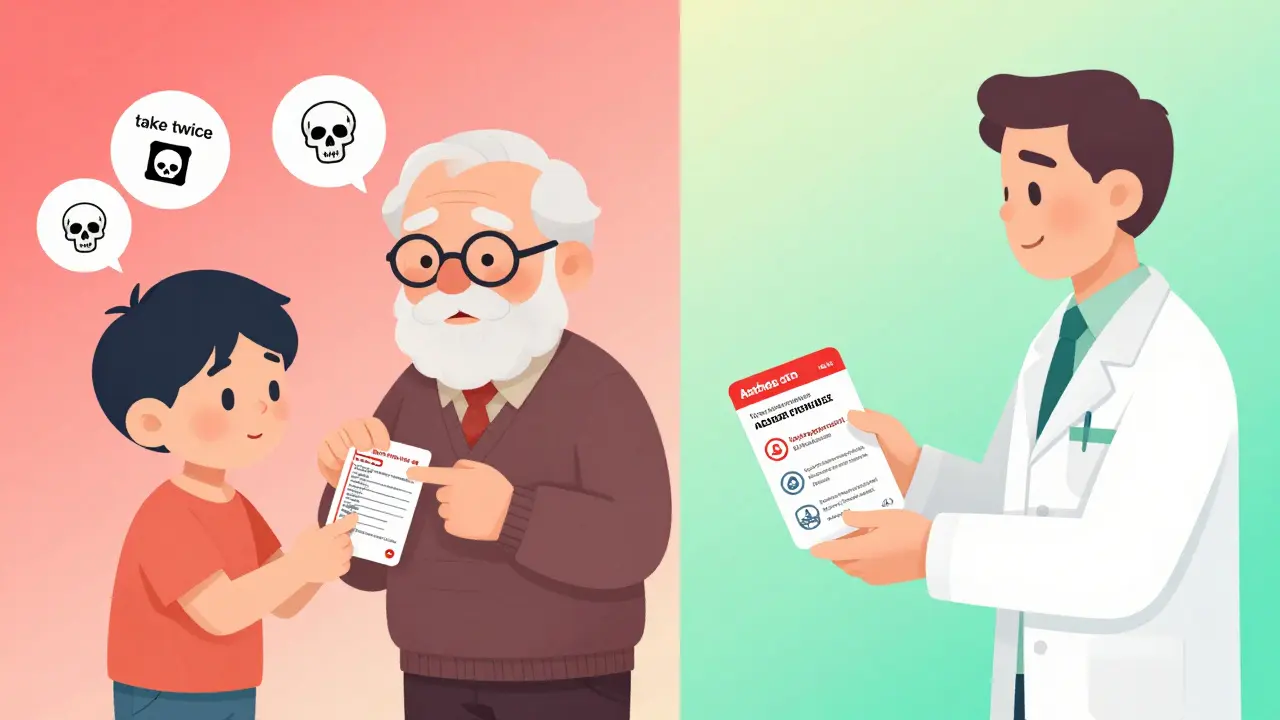
In the U.S., over 25 million people have limited English proficiency. That’s 1 in 12 people. Many of them rely on prescriptions for high-risk medications: blood thinners, insulin, heart drugs, or seizure meds. These aren’t medicines you can guess your way through. A single mistake-taking twice the dose, mixing drugs, or skipping doses-can be deadly. A 2006 Institute of Medicine report found that non-English speakers are 1.5 to 3 times more likely to have a dangerous medication error than English speakers. Why? Because most pharmacy labels are written in complex medical jargon-even for native speakers. For someone learning English, it’s nearly impossible. Labels say things like “take once daily” or “take with food.” But “daily” doesn’t always mean “every day.” In some languages, the word for “daily” can be confused with “every day.” One Korean patient took her blood thinner twice a day because she thought “daily” meant twice. She ended up in the ER with internal bleeding.What’s on the Label-and What’s Missing
Traditional prescription labels have three parts: the main instructions (called SIG codes), warning stickers, and small print about side effects. Most of these are translated using automated tools or bilingual staff who aren’t trained in medical terminology. The results are messy. A 2020 FDA safety communication showed that unvalidated automated translations have a 38% error rate. That means nearly 4 in 10 translated labels give wrong or confusing instructions. Even worse, a 2022 study found that when family members translate, medication errors go up by 65%. A child translating for a grandparent? A neighbor who speaks a little English? These aren’t safe options. The labels themselves are often poorly designed. They use tiny fonts, unclear symbols, and no pictures. The FDA recommends using simple pictograms-like a sun for “take in the morning” or a skull for “dangerous if mixed with alcohol.” But only a small number of pharmacies use them. Most still rely on text alone.What Works: The Proven Solutions
There’s good news. When pharmacies use the right tools, the results are dramatic. A 2018 University of California study showed that properly translated labels cut medication errors by up to 62%. How? Three things make the difference:- Professionally translated labels-not Google Translate. Companies like RxTran and TransPerfect Healthcare use certified medical translators who understand drug names, dosing terms, and side effects in languages like Spanish, Vietnamese, Chinese, Arabic, and Russian. They simplify phrases like “take as directed” into clear instructions like “take one pill at 8 a.m. every day.”
- Bilingual labels with pictograms-labels that show both English and the patient’s language, with simple images. A 2021 UK study found that 89% of patients understood their instructions when labels were in their native language with pictures. Only 22% understood English-only labels.
- Live interpreter services-phone or video interpreters who speak the patient’s language and are trained in medical terms. A 2019 University of Michigan study showed that when patients got both translated labels and a live interpreter, medication errors dropped by 58% and adherence improved by 37%.
One program, ConcordantRx, created standardized instructions in Chinese, Korean, and Russian. They tested them with real patients. The result? 100% comprehension. Compare that to the 45% comprehension rate with standard pharmacy translations. That’s not a small improvement-it’s life or death.
The Reality: Most Pharmacies Still Don’t Do Enough
Despite federal law-Title VI of the Civil Rights Act-requiring pharmacies to provide language access, only 57% of community pharmacies offer translated prescription labels, according to a 2021 American Pharmacists Association survey. Many don’t even ask patients what language they prefer. Independent pharmacies are especially behind. Only 32% of them offer translation services. Hospital pharmacies are better, at 78%. That means if you live in a small town or use a local pharmacy, your chances of getting clear instructions are much lower. Even when translation services exist, they’re often outdated. A 2022 California audit found that 68% of pharmacies used old translations that didn’t match current prescriptions. One patient got a label for a drug that was discontinued two years earlier. Another got instructions for a different brand with the same generic name.What You Can Do: A Simple Action Plan
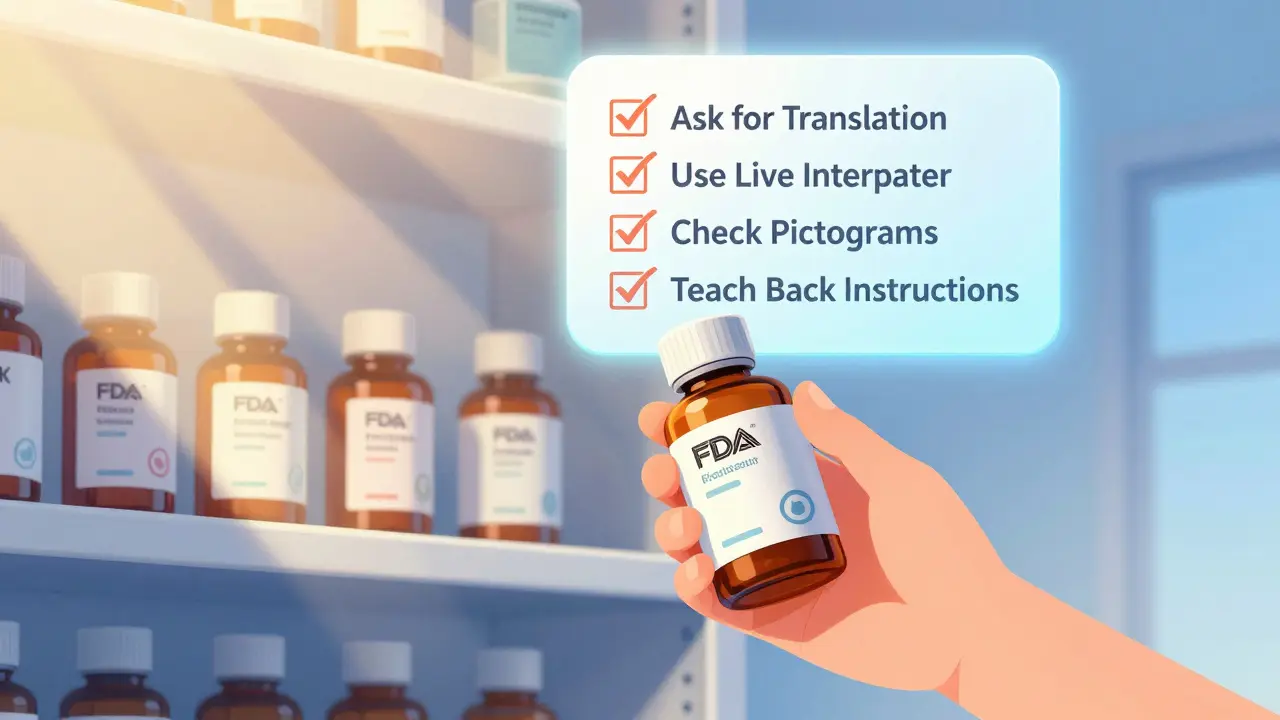
If you or someone you care for doesn’t speak English well, here’s what to do right now:- Ask for your preferred language-at the pharmacy counter, when you drop off the prescription. Say: “Can you give me the label in [language]?” Don’t assume they’ll offer it.
- Request a live interpreter-ask if they have phone or video interpreters available. Don’t rely on staff who speak a little of your language unless they’re certified.
- Check the label-look for pictures, simple words, and both English and your language. If it’s only in English, ask for a translated version.
- Use the “Teach Back” method-after the pharmacist explains, say: “Can you show me how to take this?” Then repeat the instructions back in your own words. If you can’t, ask again.
- Report problems-if you get a confusing label or no translation, file a complaint with the pharmacy’s manager and your state’s board of pharmacy.
What’s Changing-And What’s Coming
Change is happening, but slowly. California now requires pharmacies to translate labels for the top five non-English languages spoken in their area. New York City requires translations for the top ten. Starting in 2024, California pharmacies must be certified in language access to operate. The federal government is also stepping up. In 2023, the FDA released draft guidance setting standards for how translations should be tested and validated. In 2024, electronic health records will be required to automatically flag a patient’s language preference and trigger translation services. But the biggest shift is in awareness. More pharmacists now understand that language access isn’t a luxury-it’s a safety issue. The Institute for Safe Medication Practices calls it a “critical patient safety practice.” The Joint Commission has found that inadequate language access contributed to 15% of serious medication errors between 2018 and 2022.Final Thought: Clear Instructions Save Lives
Medication safety isn’t just about pills and doses. It’s about communication. A label shouldn’t be a mystery. A patient shouldn’t have to guess what “q.d.” or “b.i.d.” means. No one should risk their health because they can’t read the instructions. The tools exist. The research is clear. The laws are on the books. What’s missing is consistent action. If you’re a patient, speak up. If you’re a caregiver, insist on clarity. If you’re a pharmacist, make translation a priority. Because when instructions are clear, people take their medicine right-and stay healthy.Do pharmacies have to provide translated prescription labels?
Yes, under Title VI of the Civil Rights Act of 1964, pharmacies receiving federal funding must provide meaningful access to services for people with limited English proficiency. This includes translating vital documents like prescription labels. While enforcement varies, federal law requires it, and states like California and New York have added stricter rules.
Can I use my child or a friend to translate my prescription instructions?
It’s not recommended. Studies show using family members or untrained interpreters increases medication errors by 65%. They may not understand medical terms like “hypertension” or “anticoagulant,” or they may unintentionally simplify or skip important warnings. Professional interpreters are trained in medical language and ethics-and they’re confidential. Always ask your pharmacy for a certified interpreter instead.
What if my language isn’t supported by the pharmacy?
Even if your language isn’t listed, pharmacies should still provide access through phone or video interpreters. Services like LanguageLine and RxTran offer translation in over 25 languages, including less common ones like Hmong, Somali, and Arabic. If your pharmacy says they can’t help, ask them to call a professional interpreter service. You have the right to understand your medication instructions.
Are pictograms and symbols on labels helpful?
Yes. Standardized pictograms-like a clock for timing, a glass of water for “take with water,” or a crossed-out alcohol bottle for “avoid alcohol”-help people understand instructions even if they can’t read the text. The FDA and ISO have approved these symbols for use on medication packaging. Look for them. If they’re missing, ask your pharmacist why.
How can I tell if a translated label is accurate?
Ask the pharmacy if the translation was done by a certified medical translator, not an automated tool. Look for labels that include both your language and English, use simple words, and have clear pictograms. If the label looks rushed, has typos, or uses strange phrasing, it may not be reliable. You can also call the pharmacy’s customer service and ask for verification of the translation’s source.
about author

Becky Baker
This is why we need to stop letting people who don't speak English ruin our healthcare system. They should learn the language before they start taking life-saving pills. It's not our job to translate everything for them. We've got enough problems without playing translator for 25 million people.
Sumler Luu
I work at a clinic and I see this every day. One time, a grandmother came in because she took her insulin at night instead of morning-because the label said 'take daily' and she thought that meant 'once per day' but didn't know 'daily' meant morning. She was terrified. We got her a bilingual label with pictures. She cried. That's not a policy issue-it's a human one.
Sandeep Jain
bro i just saw a guy in my local pharmacy tryna read his blood pressure med label and he was like 'is this 2 times a day or 2 times a week?' and the pharmacist just shrugged. we need better than this. i dont care what language u speak, if u cant read it, u shudnt be left alone with it. pictograms r life savers.
roger dalomba
Oh wow. A 62% reduction in errors? Shocking. Next you'll tell me water is wet and gravity exists. Maybe if people didn't immigrate here without learning English, this wouldn't be a 'crisis.' But hey, let's spend millions on pictograms while our schools teach critical race theory. Priorities, people.
Amy Lesleighter (Wales)
it's not about language it's about dignity. if you give someone a pill and they don't know if they're supposed to take it before or after food, you're not helping you're just hoping they guess right. a picture of a sun and a moon? that's not dumbing down. that's basic human respect. i've seen people die because they trusted a label that looked like it was translated by a toddler with a google translate app
Rajni Jain
my aunt took her meds wrong for 3 months because the label was in spanish but the words were all mixed up. she thought 'una pastilla cada 12 horas' meant 'take one pill every 12 hours' but the pharmacist meant 'take one pill every day'... she almost had a stroke. please don't let your grandma be the next statistic. ask for help. they can do it. they just need to be asked.
Erwin Asilom
Language access is not a privilege. It is a clinical necessity. The data is unequivocal. Pharmacies that implement certified translation and pictogram-based labeling demonstrate statistically significant improvements in adherence and reductions in adverse events. This is not opinion. It is evidence-based practice.
Nikki Brown
Of course people are dying. They brought this on themselves. If you can't speak English, you shouldn't be here. This isn't a 'safety issue'-it's a failure of personal responsibility. And don't even get me started on using kids as interpreters. That's just sad. 😔
Peter sullen
It is imperative, from a systemic, operational, and ethical standpoint, that pharmaceutical institutions implement robust, multi-lingual, ISO-certified, FDA-compliant, and linguistically validated labeling protocols-particularly in light of the documented 38% error rate in unvalidated automated translations, which constitutes a non-trivial threat to public health infrastructure.
Steven Destiny
Enough waiting. We need mandatory translation laws in every state NOW. No more excuses. No more delays. If your pharmacy can't give me a label I understand, they shouldn't be open. Period. I'm done being patient. Someone's life is on the line every time they hand out a label in English only. Let's fix this.