
Best Online Drug Databases and Resources for Patients
Drug Interaction Checker
Check Medication Interactions
Enter 2-3 medications to see potential interactions based on DrugBank data. This tool uses simplified interaction risk levels to help you understand potential interactions. Always consult your healthcare provider before making any changes to your medication regimen.
Interaction Results
Detailed Interaction Information
This section provides specific information about potential interactions and how to manage them.
When you're taking medication, knowing exactly what you're on-and why-can make all the difference. But with so many websites out there offering drug info, how do you know which ones actually have accurate, trustworthy details? The truth is, most commercial sites are filled with ads, oversimplified summaries, or even outdated data. The real gold standard for patient drug information isn't a flashy app or a sponsored blog. It's a set of free, government-backed resources built by scientists, reviewed by pharmacists, and updated daily with official FDA labels. These aren't just helpful-they're lifesaving.
Why Most Drug Websites Fail Patients
Think about it: you Google your pill name, click the first result, and see a clean page with a picture of a smiling person holding a bottle. Sounds reassuring, right? But here's what you're not seeing: that site might be funded by drug companies, paid to highlight certain side effects, or missing critical warnings. A 2021 study in JAMA Internal Medicine found that WebMD scored only 62 out of 100 for accuracy. That’s not a typo. Nearly 40% of its drug pages had incomplete or misleading information.
Meanwhile, patients report confusion over dosage, interactions, and side effects. A 2022 study in the Annals of Internal Medicine showed that 68% of people didn’t fully understand their medication instructions. That’s not because they’re not smart-it’s because the information is buried in jargon, scattered across unreliable sources, or worse, hidden behind paywalls.
The good news? There are three free, no-ad, no-bias platforms that actually deliver what you need: precise, verified, and updated daily. They’re not perfect, but they’re the only ones you can trust.
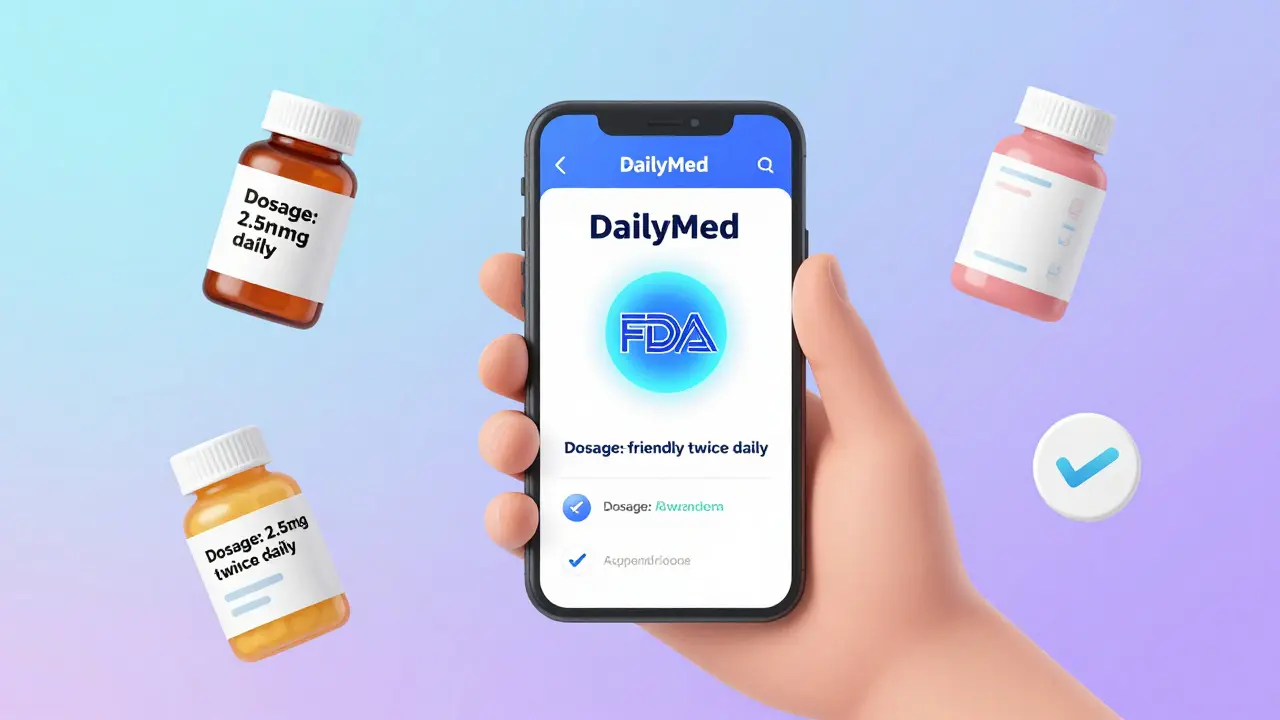
DailyMed: The Official FDA Drug Label Archive
If you want to see the exact wording the FDA used to approve your medication, DailyMed is your go-to. Launched in 2005, it’s the official repository for all FDA-approved drug labels. Every pill, injection, and inhaler you take has a document here-written by the manufacturer, reviewed by the FDA, and published without edits.
As of October 2023, DailyMed held over 142,000 drug entries. That’s everything from common antibiotics to rare cancer drugs. The site doesn’t simplify anything-it gives you the full label, including the tiny print you’d find on a prescription bottle. But here’s the catch: most of it is written at a 12th-grade reading level. That means if you’re not used to medical language, it can feel overwhelming.
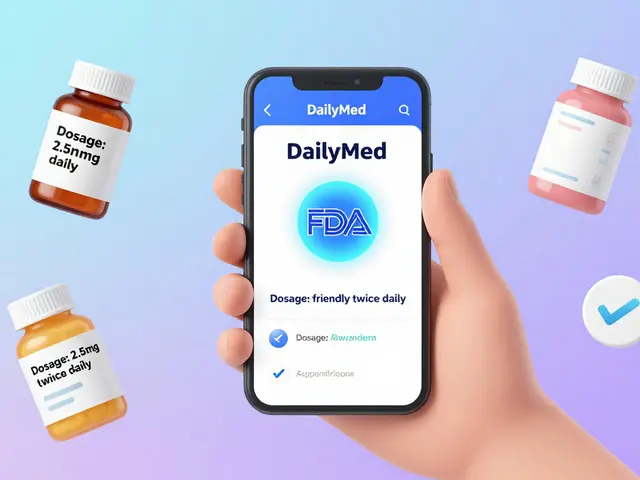
That’s why DailyMed added “Patient-Friendly Highlights” in June 2023. Now, for every new drug label, there’s a simplified section at the top that breaks down dosing, warnings, and side effects in plain language. The reading level dropped from 12.4 to 9.1 grade level. Still not perfect-but a big step forward.
One patient in Manchester shared how DailyMed saved them: “My bottle said 5mg, but the label on DailyMed said 2.5mg twice daily. I called my pharmacist. Turns out, I’d been doubling my dose. That could’ve been bad.”
Use DailyMed when you need to verify: exact dosage, boxed warnings, contraindications, or what to do if you miss a dose. It’s the closest thing to reading the original FDA paperwork.
LactMed: The Only Trusted Resource for Breastfeeding and Medications
If you’re pregnant or breastfeeding, finding reliable info on what medications are safe is terrifying. Most websites either say “consult your doctor” or give vague advice. LactMed changes that.
Run by the National Library of Medicine, LactMed is a database of over 4,200 substances-including prescription drugs, herbs, and even recreational substances-specifically evaluated for safety during breastfeeding. Each entry includes: how much of the drug passes into breast milk, its effect on the baby, and whether it’s safe to continue breastfeeding while taking it.
It’s not just data. Each monograph is written by experts from the Academy of Breastfeeding Medicine and reviewed by pharmacologists. The summaries are written at an 8th-grade reading level. In February 2024, they added full Spanish translations for every entry.
One mom in Manchester used LactMed after being prescribed sertraline for postpartum anxiety. “I was told to stop breastfeeding. LactMed showed the levels in milk were low and no adverse effects were reported. I kept nursing. My baby is fine.”
LactMed has no competitors that come close. BabyCenter, WebMD, and even Mayo Clinic’s breastfeeding guides lack the depth and evidence-based rigor here. If you’re nursing and on medication, bookmark this. It’s the only place you can find real data-not opinions.
DrugBank: For Patients Who Want Deep, Scientific Details
Not everyone wants a simplified summary. Some patients-especially those with rare conditions, complex medication regimens, or a science background-need to know how a drug works at the molecular level. That’s where DrugBank comes in.
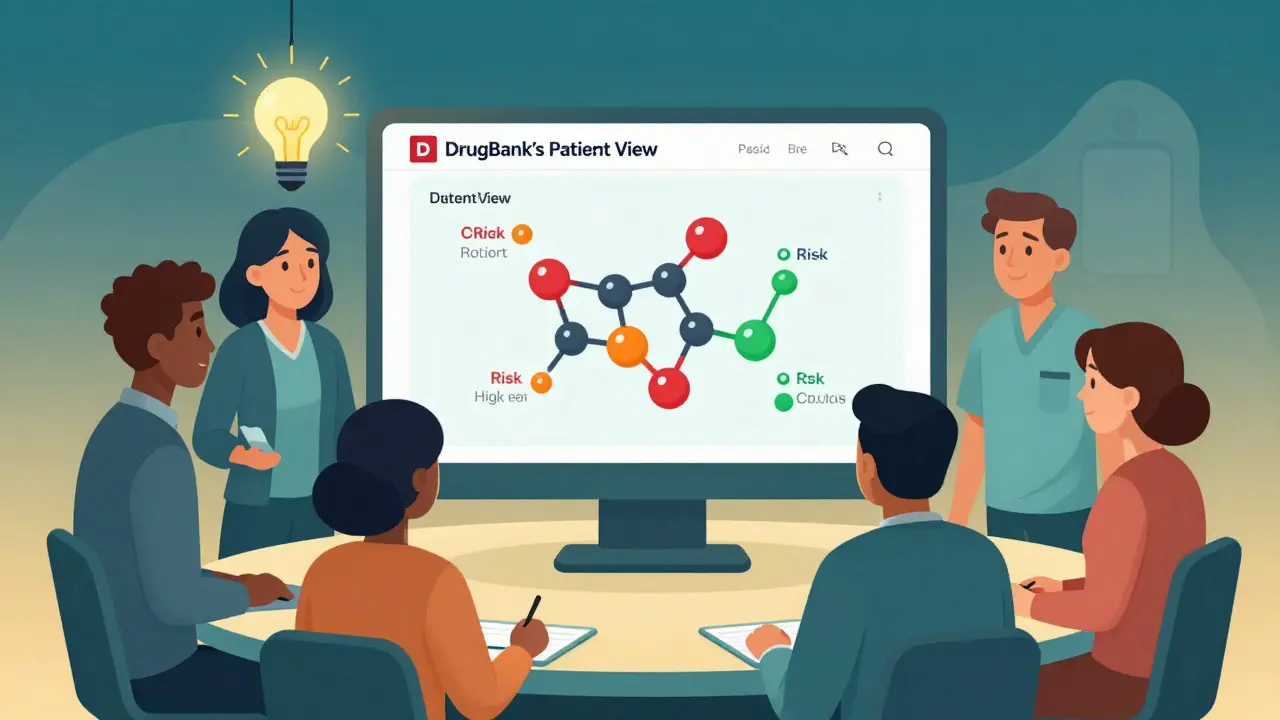
Created in 2006 by researchers at the University of Alberta, DrugBank started as a tool for scientists. But since January 2024, it’s had a new “Patient View” interface for free users. It’s still detailed-but now it uses color-coded risk levels for interactions, simplified drug mechanisms, and plain-language summaries alongside the technical data.
It covers 13,534 drugs, including 2,720 FDA-approved medications. You can search by brand name, generic name, or even chemical structure. It shows you how a drug binds to receptors, what enzymes metabolize it, and what genetic variations might affect how your body processes it.
One user with lupus told a Reddit thread: “I was on five drugs. My rheumatologist didn’t know about the interaction between my antimalarial and my blood thinner. DrugBank flagged it. We switched one. I haven’t had a clot since.”
But be warned: even with the new interface, DrugBank still feels like a research paper. It’s not meant for quick checks. Use it when you’re trying to understand why a drug isn’t working, or if you’ve had an unusual reaction. It’s not for everyone-but for some, it’s indispensable.
What These Sites Don’t Do (And What You Need to Pair Them With)
None of these tools tell you how much your drug costs. None of them help you find coupons. None of them answer “Is this covered by my insurance?” That’s where GoodRx comes in. It’s not a source of safety info-but it’s the best at showing real-time prices at local pharmacies. Use DailyMed to know what you’re taking, then use GoodRx to know how much it’ll cost.
They also don’t explain symptoms. If you feel dizzy after taking your pill, they won’t tell you whether it’s normal. For that, MedlinePlus-NLM’s patient-friendly portal-is your best friend. It links directly to DailyMed and LactMed, but wraps them in plain-language explanations, videos, and FAQs.
And here’s the most important thing: none of these replace your doctor or pharmacist. DailyMed’s “boxed warnings” are often misinterpreted as absolute no-go zones. A 2023 AHRQ study found 22% of patients stopped taking critical meds because they thought a warning meant “never use.” That’s dangerous. Always talk to your provider before making changes.
How to Use These Resources in Practice
Here’s a simple plan:
- When you get a new prescription, go to DailyMed and look up the drug by name. Read the “Patient-Friendly Highlights” first.
- If you’re breastfeeding or planning to, check LactMed for safety info-even if your doctor says it’s fine, verify it yourself.
- If you’re on multiple drugs and worried about interactions, use DrugBank’s Patient View to see how they interact. Look for red or orange risk levels.
- Use MedlinePlus (medlineplus.gov) to get plain-language summaries and printable guides.
- Use GoodRx to compare prices at pharmacies near you.
Bookmark these. Save them on your phone. Print out the highlights for your next appointment. You’re not just being cautious-you’re taking control.
What’s Coming Next
By late 2025, DailyMed will start integrating directly with Apple Health Records. That means your medication list in your phone could auto-update with the latest FDA labels. NLM is also piloting AI tools that turn dense labels into plain English summaries-think ChatGPT, but built by the NIH, not a tech company.
But the biggest change? More patients are using these tools. DailyMed now gets over 1.2 million visits a month. LactMed is used by 300,000 breastfeeding parents monthly. DrugBank’s patient traffic doubled in 2024. People are realizing: when it comes to your health, the best info doesn’t come from ads or influencers. It comes from science, transparency, and decades of public investment.
You don’t need to be a scientist to use them. You just need to know they exist.
Are DailyMed and LactMed free to use?
Yes. Both DailyMed and LactMed are funded by the U.S. National Library of Medicine and are completely free, with no registration, ads, or hidden fees. They are government-run and updated daily with official FDA data.
Can I trust DrugBank if I’m not a doctor?
Yes-but with caution. DrugBank’s free Patient View interface (launched in January 2024) simplifies complex data with color-coded interaction risks and plain-language summaries. It’s designed for motivated patients who want deeper insight, especially those on multiple medications or with rare conditions. Still, it’s not meant for quick checks. Always cross-check with your pharmacist or provider before acting on findings.
Why don’t these sites tell me how much my drug costs?
Because they’re focused on safety and accuracy, not pricing. Drug pricing changes daily, varies by pharmacy, and depends on insurance. That’s why GoodRx and other price-comparison tools exist. Use DailyMed or LactMed to know what you’re taking-and GoodRx to know how much it’ll cost.
Is DailyMed only for people in the U.S.?
The data is based on U.S. FDA-approved drugs, so it’s most accurate for medications prescribed in the United States. But the information is still useful internationally-many drugs have the same active ingredients worldwide. If you’re outside the U.S., check your country’s official drug database (like the UK’s BNF or Canada’s DIN) for local guidelines.
What if I find a warning on DailyMed that scares me?
Don’t stop your medication based on a single warning. Many warnings are rare side effects or apply only to specific groups (like pregnant women or those with kidney disease). Always talk to your doctor or pharmacist. They can help you understand if the risk applies to you-and whether the benefit outweighs it. Stopping a drug without guidance can be more dangerous than the side effect itself.
about author

Kenzie Goode
I never knew DailyMed had those Patient-Friendly Highlights until last month. My mom’s on warfarin and I was terrified she was reading the full label wrong. The simplified version? Lifesaver. Now she prints it out and sticks it on the fridge next to her pill organizer. No more panic calls at 2 a.m.
Also, LactMed saved my breastfeeding journey. Was told to wean because of my antidepressant. LactMed showed the levels were negligible. I kept going. My kid’s two now and still nursing. Science > guesswork.
Bhaskar Anand
This article is a joke. Americans think government sites are holy. In India we use what works. Google translates the pill name. We ask the pharmacist. We watch YouTube videos. Why waste time on FDA labels? Your system is bloated. We don’t need 142,000 entries. We need one clear answer. Stop overcomplicating. Simple is better.
William James
Man I love how this post just quietly drops truth bombs. Like… DailyMed doesn’t try to be cute. It doesn’t have influencers holding bottles. It just says: here’s the raw, unfiltered, FDA-approved truth. And yeah it’s dense. But that’s the point. We’ve been trained to want easy answers. But medicine isn’t TikTok. It’s not supposed to be snackable. If you’re taking something that could change your life-or end it-you owe it to yourself to read the fine print. Even if it’s boring. Even if it’s scary. Knowledge isn’t comfortable. But it’s the only thing that keeps you alive.
Also-DrugBank’s patient view? Mind blown. I didn’t know my blood pressure med interacted with my turmeric supplement. Now I don’t take it. Small change. Big difference.
Joanna Reyes
Let me tell you what happened last week. I was on a new combo of meds for my autoimmune thing, and my pharmacist didn’t catch the interaction between my methotrexate and my new vitamin D supplement. I didn’t know to ask. I didn’t even know to look. So I went to DrugBank. Found the red flag. Printed it. Took it to my rheumatologist. He said, ‘Holy crap, you’re right.’ We switched it out. I didn’t have to go to the ER. That’s not luck. That’s using the tools you’re given. And honestly? It’s infuriating that most people don’t even know these exist. We have free, world-class medical intelligence at our fingertips, and we’re still Googling ‘is this pill safe’ and clicking the first sponsored ad. We’re being sold a lie. And it’s costing lives.
Also-LactMed’s Spanish translations? Finally. My sister-in-law is undocumented and breastfeeding. She was terrified. I showed her LactMed. She cried. Not from sadness-from relief. That’s power. That’s dignity.
Dinesh Dawn
Just wanted to say thanks for this. I’m from a small town in rural Ohio. We don’t have big hospitals. My mom’s on seven pills. I showed her DailyMed. She said, ‘So this is what they’re really telling us?’ I think she finally felt like she wasn’t being talked down to. We printed the highlights. Put them in her purse. Now she asks better questions at appointments. That’s huge.
Nick Hamby
One thing people miss: these tools aren’t just for patients-they’re for caregivers, nurses, even pharmacists who are overwhelmed. I work in a clinic. We used to rely on drug reps and outdated pamphlets. Now we have a laminated cheat sheet: DailyMed for dosing, LactMed for moms, DrugBank for complex cases. We don’t need more apps. We need better access to what already exists. And we need to teach people how to use it. This post? It’s a public health win.
kirti juneja
Y’all are so serious lol. I’m in India and I just screenshot the DailyMed page and send it to my cousin in the US. She’s like ‘OMG you found the REAL label??’ I’m just vibing with science. Also, LactMed is my new BFF. I’m pregnant and took a Z-pack last month. LactMed said ‘no biggie’ so I didn’t panic. You don’t need a PhD to use these. Just a phone and a brain that doesn’t trust Instagram. 🙌
Haley Gumm
Let’s be real. These sites are useless if you’re poor. DailyMed doesn’t tell you if your insurance covers the drug. LactMed doesn’t help if you can’t afford the prescription. DrugBank doesn’t pay your rent. You think knowing the exact molecular pathway of your antidepressant is going to stop your lights from getting shut off? This is elite information for people who already have privilege. Meanwhile, millions are choosing between food and meds. And you’re here talking about ‘patient-friendly highlights.’ Cute.
Gabrielle Conroy
OMG I JUST USED DRUGBANK FOR THE FIRST TIME AND IT’S LIKE A SUPERHERO TOOLKIT!!! 🤯 I was on 4 meds and thought I was fine-until I saw the orange interaction between my thyroid med and my calcium supplement. I called my pharmacy and they said ‘oh yeah, we usually warn people’… but I had to ASK. Why isn’t this automatic?? I printed the summary and taped it to my pillbox. My doctor was impressed. I’m a patient, not a scientist-but I deserve to understand what’s in my body. Also, LactMed is a miracle. I’m nursing a 4-month-old and on Zoloft. LactMed said ‘safe as heck.’ I’m so grateful. 🥹❤️
Spenser Bickett
Wow. A whole article about government websites. Did you get paid by NIH? Or is this just your personal fanfic? Next you’ll tell us to drink filtered water and wash our hands. Groundbreaking. Meanwhile, real people are using AI chatbots that explain things in 30 seconds. Why read a 12th-grade label when you can ask Siri? Also, ‘lifesaving’? Please. You think knowing the exact chemical structure of your pill will save you? Nah. Luck will. And prayer. And good genetics.
Christopher Wiedenhaupt
Interesting perspective. I’ve been using DailyMed for years. The fact that it’s updated daily is critical. Many commercial sites lag by months. I work in regulatory affairs and can confirm: FDA labels are the gold standard. That said, accessibility remains a challenge. Not everyone reads at a 9th-grade level. There’s room for better design-voice summaries, visual guides, multilingual AI assistants. But the foundation is solid. We just need to build bridges to the people who need it most.
John Smith
Free government sites? How quaint. I use a private AI that’s faster, smarter, and doesn’t have a 1990s website design. Also, why are we still talking about FDA? The world moved on. Europe has EMA. China has NMPA. India has CDSCO. Why are you clinging to a U.S.-only system like it’s the only one that matters? This isn’t helpful. It’s isolationist. And the tone? So smug. Like you’re saving the world with a PDF. Newsflash: people are dying because they can’t afford the drugs. Not because they didn’t read the label.
Natanya Green
I just screamed. Like… out loud. I’ve been on a new med for 6 months and I thought I knew what it did. I went to DailyMed. The label said ‘may cause severe liver injury in patients with pre-existing condition.’ I have that condition. I didn’t know. I called my doctor. He said ‘we should’ve told you.’ I almost died. This isn’t a ‘resource.’ This is armor. Bookmark this. Print it. Share it. I’m telling my whole family. I’m not letting anyone else be this ignorant.
Michael FItzpatrick
My daughter’s autistic and nonverbal. She’s on three meds. I used to be terrified every time we got a new script. Then I found DailyMed. I print the highlights. I show them to her therapists. We use color-coded stickers on her pill box. She doesn’t need to understand the science. But I do. And now? I’m not just a mom. I’m her advocate. This isn’t about tech. It’s about dignity. We deserve to know what’s in our bodies. Even if we can’t say it out loud.