
Alpha-Glucosidase Inhibitors: How to Manage Gas, Bloating, and Diarrhea Side Effects
AGI Carb Management Calculator
Calculate Your Daily Carb Intake
Selected Foods:
| Food Item | Carbs (g) | Actions |
|---|
Total Carbs:
0 g
Ideal Range:
30-45 g
Tip: To minimize side effects, aim for 30-45g carbs per meal. Avoid simple sugars and white starches where possible.
Your Recommendation:
Enter food items to see your carb intake recommendations.
When you’re managing Type 2 diabetes, the goal isn’t just to lower your blood sugar - it’s to do it without making your daily life unbearable. That’s where alpha-glucosidase inhibitors (AGIs) like acarbose and miglitol come in. They’re not the first choice for most doctors anymore, but for some people, they’re still a lifeline. The problem? They turn your gut into a gas factory.
These drugs work by slowing down how fast your body breaks down carbs. Instead of sugars rushing into your bloodstream after a meal, they’re held back. That keeps your post-meal blood sugar from spiking - often by 40 to 50 mg/dL. No hypoglycemia. No weight gain. Sounds perfect, right? But here’s the catch: the carbs that don’t get digested don’t just disappear. They head straight to your colon, where bacteria feast on them. And that’s when the trouble starts.
Why You Get Gas, Bloating, and Diarrhea
It’s not a bug - it’s the whole point of how these drugs work. When acarbose is a medication that blocks enzymes in the small intestine that break down starches and sugars, undigested carbs pile up. Your gut bacteria ferment them, producing hydrogen, methane, and carbon dioxide. That’s the gas. The extra fluid drawn into your colon by those undigested sugars? That’s the diarrhea. And the bloating? That’s your belly stretching from all the gas and fluid.
Clinical studies show that 30% to 50% of people on AGIs get flatulence. Up to 73% in the first month. By six months, that drops to about 25% - but not for everyone. A 2020 meta-analysis in the Journal of Diabetes Research found that nearly one in three people still struggle with bloating after a year. And diarrhea? It hits 10% to 20% of users. For some, it’s a daily nuisance. For others, it’s enough to quit the drug entirely.
How AGIs Compare to Other Diabetes Drugs
Let’s put this in perspective. Metformin is the most common first-line diabetes drug that causes nausea and stomach upset in 20-30% of users. But its side effects are mostly in the upper GI - nausea, vomiting, upset stomach. AGIs? They hit lower down. You’re not throwing up - you’re bloated, gassy, and running to the bathroom.
Compare that to GLP-1 agonists like semaglutide, which cause nausea in nearly half of users. Or SGLT2 inhibitors like empagliflozin, which can lead to yeast infections or rare but serious ketoacidosis. AGIs don’t cause those. But their side effects are more… constant. More embarrassing. More likely to make you cancel plans.
And here’s the kicker: AGIs have one of the highest discontinuation rates among diabetes meds. Around 15% to 20% of people stop taking them within three months. Why? Because the side effects are predictable, persistent, and often untreated.
Real People, Real Stories
On Drugs.com, acarbose has a 4.8 out of 10 rating from nearly 500 users. Over half say it made their life worse. One Reddit user wrote: "Started at 50 mg three times a day. The gas was so bad I couldn’t sit through dinner. I quit after two weeks. My doctor said it would get better. It didn’t."
But not all stories are negative. Another user on Drugs.com shared: "Month one was hell. Month three? Barely noticeable. My post-meal sugars dropped from 220 to 160. Worth it."
The difference? How they started. And what they ate.
How to Reduce the Side Effects (For Real)
You can’t avoid the side effects entirely - but you can make them bearable. Here’s what actually works, based on clinical guidelines and patient reports.
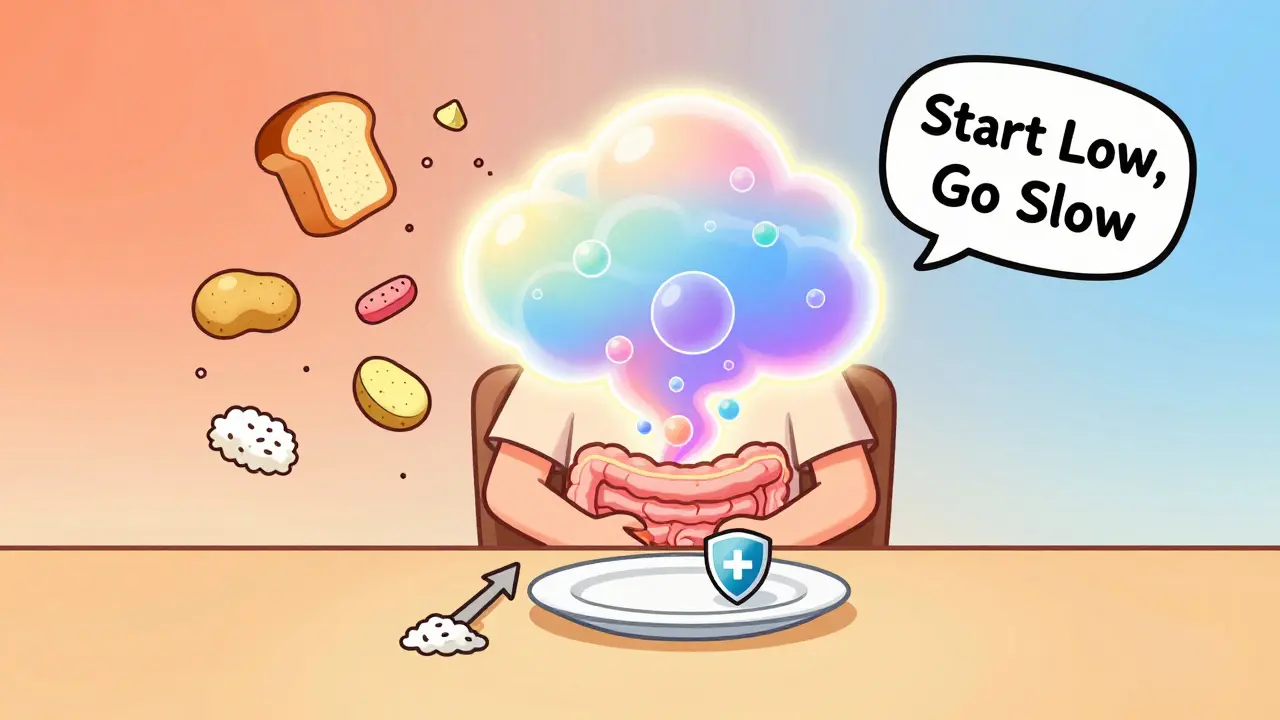
- Start low. Go slow. Don’t jump to 100 mg three times a day. Begin with 25 mg once daily with your biggest meal. Wait two weeks. Then add a second dose. Then a third. This gives your gut time to adjust. A 2022 University of Michigan study found that patients who followed this slow titration had 45% fewer side effects at 12 weeks.
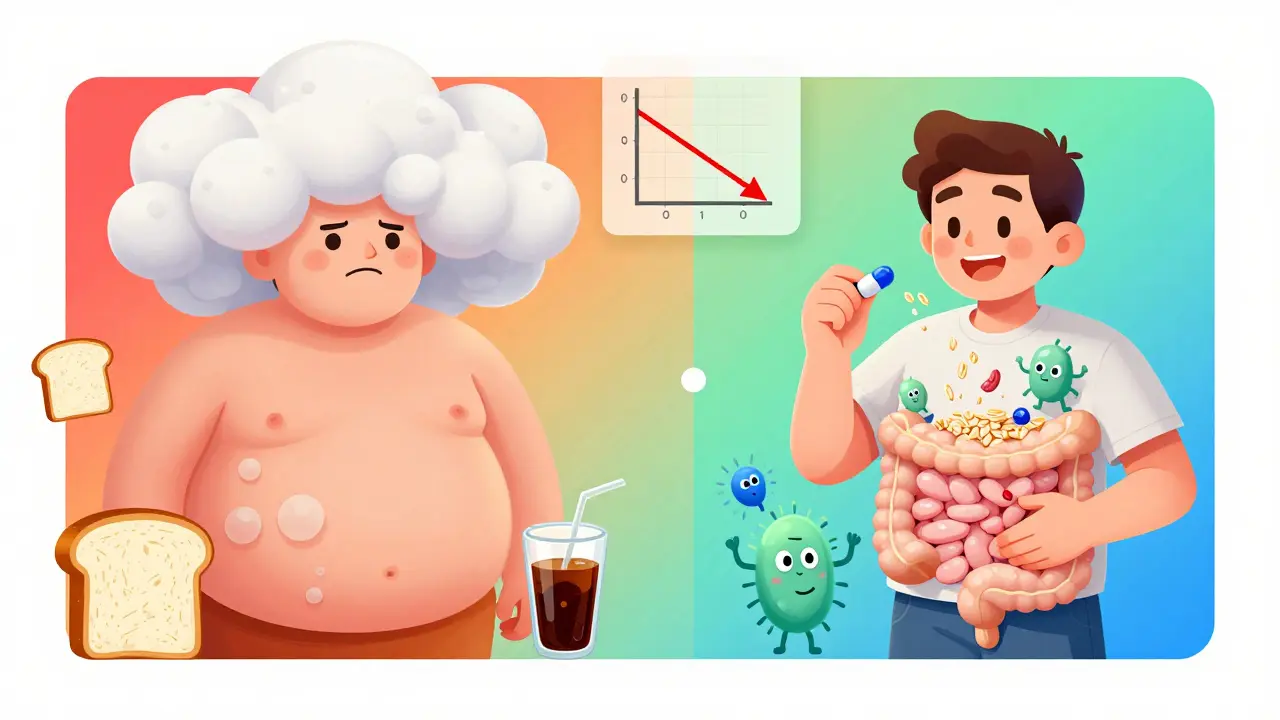
- Watch your carbs - especially the wrong kind. Avoid white bread, potatoes, sugary snacks, and soda. These are the carbs that get broken down fastest - and cause the most gas. Instead, focus on whole grains, legumes, and vegetables. Aim for 30 to 45 grams of carbs per meal. A 2023 study in Gut Microbes showed that replacing simple sugars with resistant starches (like cooled cooked oats or beans) cut gas symptoms by 40%.
- Don’t use Beano. It sounds like a good idea - it’s an enzyme that helps digest beans. But Beano contains alpha-galactosidase, which works the same way as acarbose. Using both together can make side effects worse, not better.
- Try simethicone for gas. A 125 mg tablet before meals can help break up gas bubbles. It doesn’t stop the gas from forming, but it makes it less painful.
- For diarrhea, use loperamide (Imodium) as needed. Don’t take it daily. Use it only when symptoms flare. Avoid high-fat foods - they make diarrhea worse.
- Consider probiotics. A 2023 trial showed that combining acarbose with Lactobacillus acidophilus and Bifidobacterium lactis reduced flatulence by 35%. Look for a probiotic with at least 10 billion CFUs and these two strains.
Who Still Benefits From AGIs?
These drugs aren’t for everyone. But they’re still useful for specific groups:
- Elderly patients - especially those on Medicare. AGIs don’t cause low blood sugar, which is a big risk with sulfonylureas. In 2022, 7.8% of Medicare Part D diabetes prescriptions were for acarbose.
- People with kidney problems - unlike metformin or SGLT2 inhibitors, AGIs aren’t cleared by the kidneys. They’re safe even with moderate kidney disease.
- Those who can’t afford newer drugs - generic acarbose costs $15 to $25 a month. GLP-1 agonists can run over $500.
- Prediabetic patients - the STOP-NIDDM trial showed acarbose reduced diabetes progression by 25%. And at lower doses, side effects are milder.
Why AGIs Are Fading - But Not Gone
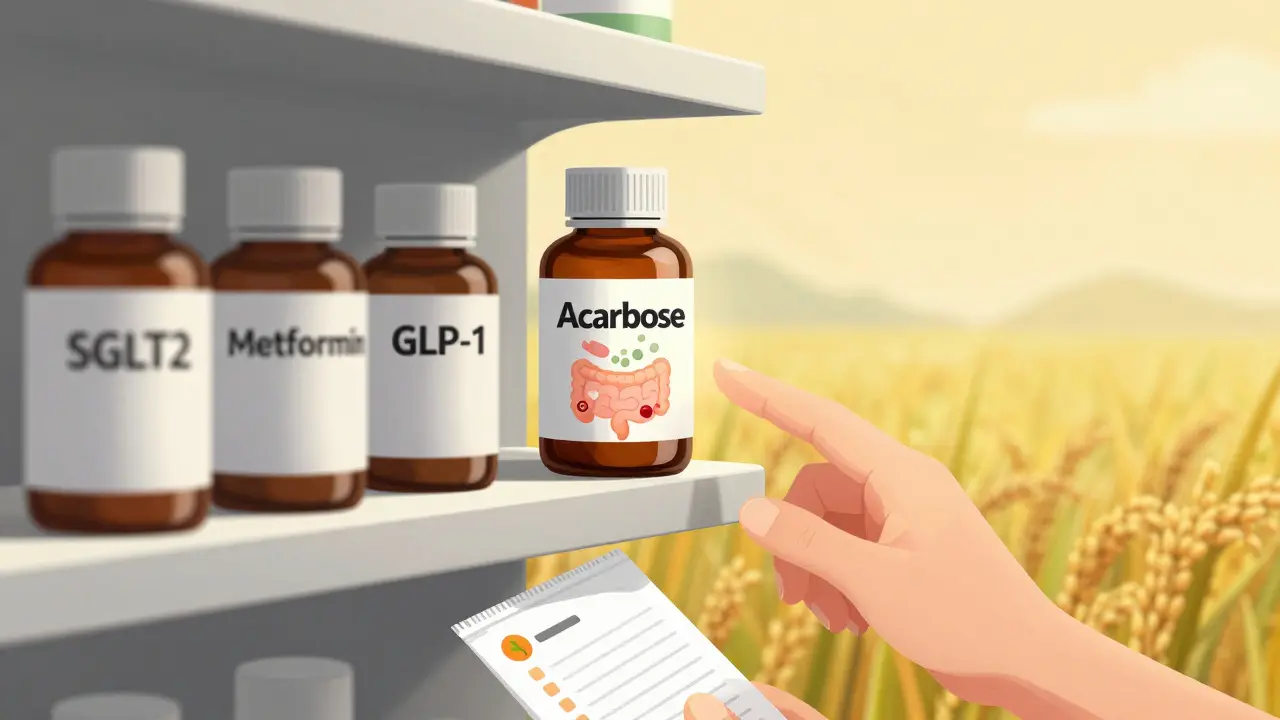
In the U.S., AGIs make up just 3.2% of diabetes prescriptions - down from over 5% in 2018. Newer drugs are more effective, better tolerated, and sometimes even help with weight loss. But in Asia, where diets are high in rice and noodles, AGIs are still widely used. In China, they’re prescribed in 12.5% of cases.
Here’s the truth: AGIs aren’t obsolete. They’re just misunderstood. If you’re prescribed one, don’t assume you’re stuck with the side effects. Talk to your doctor about starting low, changing your diet, and using probiotics. Most people who stick with it for six months say the benefits outweigh the discomfort.
And if you’re still struggling? There are other options. But if you’re looking for a drug that lowers post-meal sugar without hypoglycemia or weight gain - and you’re willing to manage the gas - AGIs still have a place.
Do alpha-glucosidase inhibitors cause weight gain?
No, they don’t. Unlike insulin or sulfonylureas, AGIs don’t cause weight gain. In fact, because they reduce the number of calories absorbed from carbs, some people lose a small amount of weight - usually 1 to 3 pounds over several months. This makes them a good option for people with obesity and Type 2 diabetes.
Can I take acarbose with other diabetes medications?
Yes. Acarbose is often used as an add-on to metformin, SGLT2 inhibitors, or even insulin. It doesn’t interact dangerously with most other diabetes drugs. The main concern is if you’re also taking insulin or sulfonylureas - those can cause low blood sugar. If that happens, you’ll need to treat it with glucose tablets or juice, not regular sugar (like candy or soda), because acarbose blocks the digestion of sucrose and other complex sugars.
How long does it take for the side effects to go away?
Most people notice improvement after 4 to 8 weeks. By 12 weeks, symptoms are often much milder. A 2020 study found that flatulence dropped from 73% in the first month to 25% after six months. This happens because your gut bacteria adapt to the extra carbs. But if symptoms are severe after three months, talk to your doctor - you might need to adjust your dose or switch.
Is there a generic version of acarbose?
Yes. Generic acarbose is widely available and costs between $15 and $25 a month. It’s the same as the brand-name version (Precose). Miglitol is also available as a generic, though it’s less commonly prescribed. Both are covered by most insurance plans.
Can I stop taking acarbose if the side effects are too bad?
Yes - but don’t quit cold turkey. Talk to your doctor first. Stopping suddenly won’t hurt you, but your blood sugar may rise again. Your doctor might suggest lowering the dose slowly or switching to another medication. If you’re struggling, ask about probiotics, diet changes, or simethicone - these can help you stay on the drug longer.
Next Steps If You’re on AGIs
Start by tracking your symptoms. Use a simple 1-to-10 scale for gas, bloating, and diarrhea each day. After two weeks, meet with your doctor. Bring your food log too - what you eat matters just as much as the pill. If you’re still struggling, ask about probiotics or lowering your carb intake. Most people who stick with it - and adjust their diet - find a balance. It’s not easy. But for some, it’s the only way to keep their blood sugar stable without risking low sugar or gaining weight.
about author


Gabrielle Conroy
Okay, I just read this entire thing and I’m so here for it 🙌 I’ve been on acarbose for 8 months and honestly? The first month was a war zone-gas so loud my cat left the room. But then I started eating cooled sweet potatoes instead of mashed, swapped white rice for barley, and started a 10-billion CFU probiotic with L. acidophilus and B. lactis? Game. Changer. My post-meal sugars dropped from 240 to 155. And the bloating? Gone. I swear by this combo. If you’re struggling, don’t quit-just tweak. Your gut is not your enemy. It’s just confused.
Kenzie Goode
This is the most balanced take on AGIs I’ve ever seen. I used to think they were just ‘old-school drugs no one uses anymore’-but the part about Asian diets and rice? That clicked. My dad’s from Vietnam, and he’s been on acarbose for 5 years. He eats brown rice, steamed veggies, and tofu. No gas. No drama. It’s not the drug-it’s the carbs you pair it with. I’m sharing this with my whole family.
Haley Gumm
Let’s be real: the real villain here isn’t acarbose-it’s the American diet. You take a drug designed to slow carb absorption, then you eat a bagel with jam and a latte? Of course you’re gonna turn into a methane-powered trolley. The solution isn’t more meds-it’s less white bread. But hey, at least you’re not on insulin. At least you’re not gaining 20 lbs. At least you’re not paying $800/month. Maybe the side effects are just your body screaming, ‘STOP EATING LIKE A HUMAN BEAR.’
Spenser Bickett
so like... if you're taking acarbose and still eating pizza... you deserve the gas. no sympathy. i mean come on. you want to eat like a toddler and act like a biochemist? the universe has rules. your colon is not your bff.
John Smith
I’ve been on this for 14 months and I swear I’ve become a gas-powered ghost. I can’t go to family dinners. I canceled my sister’s baby shower because I was ‘sick.’ I’m not even exaggerating. I’ve tried probiotics, simethicone, low-carb, high-fiber-nothing works. My doctor says ‘give it time.’ But time doesn’t fix a biological betrayal. I’m switching to metformin next week. If you’re still gasping after six months... you’re not broken. The drug is.
Christopher Brown
AGIs are for people who can't afford GLP-1s. That's it. If you're on Medicare and eating rice, fine. But if you're in the U.S. with access to semaglutide and you're choosing acarbose? You're choosing discomfort. This isn't science. It's poverty medicine. And don't act like it's a lifestyle hack. It's a compromise.
Maranda Najar
Oh my GOD. I read this and I just... I just cried. Not because I’m sad. Because I’m SEEN. For months, I was the woman who left dinner early. The one who excused herself to the bathroom after dessert. The one who wore loose pants and carried Imodium like a security blanket. I thought I was weak. I thought I was failing. But this? This is the first time I’ve read something that says: your pain is valid. Your body is adapting. Your choices matter. I’m starting probiotics tomorrow. I’m eating cooled oats. I’m not giving up. I’m not broken. I’m just... adjusting. Thank you.
Sanjaykumar Rabari
I think the government and big pharma are using these drugs to control our gut bacteria. They want us to be weak. They want us to rely on probiotics and simethicone. Why? So they can sell more pills. The real solution is to stop eating carbs entirely. No rice. No bread. No potatoes. Just meat and water. That's how our ancestors lived. This is all a scam.