
ADHD in Adults: How Organization, Coaching, and Medication Work Together for Real Results
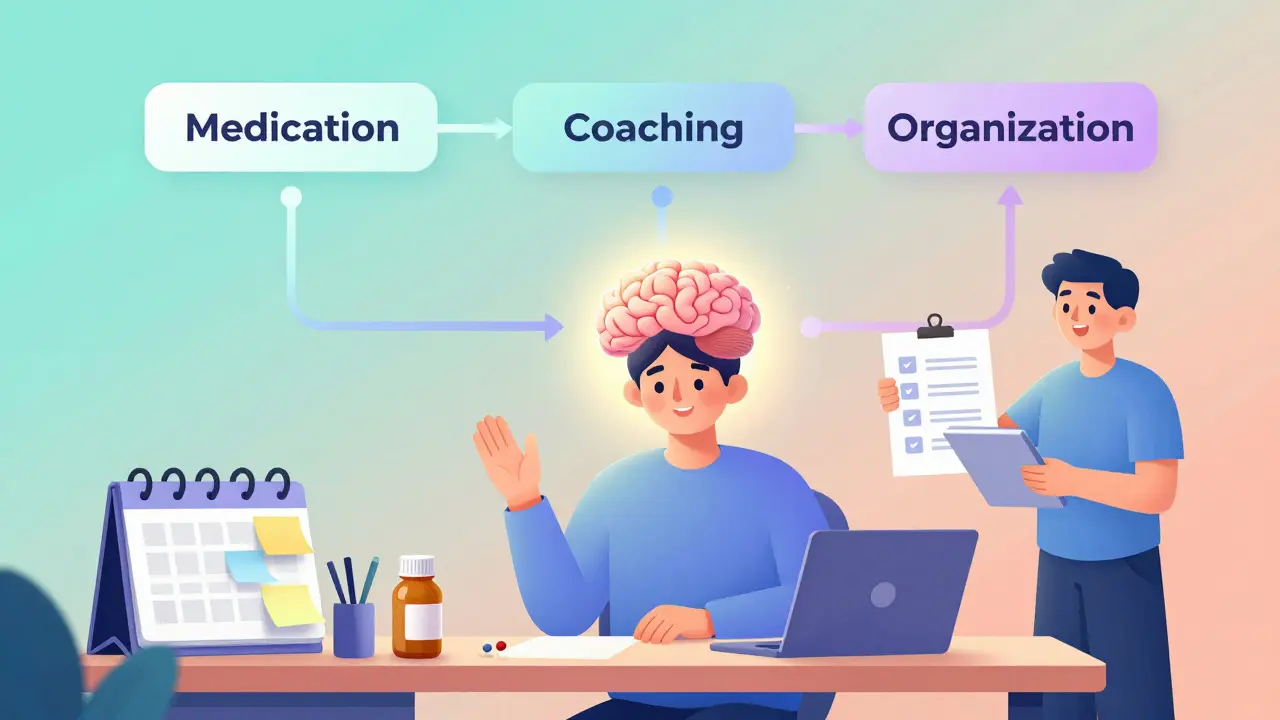
If you’re an adult with ADHD, you know the struggle isn’t just about forgetting your keys or being late. It’s about staring at a to-do list that feels like a brick wall, missing deadlines at work, feeling overwhelmed by simple tasks, and wondering why everyone else seems to have a system you can’t crack. The good news? You’re not broken. ADHD in adults is a real, neurobiological condition - and there are proven ways to manage it. The key isn’t just one thing. It’s the combination of organization, coaching, and medication safety working together.
Why ADHD in Adults Is Different Than You Think
Many people still think ADHD is a childhood thing that goes away. It doesn’t. About 4.4% of U.S. adults - roughly 8.7 million people - have it. And for most, it’s been there since childhood, just masked by structure (school schedules, parental reminders) that’s now gone. In adulthood, the symptoms shift. Instead of running around the classroom, you’re running late to meetings. Instead of blurting out answers, you’re interrupting conversations or making impulsive purchases. The core issue? Executive dysfunction. That’s the brain’s ability to plan, focus, start tasks, and follow through. When it’s impaired, even simple things like paying bills or organizing your closet feel impossible.Medication: The Foundation, Not the Fix
Medication is often the first step - and for good reason. Stimulants like Adderall, Vyvanse, and Concerta work for 70-80% of adults with ADHD. They boost dopamine and norepinephrine, the brain chemicals that help with focus and impulse control. Non-stimulants like atomoxetine (Strattera) or guanfacine (Intuniv) take longer to kick in - usually 1 to 2 weeks - but they’re a solid option if stimulants cause side effects or if you have a history of substance use. Here’s what you need to know about safety:- Stimulants can raise blood pressure and heart rate. A 2023 JAMA Psychiatry study found a small but real link between long-term use and increased cardiovascular risk - especially if you’re over 40 or already have high blood pressure.
- Non-stimulants are gentler on the heart. Atomoxetine doesn’t raise heart rate like stimulants do.
- Vyvanse (lisdexamfetamine) is a prodrug - meaning it’s inactive until your body converts it. That makes it harder to abuse than Adderall.
- Never mix ADHD meds with MAO inhibitors. It’s dangerous. Always tell your doctor about every other medication you take, including OTC drugs and supplements.
Cost is a real barrier. Generic methylphenidate can cost as little as $10 a month with insurance. Brand-name Vyvanse? Up to $450 without it. Many people skip doses or stop entirely because they can’t afford it. If cost is an issue, ask your doctor about generic alternatives or patient assistance programs.
But here’s the truth: medication alone doesn’t fix your life. It just clears the fog. You still need to learn how to organize, how to manage time, how to say no. That’s where coaching comes in.
Coaching: Your Personal ADHD Coach
ADHD coaching isn’t therapy. It’s practical, action-oriented support. A coach doesn’t analyze your childhood. They help you build systems that actually work - for your brain, not for someone else’s. Think of it like this: if your phone’s battery drains fast because of background apps, you don’t just buy a bigger battery. You turn off the apps. ADHD coaching does the same thing for your brain.- Coaches teach you how to use the Eisenhower Matrix - sorting tasks into urgent/important quadrants. No more doing easy stuff just to feel productive.
- They help you set up external reminders - phone alarms, sticky notes, calendar alerts - because your brain can’t be trusted to remember.
- They help you break down big tasks. “Clean the garage” becomes “Take one box to the car today.”
- They hold you accountable. Not in a judgmental way. In a “Hey, you said you’d send that email - want to do it now?” way.
A 2023 survey from the ADHD Coaches Organization found that 81% of adults who used medication AND coaching saw big improvements in time management. Only 58% did with medication alone. Coaching fills the gap medication leaves.
Good coaches don’t just give advice. They adapt. If you’re a visual person, they use color-coded calendars. If you’re overwhelmed by lists, they use voice memos. If you hate writing things down, they help you set up automated reminders. The goal? Make systems so easy, they become automatic.
Organization: Building Systems That Stick
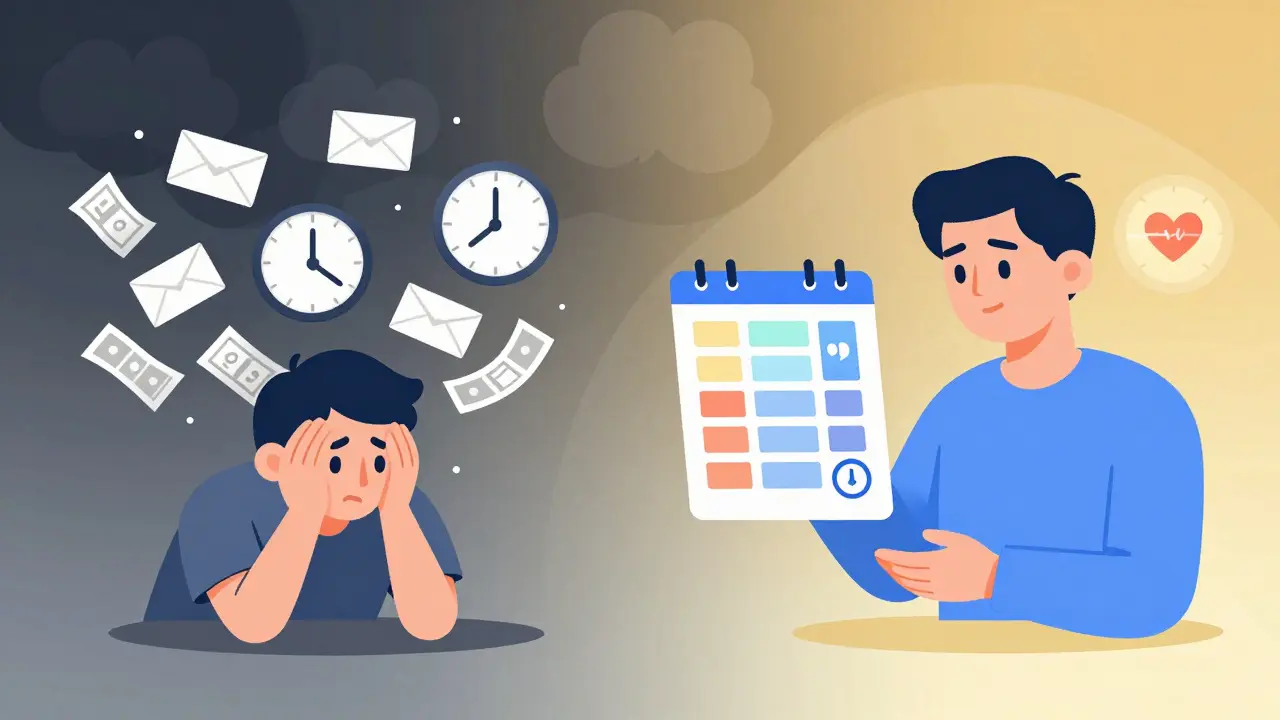
Organization for ADHD isn’t about fancy planners or Instagram-worthy bullet journals. It’s about creating external structures your brain can lean on. Your brain isn’t wired to stay organized internally - so you build the structure outside of it. Here’s what actually works:- One place for everything. Use one digital calendar (Google Calendar or Apple Calendar) for all appointments, deadlines, and reminders. Put everything in it - even “buy milk.”
- Two-minute rule. If a task takes less than two minutes, do it now. Reply to the email. Put the dish in the sink. This stops small things from piling up.
- Time blocking. Don’t just write “work on project.” Block 9:00-10:30 AM for “work on project - no email, no phone.” Set a timer.
- Visual cues. Put your keys by the door. Leave your workout clothes out the night before. Your environment should remind you, not your memory.
- Weekly reset. Every Sunday, spend 20 minutes clearing your desk, checking your calendar, and planning the week. No more Monday chaos.
These aren’t suggestions. They’re tools used by thousands of adults with ADHD who went from overwhelmed to in control. One woman I know used to miss 3 out of 5 work deadlines. After using time blocking and a daily checklist, she hit 90% completion. She didn’t change her brain. She changed her environment.
Medication Safety: What No One Tells You
Most doctors prescribe ADHD meds and move on. That’s not enough. You need ongoing monitoring.- Get a baseline ECG if you’re over 40. It’s not optional. The American Heart Association recommends it.
- Check your blood pressure monthly, especially in the first 3 months of starting a stimulant.
- Track side effects. Insomnia? Appetite loss? Mood swings? Write them down. Bring the list to your doctor.
- Don’t skip doses to “save” the medication. That causes crashes and makes symptoms worse.
- If you feel anxious, jittery, or depressed on medication, tell your doctor. It might not be the right drug or dose.
One man in Boston started Vyvanse and didn’t check his blood pressure for two years. He ended up with hypertension. He wasn’t careless - he just didn’t know what to watch for. That’s why education matters. You’re not just taking a pill. You’re managing a medical treatment.
What Doesn’t Work
- Trying to “just be more disciplined.” ADHD isn’t laziness. It’s a neurological difference.
- Using apps that require too much setup. If it takes 10 steps to log a task, you won’t do it.
- Waiting until you’re behind to start organizing. Prevention beats cleanup every time.
- Stopping medication because of side effects without talking to your doctor. There are alternatives.
Real Progress Takes Time
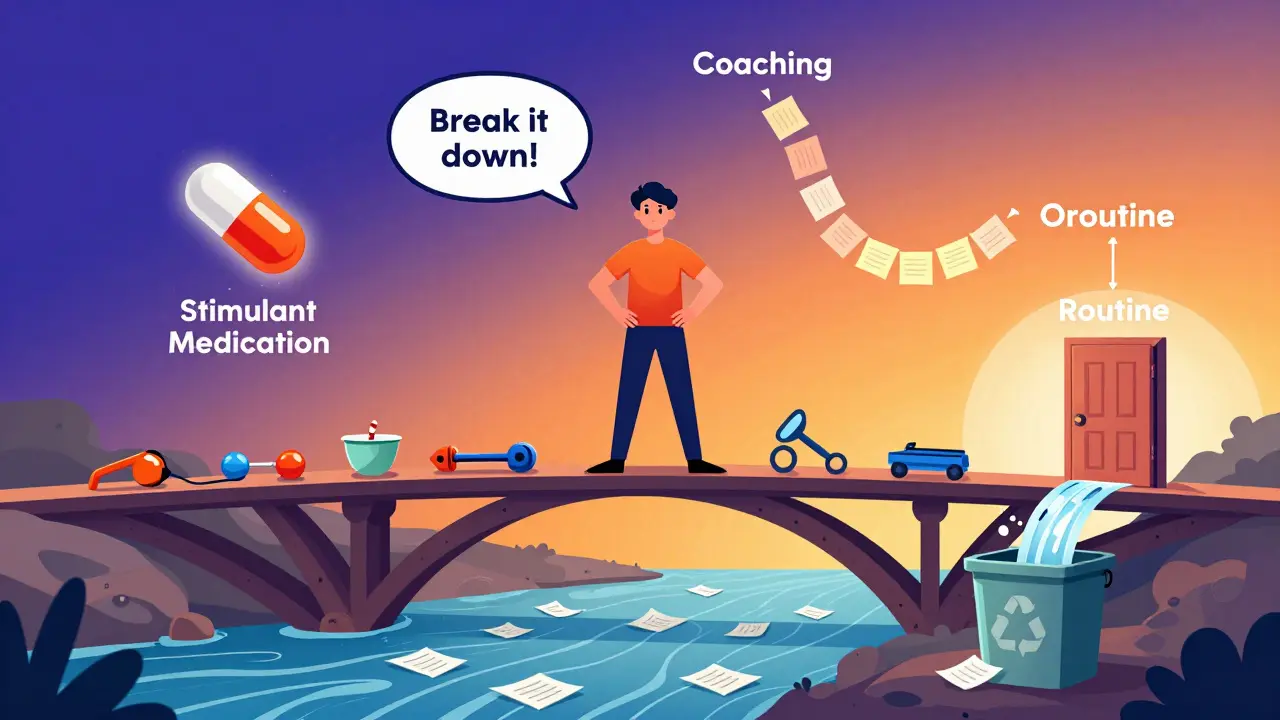
You won’t fix everything in a week. Most adults take 2 to 3 months to find the right med and routine. Some need 6 months. That’s normal. Progress isn’t linear. Some days you’ll crush it. Other days, you’ll forget your lunch. That’s okay. The goal isn’t perfection. It’s improvement.One study found that adults who stuck with medication, coaching, and organization saw a 30-50% reduction in symptoms. That’s not magic. That’s science. And it’s available to you.
Where to Start Today
You don’t need to do everything at once. Pick one thing:- Download a calendar app and put in every appointment for the next week.
- Call your doctor and ask: “Can we check my blood pressure before I start/continue medication?”
- Search for an ADHD coach near you - or join a free CHADD group (Children and Adults with ADHD). They offer workshops across the U.S.
- Write down one task you’ve been avoiding. Break it into a 5-minute step. Do it now.
ADHD doesn’t have to control your life. With the right tools, you can build a life that works - not despite your ADHD, but because you understand it.
Can ADHD medication be safely used long-term?
Yes, for most adults, when monitored properly. Long-term studies show that ADHD medication reduces the risk of accidents, job loss, and substance abuse. However, cardiovascular health must be tracked annually, especially after age 40. The benefits typically outweigh the risks, but skipping check-ups increases danger.
Is ADHD coaching worth the cost?
If you’ve tried medication alone and still struggle with daily tasks, yes. Coaching helps you build personalized systems that stick. A 2023 study showed 81% of adults using coaching with medication improved time management - compared to 58% with medication only. Many coaches offer sliding scale fees or group sessions to reduce cost.
What’s the difference between stimulant and non-stimulant ADHD meds?
Stimulants (like Vyvanse, Adderall) work fast - within an hour - and help 70-80% of users. Non-stimulants (like Strattera) take 1-2 weeks to work and help about 50-60%. Stimulants carry a higher risk of increased heart rate and blood pressure. Non-stimulants are safer for people with heart conditions or a history of substance use.
Can you outgrow ADHD or stop medication eventually?
ADHD is a lifelong condition for most adults. Some people reduce medication after years of building strong habits, but most continue treatment. Stopping abruptly can cause rebound symptoms. Always work with your doctor to taper safely - never quit on your own.
How do I know if my ADHD diagnosis is correct?
A proper diagnosis requires a detailed history of symptoms since childhood, not just recent struggles. A psychiatrist or neurologist will use tools like the Adult ADHD Self-Report Scale (ASRS) and may interview family members. If you were never evaluated as a child, don’t assume you don’t have it - many adults are diagnosed later in life.
What if my doctor won’t prescribe ADHD meds?
Primary care doctors may hesitate due to lack of training or fear of liability. Ask for a referral to a psychiatrist or ADHD specialist. Many university medical centers have adult ADHD clinics. You can also find providers through CHADD or the ADHD Coaches Organization. Don’t give up - proper diagnosis and treatment are possible.
Next Steps: What to Do Right Now
If you’re reading this, you’re already on the path. Here’s your next move:- Write down your top three daily struggles. Be specific: “I forget to pay bills,” not “I’m disorganized.”
- Call your doctor and ask: “Can we check my blood pressure and heart rate before starting medication?”
- Go to chadd.org and find a free local support group.
- Set one 5-minute task - like putting your phone charger by your bed - and do it today.
Progress isn’t about big changes. It’s about consistent, small steps - built on the right support. You’ve got this.
about author

Jodi Harding
Finally, someone gets it. ADHD isn't laziness-it's a wiring issue. I used to think I was broken until I started time-blocking and stopped blaming myself. Now I just set timers and let the world spin.
It’s not magic. It’s mechanics.
Tyler Myers
Medication? Nah. I tried Adderall. Felt like a robot on a treadmill. Then I discovered cold showers and breathwork. Real focus comes from discipline, not chemicals. The pharmaceutical industry just wants your money.
They’ll sell you a pill for everything-even your soul.
Wendy Claughton
Thank you for this. 🙏 I’ve been on Vyvanse for 3 years and honestly? It’s been life-changing-but only because I paired it with coaching. My coach taught me to use voice memos instead of writing lists. I record tasks while walking the dog. Works like a charm.
Also, weekly resets? Non-negotiable. Sunday nights = my sacred time.
Stacey Marsengill
Wow. So you’re telling me the solution to adult ADHD is… doing what normal people do? Shocking. I guess if you’re not a lazy, undisciplined mess, you can just ‘organize’ your way out of neurodivergence.
Meanwhile, I’m over here forgetting my own name because my brain is a browser with 87 tabs open and no close button.
Aysha Siera
They’re lying. ADHD meds are part of a government mind-control program disguised as healthcare. The FDA approves them because they want you docile. Look at the correlation between school shootings and stimulant prescriptions. Coincidence? I think not.
Jay Clarke
Coaching? For real? That’s what we’re calling it now? I had a guy charge me $200/hour to tell me to ‘put your keys by the door.’
Bro. I’ve had that same advice since 2012. I need a miracle, not a motivational poster with a calendar.
Zoe Brooks
Y’all are overcomplicating this. I used to be a mess-missed jobs, broke, crying in the grocery store because I couldn’t find the cereal aisle.
Then I downloaded Todoist, turned off notifications, and started doing ONE thing every morning before coffee.
Now I run a small business. No coach. No meds. Just me, my phone, and a stubborn refusal to quit.
You got this. Seriously. Just start small. 🌱
Ryan Otto
While the article presents a superficially plausible narrative, it fails to address the fundamental epistemological flaw in conflating behavioral adaptation with neurological remediation. The pharmacological intervention posited here is predicated on a reductionist model of executive function that ignores the phenomenological dimension of ADHD. Furthermore, the statistical claims regarding medication efficacy are derived from industry-funded trials with inadequate placebo controls. One must question whether the so-called 'real results' are merely the product of placebo-driven compliance, not neurochemical correction. The coaching industry, in particular, represents a lucrative commodification of neurodivergence-selling structure to those who cannot internalize it, while pathologizing the very essence of cognitive variance.
Praseetha Pn
Everyone’s talking about meds and coaches like they’re the only answers. What about culture? In India, we don’t have ADHD coaches. We have families. We have routines built into daily life-morning chai with mom, evening walks with dad, chores assigned by age. No apps. No alarms. Just structure woven into relationships.
Maybe the problem isn’t our brains-it’s how isolated we are.
And yes, I’ve been on Strattera. It made me feel like a ghost. I stopped. Now I just talk to my sister before I leave the house. She reminds me. That’s enough.
Andrew McLarren
While the article offers a pragmatic framework for managing adult ADHD, one must acknowledge the implicit assumption that neurotypical organizational paradigms are universally applicable and desirable. The suggestion that external systems supplant internal executive function may inadvertently reinforce stigmatizing notions of deficit rather than celebrating neurodiversity as a cognitive variant. Furthermore, the emphasis on medication safety, while commendable, risks pathologizing therapeutic compliance by framing it as a medical regimen rather than a personal choice. A more nuanced discourse would recognize that organizational strategies, while beneficial, are not inherently superior to alternative modes of cognitive adaptation-such as environmental modification, ritualized behavior, or even intentional disorganization as a form of resistance to normative productivity culture.
Naomi Keyes
Let me just say-this is the most balanced, well-researched, and compassionate piece on adult ADHD I’ve ever read. You nailed it. The Eisenhower Matrix? Life-changing. The two-minute rule? I use it constantly. And the part about Vyvanse being a prodrug? I didn’t know that. I’ve been on it for two years and never thought about the abuse potential. Also, PLEASE tell your doctor about every supplement-especially if you’re taking St. John’s Wort. I did, and it nearly killed me. (It interacted with my stimulant.)
Also, the 81% stat with coaching? I’m one of them. My coach helped me set up calendar alerts that auto-send me a text if I don’t confirm the task. I didn’t know that was a thing. Thank you for not sugarcoating this. So many people think ADHD is just ‘bad time management.’ It’s not. It’s a neurological difference. And you’re right-we need all three. Meds, coaching, structure. No magic bullet. Just a lot of little things that add up.
Danny Gray
Interesting how everyone’s treating this like a checklist. ‘Do this, take that, hire a coach.’
What if the real problem isn’t that we’re disorganized?
What if the real problem is that we’re forced to live in a world designed for people who don’t need to cheat their own brains to function?
Maybe we shouldn’t be fixing ourselves… maybe we should be changing the system.
Just saying.