
Osteoarthritis of the Hip: How Weight Loss Can Preserve Your Joint and Reduce Pain
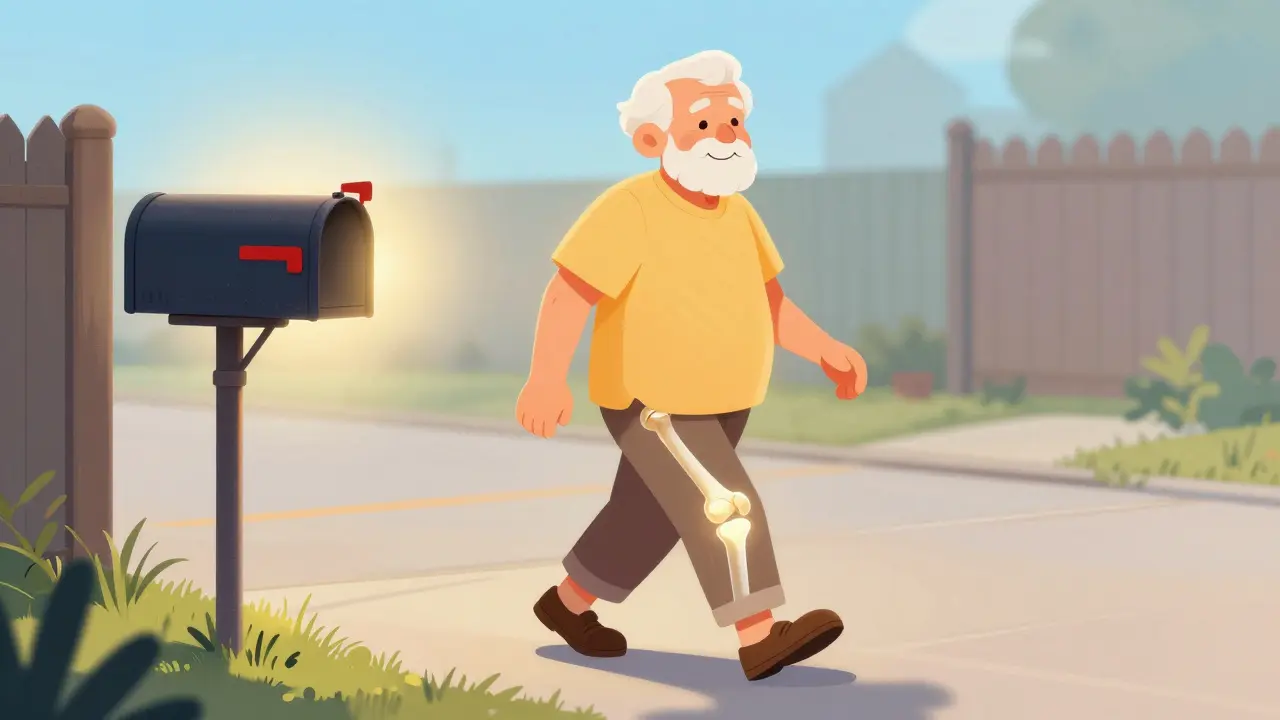
When your hip hurts just walking to the mailbox, losing weight isn’t just about looking better-it’s about keeping you moving.
For many people over 50, hip osteoarthritis (OA) isn’t just a dull ache. It’s the reason you avoid stairs, skip walks, or need help getting out of a car. The cartilage in your hip joint wears down. Bone rubs on bone. Inflammation sets in. And the pain gets worse over time. But here’s something most people don’t realize: hip osteoarthritis doesn’t always respond the same way to weight loss as knee OA does. Some studies say it helps. Others say it barely makes a difference. So what’s really going on?
The truth? It’s not about whether weight loss works-it’s about how much you lose, and how you do it.
Why losing even a little weight can change your hip pain
Think of your hip joint like a door hinge. The more weight it carries, the more stress it takes. Every extra pound adds pressure-not just on the joint, but on the muscles and ligaments around it. Research from the 2024 Nature study tracked 65-year-olds with hip OA and obesity. Those who lost more than 10% of their body weight saw a 31% improvement in their quality of life. That’s not a small number. It means they could get dressed without pain, sleep through the night, and even enjoy a short walk again.
But here’s the catch: losing 5%-the number often cited for knee OA-doesn’t always cut it for the hip. That study showed the biggest gains came from losing over 10%. For someone weighing 200 pounds, that’s 20 pounds. Not easy. But possible. And it’s not magic. It’s physics. Less weight = less grinding = less pain.
Why hip OA is different from knee OA
Here’s where things get confusing. If you search for weight loss and arthritis, you’ll find dozens of studies saying it’s a game-changer for knee pain. That’s true. The knee is a hinge joint. It bears most of your body’s weight when you walk or climb stairs. Lose weight? The knee feels it right away.
The hip? It’s a ball-and-socket joint. It’s built for stability, not just movement. That means it doesn’t always react the same way. A 2023 clinical trial compared a very-low-calorie diet plus exercise against exercise alone in 101 people with hip OA. At six months, there was no real difference in pain levels between the two groups. That’s the study that made NEJM Journal Watch say, “Osteoarthritis of the Hips Is Unaffected by Weight Loss.”
But wait-there’s more. At 12 months, the group that lost weight showed clear improvements in pain, function, and overall hip condition. The benefits were delayed. That’s critical. If you give up after six months because you don’t feel better, you’re missing the real payoff.
So the lesson isn’t that weight loss doesn’t work for hip OA. It’s that it takes longer. And you need to stick with it.
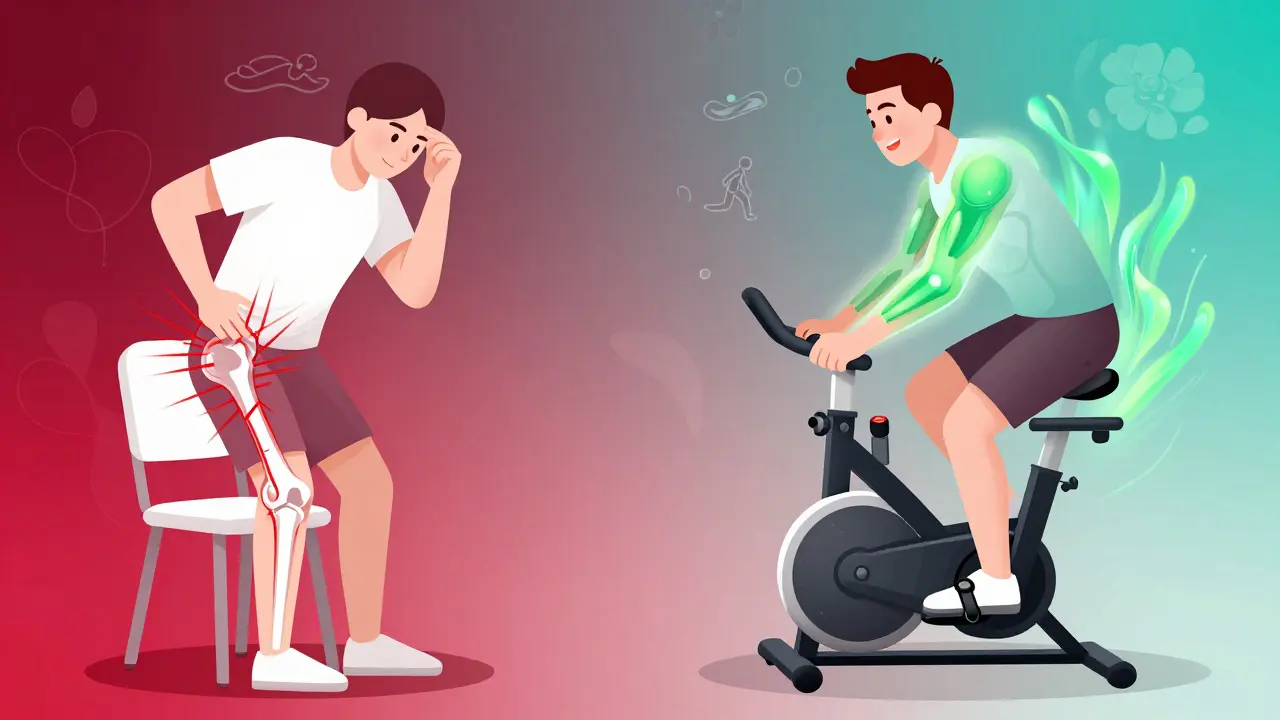
What actually works: The OAHWFL program and real results
One of the most successful programs for joint preservation comes from Australia and New Zealand: the Osteoarthritis Healthy Weight For Life (OAHWFL) program. Originally designed for knee OA, it was adapted for hip OA. The structure? 18 weeks of structured weight loss, followed by lifelong maintenance.
Participants followed a low-carb, calorie-controlled diet and did daily exercises tailored to protect the hip joint. The goal? 7-10% weight loss. In one study, people lost an average of 8.5% of their body weight. Their pain dropped. Their mobility improved. Their HOOS scores-used to measure hip function-went up across all categories: pain, stiffness, daily activities, sports, and quality of life.
And here’s something you won’t hear often: those who didn’t finish the 18 weeks had worse symptoms to begin with. That’s not a failure. It’s a clue. People with advanced hip OA need more support-more coaching, more motivation, maybe even telehealth check-ins. This isn’t a diet you do alone.
Exercise that protects your hip-not hurts it
Weight loss without exercise is like putting out a fire with a spray bottle. You might cool it down, but the embers stay hot. For hip OA, the right exercise does two things: helps you lose weight and strengthens the muscles that support your joint.
Forget running. Forget deep squats. Those hurt. Instead, focus on:
- Swimming or water aerobics-zero impact, full movement
- Cycling on a stationary bike-low resistance, smooth motion
- Seated leg lifts and glute bridges-builds hip stabilizers without pressure
- Walking on flat ground, with supportive shoes-start with 10 minutes, build to 30
A 2012 study of 35 people with hip OA who did an 8-month program of diet and exercise saw a 32.6% improvement in physical function. That’s not a fluke. That’s science. And the best part? No surgery. No shots. Just consistent movement.
When weight loss alone isn’t enough
Not everyone can lose 10% of their body weight. Some have mobility issues. Others have metabolic conditions. Others just can’t stick with a diet. That’s okay. You still have options.
The American College of Rheumatology recommends weight loss as a conditional treatment for hip OA-but only if you’re overweight or obese. That means if your BMI is above 25, you’re in the target group. But if you’ve tried and failed? Don’t give up. Talk to your doctor about FDA-approved weight loss medications. These are not magic pills. They’re tools for people who’ve tried everything else and need a boost.
And remember: even if you only lose 5%, you’re still reducing stress on your joint. Every pound counts. You don’t need to be thin. You just need to be lighter than you were yesterday.

What about surgery?
When hip pain stops you from living, surgery-like a hip replacement-can be life-changing. But it’s not the first step. It’s the last. And weight loss can delay it. For many, losing even 10% of body weight means postponing surgery by years. That’s huge. Hip replacements last 15-20 years. If you’re 60 and get one now, you might need a second one in your 80s. That’s risky. Avoiding surgery means avoiding complications, hospital stays, and long rehab.
Weight loss isn’t just about pain. It’s about preserving your joint so you can stay active, independent, and out of the hospital.
Real progress, not quick fixes
There’s no miracle cure for hip osteoarthritis. But there is a proven path: lose weight slowly, move safely, and stick with it. The 2024 Nature study showed that people who lost more than 10% had the best results. The 2023 trial showed those results took time. And the OAHWFL program proved it works in real life.
You don’t need to run a marathon. You don’t need to eat kale every day. You just need to eat less than you burn, move without pain, and keep going-even when it’s hard.
And if you’re wondering whether it’s worth it? Ask yourself this: Would you rather spend your 70s walking without pain-or sitting on the sidelines, waiting for the next flare-up?
Can losing weight really help hip osteoarthritis, or is it just for knee pain?
Yes, it can help-but the effect is slower and less dramatic than with knee OA. Studies show that losing 10% or more of your body weight leads to meaningful improvements in hip pain, function, and quality of life. While some early studies suggested little benefit, longer-term research (12+ months) confirms that weight loss, especially when paired with exercise, reduces symptoms and delays the need for surgery.
How much weight do I need to lose to feel better with hip OA?
For knee OA, 5% weight loss often brings relief. For hip OA, research suggests you need at least 7-10%. People who lost over 10% in a 2024 study saw a 31% improvement in their quality of life scores. Losing 5% helps, but 10% gives you the best chance at real, lasting change. That’s about 20 pounds for someone who weighs 200.
What kind of exercise is safe for someone with hip osteoarthritis?
Avoid high-impact activities like running or jumping. Focus on low-impact options: swimming, water aerobics, stationary cycling, walking on flat surfaces, and strength exercises like seated leg lifts and glute bridges. These build muscle around the hip without grinding the joint. Physical therapists can design a personalized plan that protects your joint while helping you move better.
Should I consider weight loss medications for hip OA?
FDA-approved weight loss medications are an option if your BMI is above 30 (or above 27 with other health risks) and you’ve tried lifestyle changes for at least six months without success. These aren’t shortcuts-they’re tools to help you stick with a plan. Always use them under medical supervision, and never as a replacement for diet and exercise.
Will losing weight prevent me from needing a hip replacement?
It can delay it-sometimes by years. Hip replacements last 15-20 years. If you get one too early, you might need a second surgery later, which is riskier. Losing weight reduces joint stress, slows cartilage wear, and improves mobility, all of which help you avoid surgery for as long as possible. Even if you eventually need one, being at a healthier weight makes recovery faster and safer.
What to do next
Start small. Track your weight once a week. Walk 10 minutes a day. Swap one sugary drink for water. That’s it. Don’t aim for perfection. Aim for progress.
If you’re unsure where to begin, talk to your doctor or a physical therapist. Ask about structured programs like OAHWFL. Ask if telehealth coaching is available. You don’t have to do this alone.
Your hip doesn’t need to be perfect. It just needs to last.
about author

Lindsey Kidd
I lost 18 lbs after my hip started screaming every time I got out of bed 🥲 and now I can walk to the store without crying. It’s not magic-it’s just less weight grinding on bone. Also, water aerobics saved my life. 💦✨
Isaac Bonillo Alcaina
The article is misleading. Claiming '10% weight loss improves hip OA' ignores confounding variables: age, baseline inflammation, and medication use. The 2023 trial showed no significant difference at 6 months-this is why evidence-based medicine requires longitudinal data, not cherry-picked anecdotes.
Bhargav Patel
The human body is not a mechanical system reducible to force equations. While biomechanics suggest that reduced load should alleviate joint stress, the physiological reality is more nuanced. Inflammation, neuromuscular adaptation, and systemic metabolic shifts play roles that cannot be quantified by pounds alone. Weight loss may be a catalyst, but not a cure. The soul of healing lies in harmony-not merely in subtraction.
Steven Mayer
The clinical efficacy of weight reduction in hip OA is confounded by poor adherence metrics and lack of control for sarcopenia. The OAHWFL program’s 8.5% mean loss is statistically significant but clinically marginal when adjusted for baseline HOOS scores and comorbidities like T2DM. Without DEXA scans or CRP tracking, the data lacks granularity.
Charles Barry
They don’t want you to know the truth. Big Pharma and orthopedic surgeons are pushing this 'lose weight' narrative because hip replacements pay $50k per surgery. They’d rather you suffer for 10 years than lose a $50k payday. The real fix? Stem cells. But they’re banned in the US because insurance won’t cover them. Wake up.
Rosemary O'Shea
Honestly, if you’re over 50 and still blaming your hip pain on weight, you’re missing the point entirely. My cousin’s husband lost 30 lbs and still needed a replacement by 62. This isn’t about discipline-it’s about genetics, poor posture since childhood, and the fact that we’ve all been sold a lie about 'movement = healing.'
Joe Jeter
I’ve seen 200-pound people walk pain-free and 140-pound people in wheelchairs. This whole 'weight loss fixes everything' thing is just a lazy societal scapegoat. Maybe the problem isn’t your body fat-it’s your shitty mattress, your sedentary job, or the fact that your shoes are made of cardboard.
Sidra Khan
I lost 12 lbs and my hip still cracks like a popcorn kernel. 🤦♀️ I’m not mad, just… tired. Why is it always about weight? What about my vitamin D? My sleep? My stress? Nobody talks about that. Also, I hate water aerobics. It feels like drowning in a spa.
Lu Jelonek
In my community in rural Oregon, we’ve seen older adults improve mobility not by dieting, but by joining walking groups and sharing meals with neighbors. The real magic isn’t in the scale-it’s in connection. Movement becomes sustainable when it’s shared. I’ve seen people who never lost a pound walk 2 miles a day for 5 years and never need surgery.
Ademola Madehin
Bro, I lost 25kg and my hip still hurt like hell. Then I started drinking ginger tea and dancing to Afrobeats at home. No joke. My pain dropped like a rock. This Western medicine stuff is too rigid. Africa taught me: pain ain’t just physical-it’s emotional. Move your body, but also move your soul. 🕺🔥
suhani mathur
Ah yes, the classic 'lose weight and everything’s fixed' fairy tale. Meanwhile, my 70-year-old neighbor lost 15 lbs, did all the exercises, and still got her hip replaced last month. The real issue? We’re treating symptoms, not root causes. Who’s studying the role of chronic stress on joint degradation? Nobody. Because it’s not profitable.
bharath vinay
This whole article is a cover-up. The government and pharmaceutical companies know that joint degeneration is linked to glyphosate in our food supply. That’s why they promote 'weight loss'-it distracts from the real toxin. If you’re eating anything from a bag, you’re poisoning your cartilage. Stop trusting 'studies' funded by Big Pharma.
Delilah Rose
I think what’s missing from this conversation is the emotional toll. I lost 22 pounds over 14 months and yes, my hip hurt less-but I also cried a lot. I felt like my body was betraying me. I felt guilty for not losing faster. I felt invisible when people said, 'Just eat less.' But then, one day, I stood up from my chair without grabbing the arms-and I didn’t cry. That moment? That’s the real win. Not the number on the scale. It’s the quiet, daily courage to keep going. I don’t know if I’ll ever be 'thin.' But I’m learning to be kind to myself while I move. And that matters more than any study.