
Kidney Transplant: Eligibility, Surgery, and Long-Term Management

When your kidneys fail, life changes in ways you can’t ignore. Dialysis keeps you alive, but it doesn’t give you back your life. A kidney transplant offers something else: freedom from needles, strict schedules, and constant fatigue. For many, it’s the best shot at returning to normal-working, traveling, playing with grandkids, sleeping through the night. But it’s not simple. It’s not automatic. And it doesn’t end when the surgery is over.
Who Qualifies for a Kidney Transplant?
You don’t just sign up for a transplant because you have kidney disease. You need to be in the right condition to survive the surgery and thrive afterward. Most transplant centers require you to have end-stage renal disease (ESRD), meaning your kidneys are working at 15% or less of normal capacity. That’s measured by your glomerular filtration rate (GFR), and if it’s below 20 mL/min, you’re typically eligible. Some centers, like Mayo Clinic, may consider you even if your GFR is up to 25 mL/min-if your kidney function is dropping fast or you already have a living donor lined up.Age isn’t a hard cutoff. You can be 70, 80, even older-and still qualify-if you’re otherwise healthy. Vanderbilt and UCLA look at your whole picture: heart health, muscle strength, mental clarity, not just your birth year. But if you’re frail, weak, or have other serious conditions, the risks may outweigh the benefits.
Obesity is a major barrier. A BMI over 35 raises your risk of complications. Over 45? Most centers won’t operate. Why? Fat makes surgery harder, increases infection risk, and lowers the chance the new kidney will last. Studies show obese patients have a 35% higher chance of surgical problems and a 20% higher risk of graft failure.
Your heart and lungs matter too. If you have severe pulmonary hypertension-pressure in your lung arteries above 70 mm Hg-you won’t qualify. Same if you’re on oxygen long-term because of COPD. Your heart needs to be strong enough to handle the stress. An echocardiogram will check your ejection fraction. If it’s below 35%, you’re usually ruled out.
Then there’s the mental and social side. Can you remember to take 10 pills every day for the rest of your life? Do you have someone to drive you to appointments, help you if you feel sick, or notice if something’s wrong? Most centers require a care partner. If you’re struggling with untreated depression, active addiction, or can’t follow medical advice, you won’t be approved. Transplant centers aren’t being harsh-they’re being realistic. A failed transplant isn’t just a loss. It’s a setback that could cost you your life.
What Disqualifies You?
Some conditions are absolute no-go’s. No exceptions.Active cancer-unless you’ve been cancer-free for years. For most cancers, you need at least 2-5 years of remission before you’re considered. Skin cancer? Maybe. Lung cancer? Probably not.
Untreated infections-like hepatitis B or C with active virus in your blood, or HIV with a CD4 count below 200. These don’t just make surgery dangerous-they can kill the new kidney.
Drug or alcohol abuse-if you’re still using, you’re not eligible. Not because they’re judging you, but because missing doses of anti-rejection drugs can lead to immediate, irreversible rejection. One missed week can mean losing the transplant.
Severe, uncontrolled mental illness-if you can’t manage your own care, you won’t be approved. This isn’t about stigma. It’s about survival. You need to understand what’s happening in your body and act on it.
Even if you’ve had cancer, an infection, or addiction in the past, you might still qualify-if you’ve been clean and stable for years. Transplant centers track your history closely. They want proof you’ve changed, not just promises.
What Happens During the Surgery?
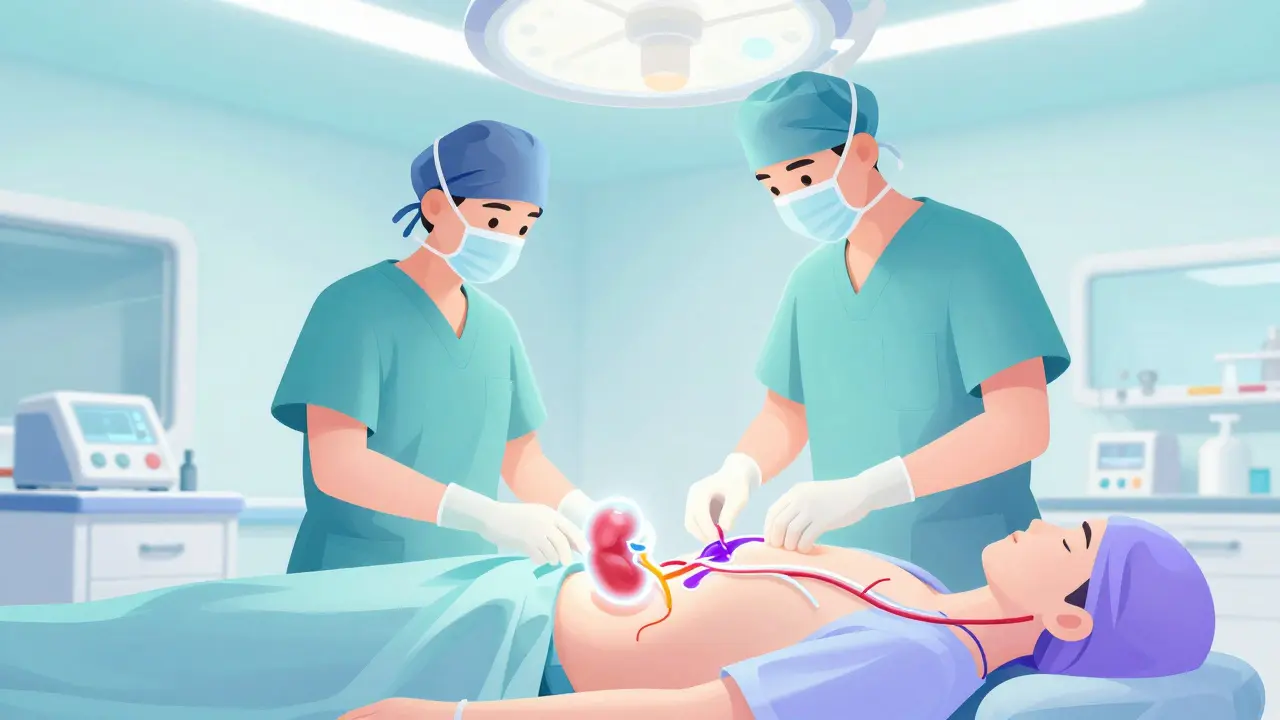
The surgery itself takes about 3 to 4 hours. You’re under general anesthesia, so you won’t feel a thing. The surgeon places the new kidney in your lower abdomen-not where your old kidneys are. Your original kidneys are usually left in place unless they’re causing pain, infection, or high blood pressure.The new kidney’s blood vessels are connected to your main artery and vein. The ureter-the tube that carries urine-is attached to your bladder. In most cases, the kidney starts working right away. You’ll see urine flowing within minutes. But sometimes, especially with kidneys from deceased donors, it takes days to kick in. That’s called delayed graft function. About 1 in 5 transplants like this need temporary dialysis until the kidney wakes up.
Recovery starts fast. Most people are up and walking the next day. You’ll be in the hospital for 3 to 7 days. Pain is managed with medication. You’ll be on a strict diet and fluid plan. Your medical team will watch your urine output, blood pressure, and kidney function like hawks.
And here’s something most people don’t expect: you won’t feel like you’ve had major surgery. No chest incisions, no rib spreading. It’s a big operation, but the recovery is surprisingly smooth-for those who follow the rules.
Life After the Transplant: The Real Work Begins
The transplant isn’t the finish line. It’s the starting line.You’ll take immunosuppressants every single day for the rest of your life. These drugs stop your body from attacking the new kidney. Common ones include tacrolimus, mycophenolate, and prednisone. Miss a dose? Risk rejection. Take too much? Risk infection, diabetes, or cancer. It’s a tightrope walk.
At first, you’ll see your transplant team every week. After a month, it’s every two weeks. Then monthly. After six months, you’ll come in every three months. And even then-you’ll need annual blood tests, ultrasounds, and biopsies if anything looks off.
Side effects are real. Weight gain. High blood sugar. High cholesterol. Tremors. Hair loss. Acne. These aren’t just annoyances-they can lead to heart disease, diabetes, or bone loss. Your doctor will adjust your meds, add new ones, and push you to eat better and move more.
And you must avoid infections. No crowded places in the first few months. No gardening without gloves. No pet litter duty. No raw sushi. Even a cold can turn dangerous. You’ll get flu shots, pneumonia shots, and maybe even hepatitis vaccines. Your immune system is turned down on purpose. That means germs you used to shrug off can now land you in the hospital.
How Long Does a Transplanted Kidney Last?
The numbers are encouraging. For living donor transplants, 95% of kidneys are still working after one year. After five years, 85% are still going strong. For deceased donor kidneys? 92% survive the first year. 78% make it to five.Why the difference? Living donor kidneys are healthier. They’re removed from a living person, flushed with preservation fluid, and implanted quickly. Deceased donor kidneys sit in cold storage longer. They’ve been through trauma. That’s why living donation is the gold standard.
But even the best kidney won’t last forever. The average lifespan of a transplanted kidney is 10 to 15 years. Some last 20 or more. Others fail sooner. If it fails, you can go back on dialysis-and get on the waiting list again. Many people get a second transplant. Some get three.
Recent advances are helping. The Kidney Donor Profile Index (KDPI) helps match kidneys to recipients. A high-KDPI kidney-say, from an older donor or someone with high blood pressure-used to be considered a last resort. Now, we know even these kidneys can give you years of better life than dialysis. If you’re older or have been waiting a long time, a high-KDPI kidney might be your best option.

What’s New in Kidney Transplants?
Science is moving fast. Researchers are testing ways to reduce or even eliminate lifelong immunosuppression. At Stanford and the University of Minnesota, clinical trials are using cell therapies and tolerance-inducing protocols to teach the immune system to accept the new kidney without drugs. It’s early, but promising.Organ preservation is improving too. New machines keep kidneys alive and functioning outside the body longer. That means better outcomes, especially for kidneys from distant donors.
And living donation? It’s growing. More people are stepping forward-not just family, but strangers. The National Kidney Registry helps match incompatible pairs: you give your kidney to someone else’s loved one, and your loved one gets a kidney from another donor. It’s a chain. And it saves lives.
What Should You Do Next?
If you’re thinking about a transplant, talk to your nephrologist. Ask for a referral to a transplant center. Don’t wait until you’re on dialysis. Get evaluated early. The process can take months. You’ll need blood tests, heart scans, mental health reviews, and social work assessments.If you have a living donor, start the process now. Don’t assume they’re eligible. They’ll need the same tests you do. And if they’re not a match? Don’t give up. There are paired exchange programs that can find a solution.
And if you’re on dialysis? Don’t lose hope. Transplant isn’t just for the young. It’s for anyone who’s willing to do the work. The survival rate after transplant is twice that of dialysis. You’re not just getting a new kidney. You’re getting a new life.
Can you get a kidney transplant if you’re over 70?
Yes. There’s no strict age limit. Centers like UCLA and Mayo Clinic evaluate older patients based on overall health-not age. If your heart is strong, your lungs are clear, you’re not frail, and you have good social support, you can qualify. Many people over 75 have successful transplants.
How long is the wait for a deceased donor kidney?
On average, you’ll wait 3 to 5 years. But it varies by blood type, tissue match, and region. Type O patients often wait longer-up to 7 years. People with rare tissue types or high antibody levels may wait even longer. Living donation cuts that wait time to zero.
Can you drink alcohol after a kidney transplant?
Moderation is allowed, but heavy drinking is dangerous. Alcohol can damage the new kidney and interfere with anti-rejection drugs. Most centers recommend no more than one drink per day, if any. Some patients are told to avoid it completely, especially if they have a history of alcohol abuse.
What happens if the transplanted kidney fails?
If the new kidney fails, you’ll go back on dialysis. You can be re-listed for another transplant. Many people receive a second or even third kidney transplant. While each subsequent transplant has slightly lower success rates, many still live full, active lives after multiple transplants.
Do you need to take medication forever?
Yes. Immunosuppressants are lifelong. Stopping them-even for a few days-can cause your body to reject the new kidney. Rejection can happen without warning, and it’s often irreversible. There’s no cure for transplant rejection yet. That’s why adherence is non-negotiable.
Can you exercise after a kidney transplant?
Yes-and you’re strongly encouraged to. Light walking starts within days. After 6 to 8 weeks, most people can return to swimming, cycling, yoga, and strength training. Avoid contact sports like football or boxing, which could damage the new kidney. Regular exercise improves heart health, helps control weight, and reduces the risk of diabetes and high blood pressure-all critical for long-term transplant success.
Can you have children after a kidney transplant?
Yes. Women who’ve had successful transplants can have healthy pregnancies, though it’s considered high-risk. Doctors recommend waiting at least one year after transplant and ensuring kidney function is stable before trying to conceive. Men can father children too. Some immunosuppressants may affect sperm, but most patients have normal fertility after transplant.
What If You’re Not Eligible?
If you’re not approved now, don’t give up. Many people improve their eligibility over time. Lose weight. Quit smoking. Get your diabetes under control. Treat your depression. Get help with addiction. Follow your doctor’s advice. Reapply in 6 to 12 months. Transplant centers want you to succeed. They’ll help you get there-if you’re willing to try.A kidney transplant isn’t a miracle. It’s a partnership-with your medical team, your body, and your own discipline. It’s not easy. But for thousands of people every year, it’s the best decision they ever made.
about author


Scottie Baker
Man, I saw my uncle go through this. Got a kidney from his brother, lived 12 years after. But the meds? Dude looked like he was aging backwards and forwards at the same time. Moon face, weight gain, shaky hands. He still said it was worth it. But damn, the trade-offs ain’t pretty.
laura Drever
transplant good. meds bad. why is this even a debate
Robin Williams
Look I get it-transplant = freedom. But let’s be real, you’re trading one prison for another. Dialysis traps you to a machine. Transplant traps you to a pill schedule. One’s physical, one’s chemical. Either way, your body ain’t yours anymore. But hey, if you wanna live, you gotta pay the price. Just don’t romanticize it.
Randall Little
So… you’re telling me the same people who say ‘trust the science’ when it’s about vaccines are the same ones who treat immunosuppressants like magic fairy dust? You’re not ‘cured’-you’re just in a prolonged state of controlled vulnerability. And yet we call this medicine. Fascinating.
John Pope
Let’s talk about the elephant in the room nobody mentions: the donor. That kidney didn’t just appear. Someone’s mother, brother, stranger, maybe even a dead person’s body gave you a shot at life. And now you’re supposed to take 10 pills every day like a good little zombie? What if you forget? What if you get depressed and just… stop? That’s not just medical failure-that’s moral failure. You owe that donor more than compliance. You owe them presence. You owe them a life worth living. Not just surviving. Living.
I’ve met transplant patients who go to the gym daily, volunteer at dialysis centers, write letters to donors. And I’ve met others who treat their new kidney like a free pass to eat pizza and binge Netflix. Guess which group lasts longer? The ones who remember they’re borrowing time. Not earning it. Borrowing it.
And don’t get me started on the ‘I’m not eligible’ crowd. You want a transplant? Lose the weight. Quit the booze. Get your depression treated. Do the work. This isn’t a reward for suffering. It’s a reward for responsibility. And if you can’t handle that? Then maybe dialysis is the better path. At least you’ll be honest with yourself.
Transplant isn’t about being ‘deserving.’ It’s about being capable. Capable of discipline. Capable of humility. Capable of showing up-even on the days you don’t feel like it. That’s the real surgery. Not the one on the table. The one inside you.
Gregory Parschauer
Let’s be brutally honest-this entire system is a profit-driven farce. Transplant centers make millions. Pharma makes billions off immunosuppressants. Insurance companies push it because it’s cheaper than lifelong dialysis. But who pays the real cost? The patient. The family. The mental health collapse. The social isolation. The fear of missing one pill and losing everything. And yet we glorify this as ‘hope.’ No. It’s institutionalized coercion wrapped in a white coat. If you can’t afford to be perfect, you don’t get to live. That’s not medicine. That’s capitalism with a stethoscope.
And don’t give me that ‘living donation is the gold standard’ nonsense. What about the poor soul who donates their kidney to a stranger because they were emotionally manipulated? What about the donors who regret it? No one talks about that. We only celebrate the recipients. The donors? They’re invisible. Until they need help. Then they’re told, ‘You made your choice.’
Stop romanticizing this. It’s not a miracle. It’s a high-stakes gamble with someone else’s organ.
Anny Kaettano
I’ve worked with transplant patients for over 15 years. I’ve seen the ones who thrive-and the ones who don’t. The difference isn’t always the meds. It’s the community. The person who has someone to remind them to take pills, to drive them to appointments, to sit with them when they cry because they’re tired of being ‘the transplant patient’-that’s who makes it. You need more than a kidney. You need to be seen. You need to be held. So if you’re considering this, don’t just ask if your body is ready. Ask if your heart is ready. And if you’re supporting someone-don’t just say ‘you got this.’ Say ‘I’m here.’ That’s the real treatment.
Damario Brown
you think you’re safe after transplant? wrong. you’re a walking infection magnet. no more kids’ birthday parties. no more dogs. no more sushi. no more colds. you’re basically a ghost in your own life. and the meds make you fat, sweaty, and moody. and if you slip up? poof. kidney gone. again. why is this even an option? why not just fix kidneys instead of swapping them like broken phones?
Jesse Ibarra
Oh wow, so now we’re praising transplant centers like they’re saints? Let me guess-you’re one of those people who thinks if you just ‘follow the rules,’ you’ll be saved? Newsflash: the system is rigged. Your GFR? Your BMI? Your ‘mental stability’? All metrics designed to filter out the poor, the disabled, the Black, the addicted. They don’t want you to succeed-they want you to qualify. And if you don’t? You’re not ‘not eligible.’ You’re just inconvenient. This isn’t healthcare. It’s eugenics with a waiting list.
Lance Nickie
transplant = better than dialysis. end of story.
Clay .Haeber
So let me get this straight-you’re telling me the miracle of modern medicine is… being forced to live like a lab rat with a kidney? No parties. No spontaneity. No risks. Just pills, paranoia, and a calendar full of blood draws? And we call this ‘freedom’? I’d rather be hooked to a machine and have a beer than live like a walking pharmacology textbook. This isn’t life. It’s a corporate-sponsored survival simulation.
Jesse Ibarra
And yet you still say ‘get evaluated early.’ Like that’s some kind of moral victory. No. It’s a trap. The system wants you to believe you’re in control. But you’re not. You’re just a patient in a pipeline. And when your kidney fails-and it will-you’ll be back here, begging for another shot. And they’ll make you prove you’ve changed again. Again. Again. Until you’re too old. Too tired. Too broken. That’s not medicine. That’s a cycle designed to keep you compliant, not cured.