
How to Read Medication Guides to Understand Risk and Monitoring Requirements
When you pick up a new prescription, you’re handed a small paper-often folded or stapled-that’s meant to protect you. It’s called a Medication Guide. But most people glance at it, toss it in the bag, and forget about it. That’s a mistake. These guides aren’t just paperwork. They’re your lifeline to understanding the real risks of your medicine and exactly what you need to watch for.
The FDA requires these guides for about 150 high-risk medications, from blood thinners like warfarin to antidepressants and immunosuppressants. These aren’t general info sheets. They’re legally mandated documents designed to stop serious harm before it happens. And they follow a strict format so you can find the critical info fast-if you know where to look.
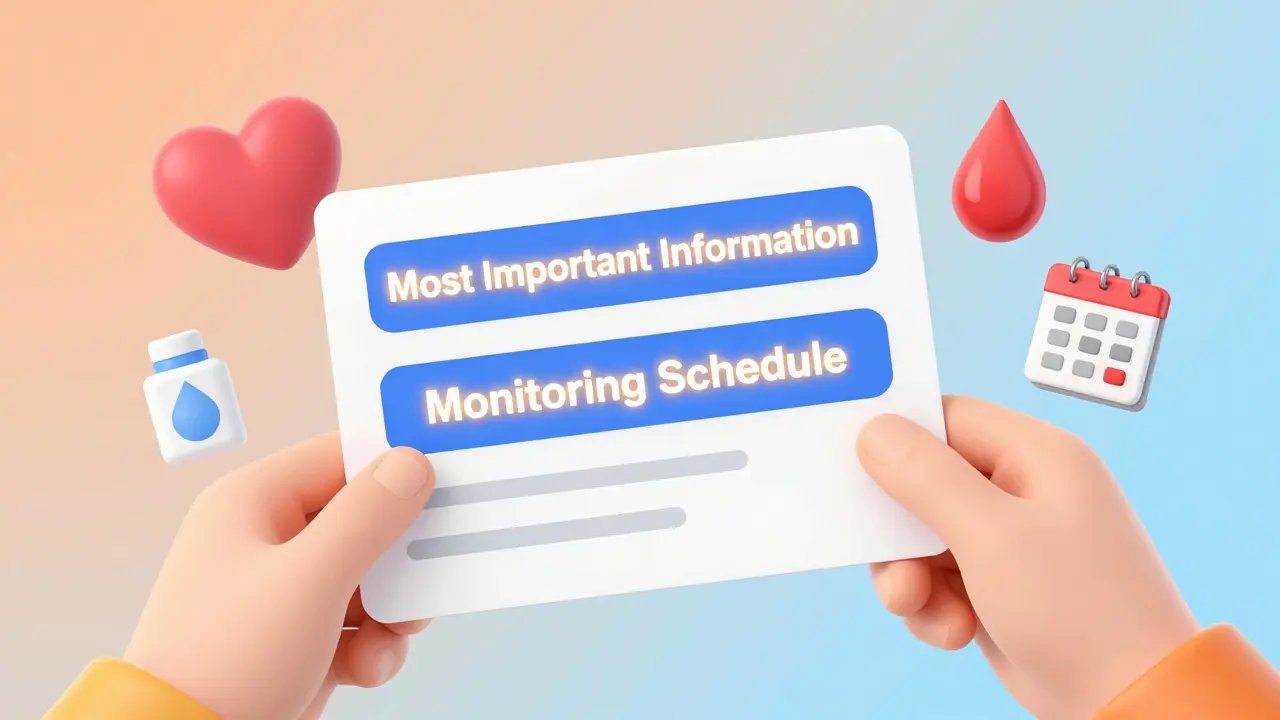
Start with the 'Most Important Information' Section
This is the first thing you should read. It’s usually bolded and placed right at the top. This section tells you the one or two things that could kill you if you ignore them. For example, the clozapine guide says: "About 1 in 200 people taking clozapine may develop a condition called agranulocytosis." That’s not "may cause low white blood cells." It’s a clear, numbered risk. The antidepressant guides warn: "Pay close attention to any changes, especially sudden changes, in mood, behavior, thoughts, or feelings." This isn’t vague. It’s specific. And it’s timed-risk is highest in the first 4 to 6 weeks after starting or changing the dose.
Don’t skip this part because it feels scary. It’s here to help you act early. If you see a warning like "can cause serious liver damage" or "may lead to life-threatening heart rhythm changes," you need to know what symptoms to watch for next.
Find the Monitoring Schedule-It’s Hidden in Plain Sight
The next thing you need is the monitoring plan. This isn’t always in one spot. You have to connect two sections: "What are the possible or reasonably likely serious side effects?" and "How should I take this medicine?"
Look for words like test, monitor, check, or measure. The warfarin guide says: "Your healthcare provider should check your INR at least once a month. If your dose is changed, check it more often." The abiraterone guide says: "Blood tests should be done before you start and every 3 months while taking this medicine." These aren’t suggestions. They’re requirements.
Some guides even give you exact timing: "Get a blood test before your first dose," or "Check your liver enzymes every 2 weeks for the first 3 months." Write these dates down. Set phone reminders. Missing a test can mean missing a warning sign.
Know Who Should Not Take the Medicine
This section answers: "Could this drug hurt me more than help?" It lists contraindications-conditions or meds that make this drug dangerous. For example, if you have severe liver disease, you might be told not to take certain antidepressants. If you’ve had a past allergic reaction to a similar drug, it will say so.
Don’t assume your doctor already checked this. Sometimes, new conditions develop after you start a drug. Or you start taking something new, like an over-the-counter painkiller, and it interacts. Always re-read this section every time you refill your prescription.
Spot the Red Flags-These Phrases Mean Action Needed
There are seven phrases in Medication Guides that should trigger immediate attention:
- "Get blood tests regularly"
- "Call your doctor immediately if..."
- "Do not stop taking without talking to your doctor"
- "Avoid sunlight exposure"
- "Do not drink alcohol"
- "May impair driving ability"
- "Keep all scheduled appointments"
These aren’t suggestions. They’re safety rules. If your guide says "call your doctor immediately if you notice unusual bruising or bleeding," don’t wait until tomorrow. Do it now. That’s how serious it is.
Use the Traffic Light System to Understand Symptoms
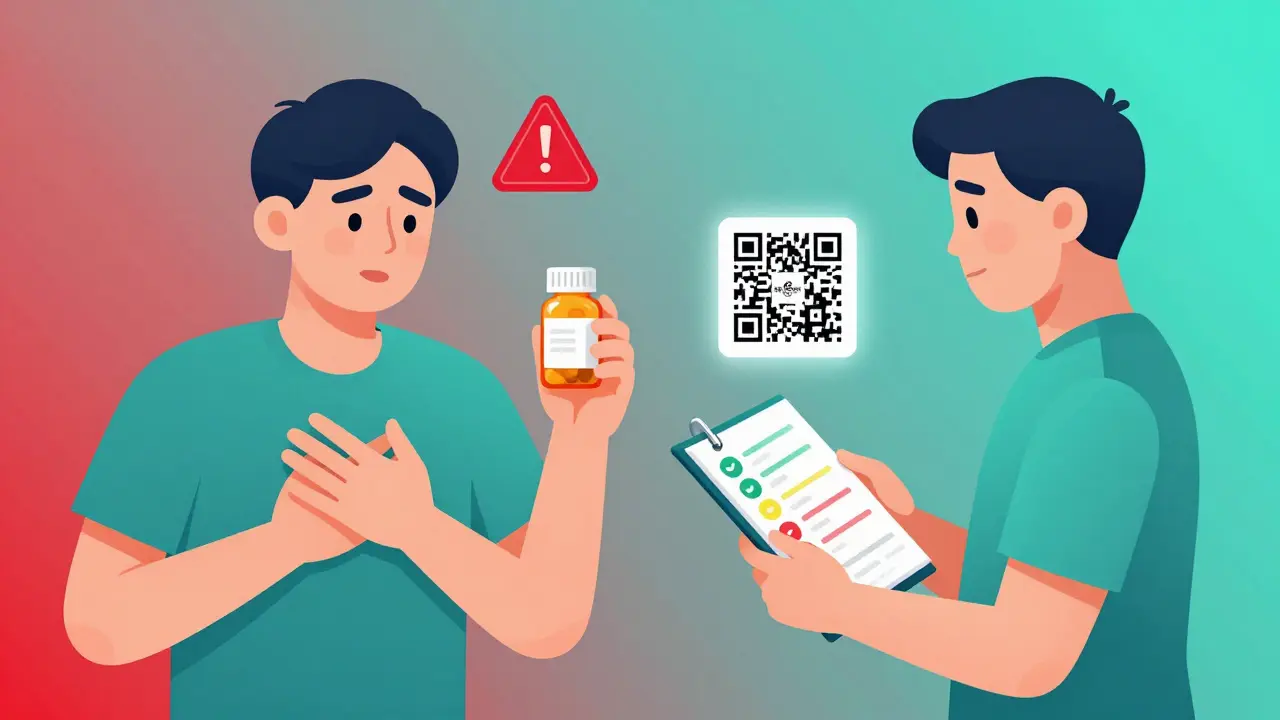
Many patients get overwhelmed by long lists of side effects. A simple trick works better: divide symptoms into three groups.
- Green: Normal, expected side effects-like mild nausea or drowsiness. These usually fade.
- Yellow: Warning signs that need monitoring-like a slight rise in liver enzymes, or occasional dizziness. Call your doctor within 24 hours.
- Red: Emergency signs-like chest pain, confusion, swelling in the throat, or black stools. Go to the ER or call 999 immediately.
Pharmacists report that patients who use this system are 55% more likely to follow their monitoring plan. You don’t need to memorize every side effect. Just know what’s normal, what’s a warning, and what’s an emergency.
Check for Updates-Your Guide Isn’t Static
Medication Guides aren’t printed once and forgotten. The FDA requires manufacturers to update them within 30 days of any new safety info. In 2022, 92% of guides were updated-up from 85% the year before.
That means the guide you got last month might be outdated. Always check the date on the guide. If it’s older than 6 months, ask your pharmacist for the latest version. You can also find current guides on DailyMed, the NIH’s official database. Search by drug name-you’ll get the exact, up-to-date version.
Use the 3-2-1 Method to Stay on Top of Your Medication
Here’s a simple routine that works:
- 3 minutes: Read the guide before you take your first dose. Don’t wait until you feel sick.
- 2 minutes: Review it every time you refill. Things change. Your body changes.
- 1 minute: During treatment, check for new warnings. Look for a "Last Updated" date. If it changed, read the new version.
Patients who follow this method have 68% fewer adverse events, according to a University of Michigan study. It doesn’t take much time. But it saves lives.

What If Your Pharmacy Doesn’t Give You the Guide?
By law, your pharmacy must give you a Medication Guide every time you fill a prescription that requires one. But audits show 41% of independent pharmacies fail to do this consistently.
If you don’t get one, ask for it. Say: "I need the FDA Medication Guide for this drug. It’s required by law." If they say they don’t have it, ask them to order it from their wholesaler. You can also download it yourself from DailyMed and bring it in. Your safety isn’t optional.
Why This Matters More Than You Think
The FDA found that patients who followed their Medication Guide’s monitoring instructions had 32% fewer serious side effects. That’s not a small number. It means thousands of hospitalizations and deaths are preventable.
And it’s getting more important. By 2025, the FDA will require Medication Guides for 127 drugs-up from 42. New rules will include QR codes on packaging that link directly to the guide, and pictograms to help people with low health literacy understand monitoring schedules.
But technology won’t fix everything. As one doctor wrote in JAMA, "Without standardized health literacy assessments, 40% of the U.S. population will still struggle to understand these guides." That’s why your effort matters. You have to read them. You have to ask questions. You have to act.
Final Tip: Keep a Medication Journal
Write down:
- When you started the drug
- What the guide says to monitor
- When your next blood test or appointment is
- Any symptoms you notice
Bring this journal to every doctor visit. It turns you from a passive patient into an active partner in your care. And that’s the whole point of the Medication Guide-to give you the power to protect yourself.
Are Medication Guides the same as the package insert?
No. The package insert is written for doctors and contains technical data like pharmacokinetics and clinical trial results. Medication Guides are for patients. They’re written in plain language, focus only on serious risks, and are legally required only for drugs with life-threatening or preventable side effects.
What if I don’t understand part of the guide?
Don’t guess. Ask your pharmacist or doctor. Point to the section you’re confused about and say, "I need help understanding this." Pharmacists are trained to explain these guides. Many offer free 5-minute consultations just for this purpose. You have the right to understand your medication.
Can I rely on my phone app or online summary instead?
No. Apps and websites often simplify or miss critical details. Only the official FDA-approved Medication Guide has the legally required risk and monitoring info. Use apps as a reminder tool, but always check the official guide for accuracy. Download it from DailyMed if you lose the paper copy.
Why do some guides feel harder to read than others?
Some guides are better written than others. Cancer drug guides often use complex terms because the conditions are complex. But even those should follow FDA rules: 6th-8th grade reading level, bold headers, 10-point font minimum. If it feels overwhelming, ask your pharmacist to walk you through the key sections. You don’t need to read every word-just the risk and monitoring parts.
Is it really necessary to read the guide every time I refill?
Yes. Your body changes. Other meds you take may change. New safety data may have been added. A guide updated last month might now say "avoid grapefruit juice" or "check kidney function monthly"-something that wasn’t there before. Re-reading takes 2 minutes. Skipping it could cost you your health.
Next Steps: Make This a Habit
Start today. Take the next prescription you get. Don’t put the guide in your purse or pocket. Put it on your nightstand. Read it before you take your first pill. Write down the monitoring dates. Set a reminder on your phone. Talk to your pharmacist. This isn’t about being paranoid. It’s about being smart.
Medication Guides exist because people have died from side effects that could have been caught early. You don’t need to be a doctor to save your own life. You just need to read the paper they gave you-and act on it.
about author

Jay Ara
Just read my warfarin guide for the first time after 3 years on it. Turns out I was supposed to get INR checked monthly. My doctor never told me. I’m lucky I didn’t bleed out.
Michael Bond
This is the most important thing I’ve read all year.
Kuldipsinh Rathod
My mom died because she never read these. I make sure everyone in my family reads theirs now. No excuses.
Zina Constantin
I work in pharmacy and I can’t tell you how many people hand me back a script and say, "I didn’t get a guide." I hand them the FDA link on the spot. It’s not optional. It’s not a suggestion. It’s your legal right to know what could kill you-and how to stop it. If you’re not reading these, you’re gambling with your life. And honestly? That’s not bravery. It’s negligence.
I’ve seen people ignore "call your doctor immediately if you notice bruising" and show up in the ER with internal bleeding. I’ve seen patients stop their antidepressants because they felt "better" and crash into suicidal ideation. These aren’t scary stories to scare you-they’re real outcomes that happen every day because people think they’re too busy to read a few paragraphs.
The 3-2-1 method? That’s not a hack. That’s a survival protocol. Three minutes before your first dose. Two minutes every refill. One minute checking for updates. That’s less time than it takes to scroll through TikTok. And yet, people will spend 20 minutes debating whether oat milk is better than almond milk but won’t spend 60 seconds reading the one document that could save them from organ failure.
And yes, some guides are poorly written. But that’s not an excuse. Ask your pharmacist to walk you through it. They’re paid to explain this stuff. You don’t need to be a doctor. You just need to care enough to ask.
My cousin took clozapine. She didn’t read the guide. Didn’t get her WBC checked. Ended up in ICU for three weeks. She’s fine now. But she’ll never forget it. And neither will I.
Don’t wait until you’re hospitalized to start reading. Start today. Print it. Tape it to your mirror. Set a calendar alert. Make it a ritual. Because your life isn’t a suggestion. It’s a requirement.
SHAKTI BHARDWAJ
Ugh why do they make these so long?? Like who has time?? My doctor just gives me the pill and says "take it" and that’s it. I’m not a nurse.
carissa projo
There’s something deeply human about this-the idea that our survival hinges on reading a tiny, folded paper we’re handed like a receipt. We’re taught to trust doctors, to trust science, to trust the system… but then we’re handed a document that says, "You are the last line of defense," and we’re expected to just… absorb it? No training. No test. No follow-up. Just a piece of paper and a prayer.
I used to think these guides were bureaucratic noise. Then my sister started on an immunosuppressant after her transplant. I read the guide with her. We highlighted the red flags. We set phone alarms for her monthly liver tests. She didn’t know what "transaminitis" meant-but she knew to call if her eyes turned yellow. That’s all she needed. That’s all any of us need.
These guides aren’t about intelligence. They’re about intention. They’re not written for the educated elite. They’re written for the exhausted single mom who works two jobs. The veteran who can’t afford to miss a day of work. The teenager on ADHD meds who just wants to feel normal. They’re written for people who don’t have time to be experts… but still deserve to live.
So if you’re reading this and thinking, "I don’t have time," ask yourself: What’s more important? Your 10 minutes of scrolling… or your next birthday?
And if you’re a provider-stop assuming people read these. Ask them. Show them. Walk them through it. Make it part of the ritual. Because the guide isn’t just paper. It’s permission. Permission to ask. To notice. To survive.
Matthew Ingersoll
I downloaded the DailyMed app last week. Found three updates to my medication guide I didn’t know about. One said "avoid grapefruit"-I’d been eating it daily. I stopped. No symptoms yet. But I’m alive.
Angela Spagnolo
I… I didn’t know they were legally required… I thought they were just… marketing? I feel so stupid. I’ve been on sertraline for 5 years and never read the guide. Now I’m scared to look… but I’m going to. Right now.
Dan Alatepe
Back home in Nigeria, we don’t even get these papers. We just get the bottle and a smile. I wish someone had told me this sooner. I’m sending this to my sister in Lagos.
josue robert figueroa salazar
Yeah right. Like anyone reads these. People are dumb. They’ll take anything the doctor gives them. This post is just virtue signaling.
jesse chen
I printed out the traffic light system and taped it to my pillbox. Green: nausea, okay. Yellow: dizziness, call doc. Red: chest pain, 911. I haven’t missed a dose since.
david jackson
Let’s be real-this whole system is broken. The FDA requires these guides because the pharmaceutical companies are selling drugs that are literally lethal to a subset of users, and instead of fixing the root problem-rushing drugs to market without proper long-term studies-they just slap on a 12-page warning label and call it a day. Meanwhile, the average person gets 10 different prescriptions a year. Do you know how many pages of fine print that adds up to? 1,200 pages. 1,200 pages of fear, confusion, and guilt. And then we wonder why people are anxious about medicine. We’ve turned healthcare into a minefield where the only way to survive is to become a full-time legal and medical researcher. This isn’t empowerment. It’s exploitation dressed up as education.
And don’t get me started on the "3-2-1 method." That’s not a solution. That’s a Band-Aid on a severed artery. If your life depends on remembering to check a PDF every time you refill, then the system has already failed you. We need better drug safety protocols. We need mandatory health literacy training for prescribers. We need fewer drugs that require these guides in the first place. Not more people reading more paper.
I’m not saying don’t read the guide. I’m saying: stop pretending that reading a guide is enough. It’s not. It’s the bare minimum. And we should be ashamed that it’s the only thing standing between someone and death.
Jody Kennedy
I started using the journal method. Wrote down my dates, my symptoms, my questions. Took it to my appointment. My doctor said, "I’ve never had a patient do this." She spent 20 extra minutes with me. I felt seen. For the first time in years.
christian ebongue
lol the FDA makes you read this but doesn’t make the guides actually readable. I got one for my anticoagulant that used the word "thrombosis" 17 times and never explained what it meant. I had to Google it. Thanks, guys.
Sarah Holmes
How dare you suggest that patients bear the burden of understanding lethal pharmaceutical risks? This is not empowerment-it is the grotesque abdication of medical responsibility. The FDA mandates these guides because the drug industry has systematically failed to ensure safety, and now they offload the moral and cognitive labor onto the most vulnerable: the sick, the elderly, the undereducated, the overworked. You speak of "lifelines," but this is a lifeboat with holes in it, handed to a drowning man and told to paddle harder. Where is the accountability for the manufacturers who design drugs with narrow therapeutic windows? Where is the enforcement of physician education? Where is the funding for plain-language translation services? You praise the "3-2-1 method" as if it were a moral triumph, when it is merely the desperate improvisation of a system that has abandoned its duty. This is not patient advocacy. This is patient exploitation dressed in the clothing of responsibility.