
Biosimilars vs Generics: Key Differences Explained Clearly
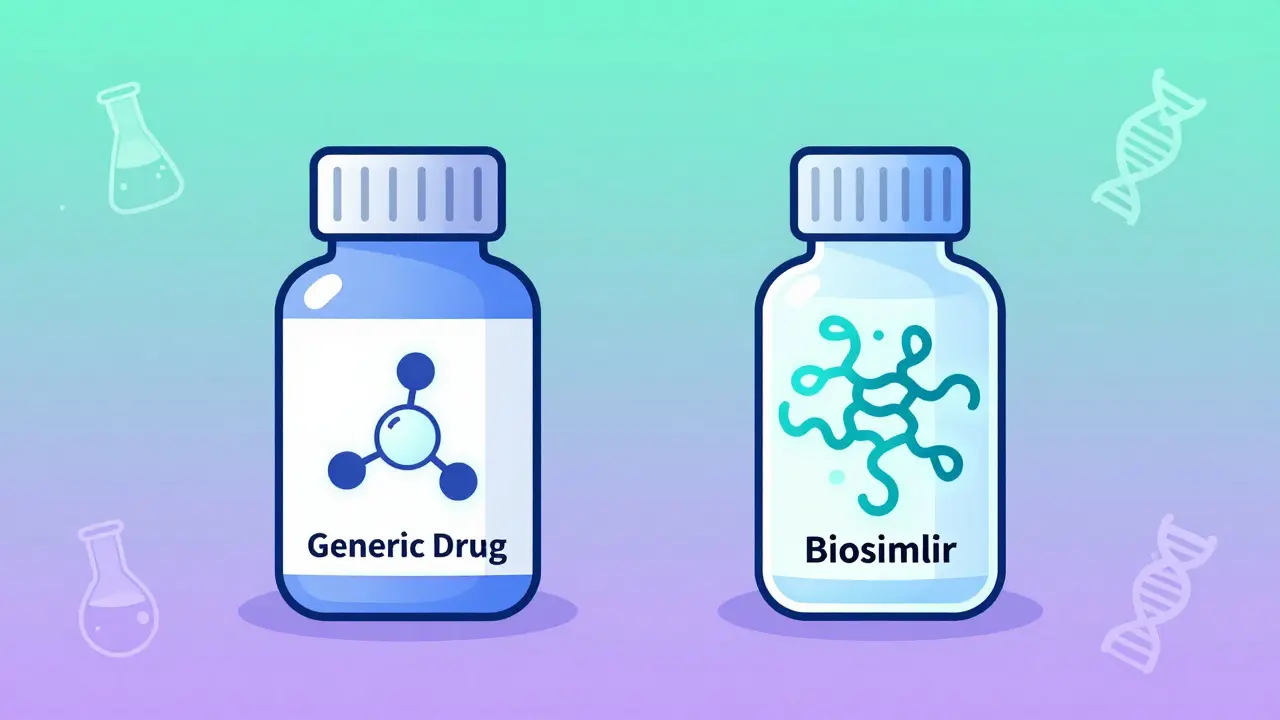
When you hear "generic drug," you probably think of a cheaper version of a brand-name pill-same active ingredient, same effect, same safety. But when someone mentions "biosimilar," it’s not the same story. Many people assume biosimilars are just generics for fancy injectable drugs. That’s not true. And confusing them can lead to misunderstandings about cost, safety, and how your treatment works.
What Are Generics?
Generics are the original workhorses of affordable medicine. They’re small-molecule drugs made from simple chemical compounds. Think ibuprofen, metformin, or amoxicillin. Once the patent on a brand-name drug expires, other companies can make exact copies. The FDA doesn’t require them to repeat expensive clinical trials. Instead, they just need to prove they deliver the same amount of active ingredient into your bloodstream at the same rate as the original. That’s called bioequivalence. If a generic drug absorbs 80% to 125% as much as the brand, it’s approved.
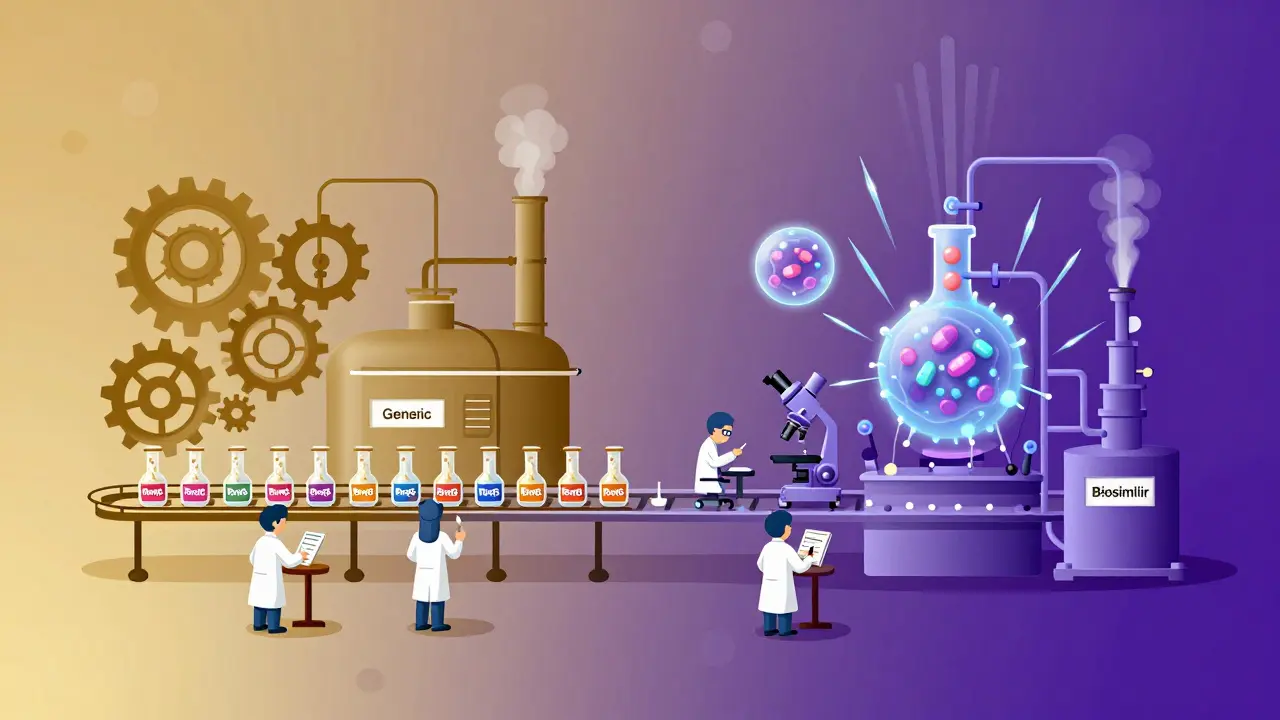
Because the chemistry is straightforward, manufacturers can replicate the formula perfectly. The result? A pill or capsule that’s chemically identical to the brand. No surprises. No variability. That’s why pharmacists can swap a brand for a generic without asking your doctor-this is called automatic substitution, and it’s legal in every U.S. state.
Over 90% of prescriptions filled in the U.S. are for generics. Yet they make up only about 20% of total drug spending because they’re so cheap-typically 40% to 50% less than the brand-name version. A 30-day supply of generic lisinopril might cost $4. A brand-name version? $100 or more.
What Are Biosimilars?
Biosimilars are different. They’re not copies. They’re highly similar versions of biologic drugs. Biologics aren’t made in a lab with chemicals. They’re grown inside living cells-yeast, bacteria, or animal cells. These are complex proteins, often antibodies, that target specific parts of the immune system. Examples include Humira (adalimumab), Enbrel (etanercept), and Herceptin (trastuzumab).
Because they’re made by living cells, no two batches are exactly alike. Even the original manufacturer can’t make them identical every time. That’s why a biosimilar doesn’t need to be identical-it just needs to be "highly similar" with no clinically meaningful differences in safety, purity, or potency. The FDA requires biosimilar makers to run dozens of tests: structural analysis, functional assays, animal studies, and sometimes small clinical trials. The goal? Prove that switching from the original to the biosimilar won’t change how you respond.
It’s not easy. Developing a biosimilar costs $100 million to $200 million-up to 50 times more than making a generic. That’s why biosimilars don’t save as much. They’re usually 15% to 20% cheaper than the brand, though some reports show savings as high as 33%. Still, that’s far less than what generics offer.
Why Can’t Biosimilars Be Like Generics?
Imagine trying to copy a handmade silk scarf. You can’t just reverse-engineer it. You need to know the exact type of silk, the weave, the dye, the humidity during production. Even then, your version will look slightly different. That’s biosimilars. The original biologic is grown in a cell line under tightly controlled conditions. The biosimilar maker doesn’t know those exact conditions. They have to reverse-engineer the whole process from scratch.
Compare that to generics. Aspirin is acetylsalicylic acid. One formula. One synthesis path. One molecule. No living cells. No variability. Just chemistry.
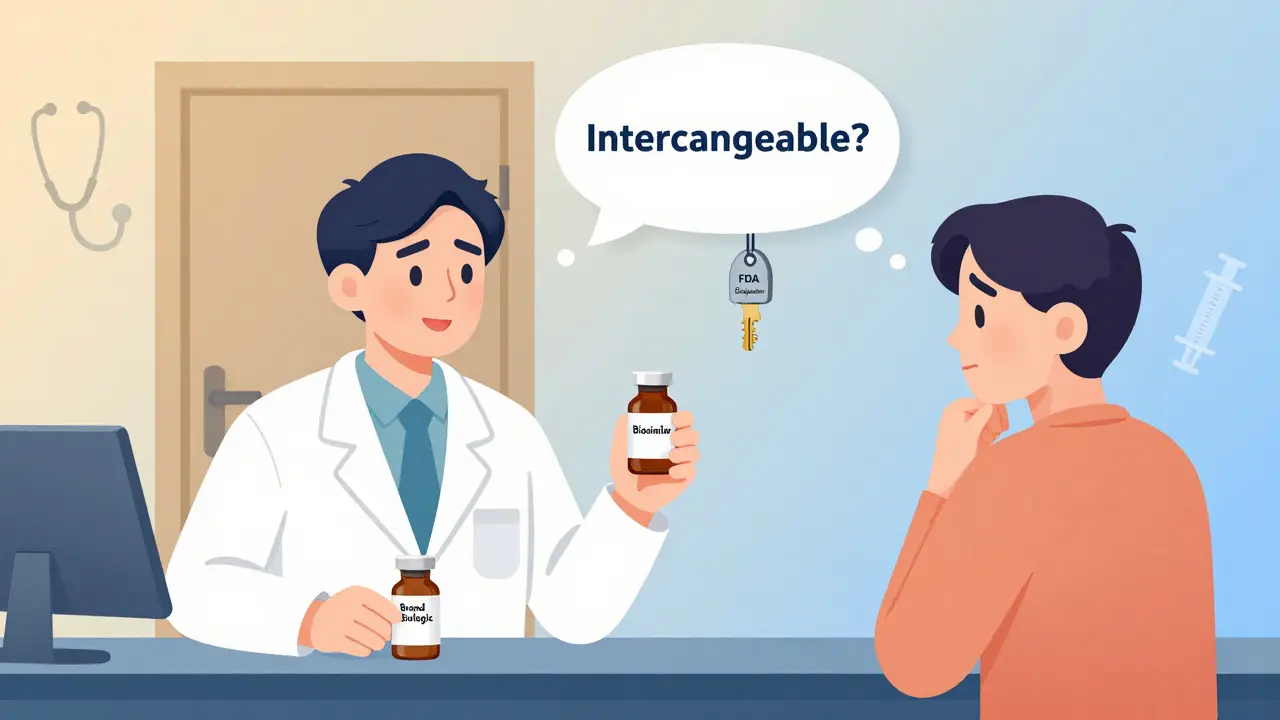
This complexity also means biosimilars can’t be automatically swapped at the pharmacy. Only one type of biosimilar-called "interchangeable"-can be substituted without a doctor’s approval. As of 2023, only 7 out of 42 FDA-approved biosimilars have this status. The rest require a prescriber to specifically order them. Why? Because of potential immune reactions. Even tiny differences in protein structure can trigger antibodies in some patients, especially with long-term use.
Regulatory Paths: Two Different Rules
Generics follow the Hatch-Waxman Act of 1984. Biosimilars follow the Biologics Price Competition and Innovation Act (BPCIA) of 2009. These aren’t just different laws-they’re different philosophies.
For generics: prove bioequivalence through blood tests. Done.
For biosimilars: prove similarity through structural analysis, functional testing, immunogenicity studies, animal trials, and often human pharmacokinetic studies. It’s a multi-step, multi-year process.
The FDA tracks generics in the "Orange Book" and biosimilars in the "Purple Book." The Purple Book is less detailed because the science is harder to summarize. You can’t just list a molecular weight and call it a day.
Market Impact and Adoption
Generics are everywhere. They’re in community pharmacies, mail-order services, and hospital formularies. They’re the default.
Biosimilars? Still finding their footing. As of 2023, they made up less than 3% of the U.S. biologics market. Why? Several reasons:
- Manufacturers of original biologics, like AbbVie with Humira, used patent thickets-hundreds of minor patents-to delay competition for years.
- Some doctors are hesitant to switch patients already stable on a biologic, fearing immune reactions.
- Payers and providers sometimes face "buy-and-bill" reimbursement rules that make it financially easier to keep using the expensive brand.
But change is coming. The first interchangeable biosimilar for Humira, Amjevita, hit the market in January 2024 with a 35% price cut. More are on the way. By 2028, analysts predict biosimilars could capture 25-30% of the U.S. biologics market.
In Europe, biosimilars are already mainstream. They make up 35% of the biologics market there. Why? Better reimbursement policies and more aggressive substitution rules.
What This Means for You
If you’re taking a generic drug-like metformin for diabetes or atorvastatin for cholesterol-you can expect it to work exactly like the brand. You can switch between generic brands without issue.
If you’re on a biologic-like a drug for rheumatoid arthritis, Crohn’s disease, or cancer-you might soon see a biosimilar option. But here’s what to know:
- Don’t assume your pharmacist can swap it without your doctor’s OK.
- If you’re stable on your current biologic, switching to a biosimilar should be done carefully, with monitoring.
- Biosimilars are not "second-rate." They’re rigorously tested. But they’re not identical. And that matters.
- Cost savings are real-but not as deep as with generics.
The bottom line? Generics are simple copies. Biosimilars are sophisticated imitations. Both save money. But only one is truly interchangeable. Understanding the difference helps you ask the right questions-of your doctor, your pharmacist, and your insurer.
Common Misconceptions
"Biosimilars are just generics for biologics." No. They’re not. They’re a whole different category.
"If a biosimilar is approved, it’s safe to switch anytime." Not always. Only interchangeable biosimilars can be swapped without a doctor’s order.
"Biosimilars are less effective." False. The FDA requires them to perform just as well as the original in clinical trials.
"All biosimilars are the same." No. Each one is developed separately. Some are more similar to the original than others.
Are biosimilars safe?
Yes. The FDA requires biosimilars to undergo extensive testing to prove they are "highly similar" to the original biologic with no clinically meaningful differences in safety, purity, or effectiveness. Post-market monitoring is also required, just like for brand-name biologics. Thousands of patients have used biosimilars without increased safety risks compared to the original products.
Can I switch from a biologic to a biosimilar?
It depends. If the biosimilar has been designated as "interchangeable" by the FDA, your pharmacist can switch you without asking your doctor. If not, your prescriber must specifically write the prescription for the biosimilar. For patients already stable on a biologic, switching is often done cautiously and with monitoring-especially for chronic conditions like rheumatoid arthritis or inflammatory bowel disease.
Why are biosimilars more expensive than generics?
Biosimilars are made using living cells, which makes production far more complex than synthesizing a chemical molecule. Developing a biosimilar can cost $100-200 million, compared to $2-5 million for a generic. The testing process is longer, more technical, and requires advanced equipment. That’s why biosimilars save less-typically 15-33%-while generics save 40-50%.
How many biosimilars are approved in the U.S.?
As of November 2023, the FDA has approved 42 biosimilars. Of those, only 7 have received the "interchangeable" designation, meaning they can be substituted at the pharmacy without a doctor’s order. More are expected as patents expire on major drugs like Stelara and Eylea.
Do biosimilars work for the same conditions as the original biologics?
Yes, but not always automatically. Biosimilars can be approved for all the same uses as the reference product through a process called "extrapolation." This means if a biosimilar works for one condition, regulators may allow its use for others based on scientific evidence. However, some providers remain cautious about extrapolation, especially for conditions with different immune responses.
about author

Alex Arcilla
yo so biosimilars are basically like trying to clone a dog but the clone has a slightly different bark? lol. i get it’s science but damn if that ain’t wild. my cousin’s on humira and they switched her to a biosimilar and she’s fine… but i still wouldn’t trust it without a second opinion. 🤷♂️
Caroline Dennis
From a pharmacokinetic standpoint, the heterogeneity of biologic manufacturing introduces stochastic variability that precludes true bioequivalence. Hence, the FDA’s ‘highly similar’ threshold isn’t a loophole-it’s a necessity. The 15–20% cost differential reflects R&D complexity, not inferiority.
Zola Parker
Wait so you’re telling me the FDA is basically saying ‘eh, close enough’ for drugs that cost $10,000 a year? 😂 I’m all for savings but if my body starts rejecting a drug because the protein folded wrong in batch #472, who’s liable? The pharmacist? The CEO? The guy who fed the yeast? 🤔
Jefferson Moratin
The distinction between chemical simplicity and structural complexity is not merely technical-it is ontological. Generics replicate identity; biosimilars approximate similarity. The former is a mirror; the latter, a shadow. This is why substitution without prescriber involvement constitutes an epistemological risk.
Katie Putbrese
Why are we even allowing this? In Europe they’re already using biosimilars like they’re candy. We’re letting foreign regulatory standards dictate our healthcare? This is how we lose medical sovereignty. The FDA’s ‘highly similar’ is just a fancy way of saying ‘good enough for your grandma but not for my kid.’
peter vencken
bro i work in a pharmacy and let me tell u-most patients dont even know what biosimilar means. we just swap it if its labeled interchangeable. if not? we call the doc. simple. no drama. people panic over nothing. 🤷♀️
Darlene Gomez
Hey, I just want to say-this whole thread is actually really helpful. I’ve been on a biologic for 7 years and I was terrified to even consider switching. But reading this? It’s not about fear. It’s about informed choice. If your doctor’s cool with it and it’s FDA-approved? That’s a win. We don’t need to fear science-we need to understand it. 💙
florence matthews
Just moved from Germany to the US and the difference in biosimilar access is night and day. Here, it’s like asking for permission to breathe. Over there? Pharmacies swap them like soda flavors. We’re not ‘behind’-we’re stuck in a profit maze. 🇩🇪➡️🇺🇸
Chris Crosson
So if biosimilars are so rigorously tested, why does the Purple Book look like a messy Excel sheet? And why do docs still hesitate? Is it fear? Or just lazy habits? Asking for a friend… who’s paying $8K/month for a drug that could be $6K.
Chris Farley
Generics? American innovation. Biosimilars? Foreign copycats with a fancy name. We’re letting Big Pharma and EU bureaucrats rewrite our rules just to save a few bucks. This isn’t progress-it’s surrender. Stick with the brand. Your life isn’t a cost-cutting experiment.
Linda Foster
Thank you for this thorough and meticulously structured explanation. The regulatory distinctions between Hatch-Waxman and BPCIA are not merely procedural-they are foundational to patient safety and pharmaceutical integrity. I commend the clarity with which this topic has been presented.