
TNF Inhibitors and Cancer Risk: What Patients Need to Know About Biologics and Immunosuppression

TNF Inhibitor Cancer Risk Comparison Tool
Understand the relative skin cancer risk associated with different TNF inhibitors based on current medical evidence. This tool helps you compare risks and learn effective risk management strategies.
Your Risk Profile
When you’re living with rheumatoid arthritis, psoriatic arthritis, or inflammatory bowel disease, the pain and fatigue can feel endless. Then comes a TNF inhibitor-medications like adalimumab, etanercept, or infliximab-and suddenly, you can walk again, sleep through the night, or go back to work. But then you hear the whisper: Could this raise my cancer risk? It’s a real fear. And it’s not just a scare tactic. There’s data. But the story isn’t as simple as ‘biologics cause cancer.’
What Are TNF Inhibitors, Really?
TNF inhibitors are a type of biologic drug that blocks tumor necrosis factor-alpha, a protein your body makes to fight infection. In autoimmune diseases, your immune system goes rogue and attacks your own joints, skin, or gut. TNF-alpha is one of the main drivers of that attack. By shutting it down, these drugs calm inflammation. That’s the goal.
Five TNF inhibitors are approved in the U.S.: infliximab (Remicade), etanercept (Enbrel), adalimumab (Humira), certolizumab pegol (Cimzia), and golimumab (Simponi). They’re not pills. You inject them under your skin or get them through an IV. Dosing varies-some weekly, some every few weeks. And they’re expensive: $4,500 to $6,500 a month, with annual costs averaging $62,000. But for many, the trade-off is worth it.
They work differently too. Adalimumab, infliximab, and golimumab are monoclonal antibodies-they latch onto TNF-alpha like a key in a lock. Etanercept is a fusion protein that soaks up excess TNF. Certolizumab is a smaller fragment, designed to last longer. These differences matter-not just for how they work, but for safety.
The Cancer Fear: Where Did It Come From?
The concern started in the early 2000s. Early clinical trials hinted at a possible rise in lymphoma and skin cancers. In 2008, the FDA added a black box warning to all TNF inhibitors: May increase risk of lymphoma and other malignancies. That warning stuck. And patients heard it loud and clear.
But here’s the twist: the same patients who got these drugs were already at higher cancer risk. Rheumatoid arthritis itself increases lymphoma risk by 1.5 to 2 times. Chronic inflammation? It’s a cancer promoter. So when someone with RA gets cancer after starting a TNF inhibitor, is it the drug-or the disease?
Large, long-term studies have tried to untangle this. The 2022 Swedish ARTIS registry followed over 15,000 RA patients for up to 12 years. The result? No overall increase in cancer risk with TNF inhibitors compared to older, non-biologic drugs. The hazard ratio was 0.98-essentially no difference.
But the data gets messy when you look closer. Adalimumab showed a small, temporary spike in cancer risk during the first year-1.6 times higher. Etanercept, meanwhile, showed no increase. In fact, it was linked to a slightly lower risk than patients who never took biologics. Why? Maybe because etanercept doesn’t bind to transmembrane TNF as tightly as antibodies do. Maybe it’s just biology. But the pattern is real.
What About Skin Cancer?
This is where patients worry the most. A 2021 meta-analysis of over 32,000 psoriasis patients found a 32% higher rate of non-melanoma skin cancer (NMSC)-mainly basal cell and squamous cell carcinomas-with TNF inhibitors. But no increase in melanoma, lung, breast, or colon cancer.
And here’s the kicker: the risk isn’t the same across drugs. A 2021 British Journal of Dermatology study found adalimumab carried a 1.3 times higher risk of NMSC than etanercept. That’s not huge, but it’s enough for dermatologists to take notice.
Real-world data backs this up. A 2022 analysis of 478 posts on the Rheumatology subreddit showed 63% of patients feared skin cancer. Nearly a third reported a dermatologist finding a basal cell carcinoma during treatment. That’s not rare. It’s common enough that the National Psoriasis Foundation now recommends skin checks every six months for anyone on TNF inhibitors.
But here’s what patients don’t hear often: most of these cancers are caught early, treated with a simple office procedure, and never come back. The risk isn’t about dying from skin cancer-it’s about having to live with more doctor visits, more biopsies, more anxiety.
What If You Already Had Cancer?
This is the hardest question. What if you had breast cancer five years ago? Or melanoma two years ago? Can you still take a TNF inhibitor?
The 2023 American College of Rheumatology guidelines say: wait five years after high-risk cancers (like lymphoma or melanoma). For low-risk cancers-breast, prostate, colon, or early-stage skin cancer-two years is enough. That’s not arbitrary. It’s based on when the risk of recurrence drops sharply.
And here’s the hopeful part: a 2023 study of 1,872 RA patients who developed lung cancer found those on TNF inhibitors had a 42% better survival rate at five years than those on older drugs. Why? Maybe because their inflammation was better controlled. Maybe because they were healthier overall. We don’t know for sure. But the data suggests TNF inhibitors might not just be safe-they could even help.
Eighty-seven percent of rheumatologists in the Corrona registry continue TNF inhibitors in patients with early-stage, treated cancer-after talking to their oncologist. And 92% of those patients had no cancer recurrence linked to the drug.
Why Do Some Drugs Seem Riskier Than Others?
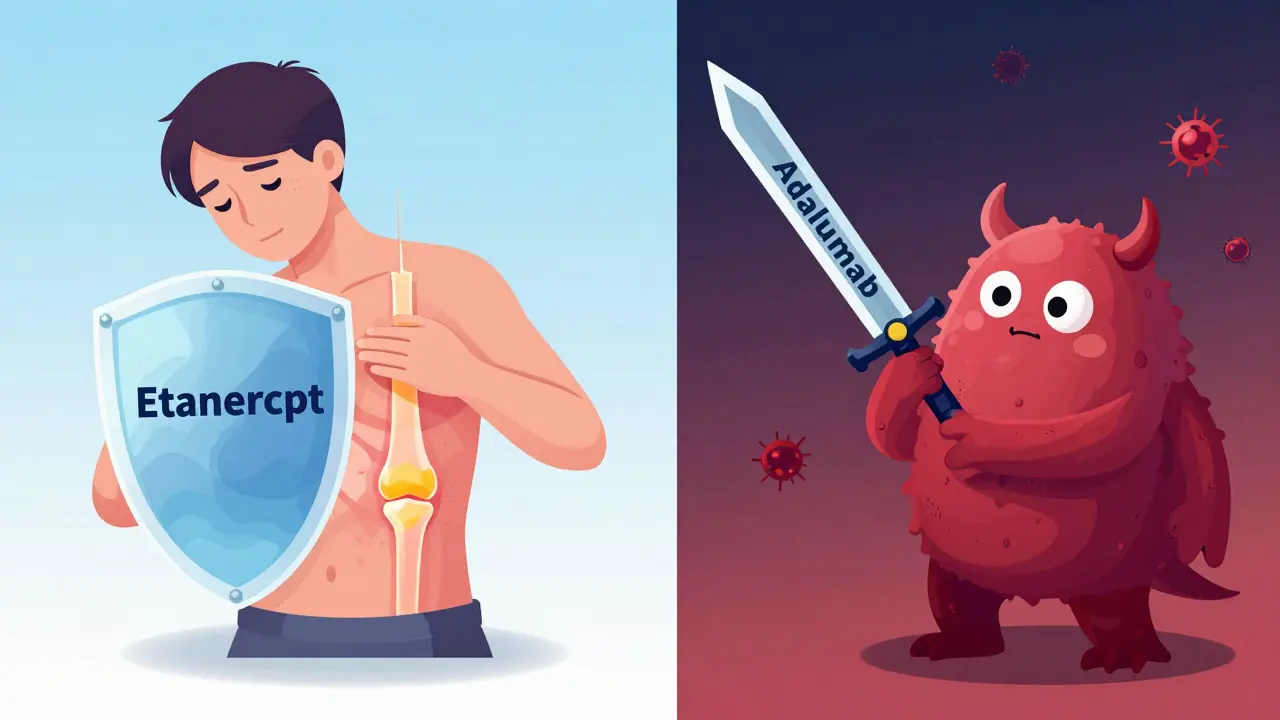
It’s not just about the drug class-it’s about the molecule. Adalimumab, infliximab, and golimumab are full antibodies. They bind tightly to TNF-alpha and can trigger immune cell death in ways etanercept doesn’t. Etanercept is a decoy receptor. It’s gentler. Certolizumab doesn’t even bind to the cell membrane. These differences aren’t just academic-they affect real-world outcomes.
Studies show etanercept has the lowest cancer risk profile among TNF inhibitors. Adalimumab has the highest, especially for skin cancer. That’s why some doctors, especially in Asia, prefer etanercept. It’s also less likely to reactivate latent TB-a big concern in countries with high TB rates.
And then there’s the issue of methotrexate. Many patients take it with TNF inhibitors. Methotrexate itself carries a small cancer risk. When you combine it with a biologic, the effect isn’t just additive-it’s multiplicative. That’s why some studies show higher cancer rates in combo therapy. But when you adjust for methotrexate use, the TNF inhibitor risk drops.

What About Steroids? They’re the Real Culprit
Here’s something rarely discussed: high-dose steroids. If you’re on prednisone at 7.5 mg or more per day, your cancer risk goes up. A lot. Studies show steroid use at that level raises the risk of worse cancer survival by 1.75 to 2.91 times.
That’s worse than any TNF inhibitor. And yet, many patients are on both. Why? Because doctors think the biologic will let them taper the steroid. But it takes time. And in that gap, the steroid is doing the damage.
That’s why the smartest approach isn’t just choosing the right TNF inhibitor-it’s getting off steroids as fast as possible. Many rheumatologists now treat steroid use like a red flag. If you’re on more than 5 mg/day of prednisone for more than three months, they push harder to switch to a biologic or JAK inhibitor.
What’s the Bottom Line?
Let’s cut through the noise.
- TNF inhibitors do not cause cancer in most people.
- Adalimumab carries a slightly higher risk of skin cancer than etanercept.
- There’s no proven increase in lymphoma, breast, or colon cancer.
- For patients with a history of early-stage cancer, TNF inhibitors can often be restarted safely after a waiting period.
- High-dose steroids are far more dangerous than TNF inhibitors when it comes to cancer outcomes.
- Regular skin checks every six months are non-negotiable if you’re on any TNF inhibitor.
The biggest risk isn’t the drug. It’s stopping it out of fear. Patients who quit TNF inhibitors because of cancer worries often end up with worse joint damage, more pain, and higher hospitalization rates. Their quality of life plummets.
And here’s the most important thing: we now have over 20 years of real-world data. The 2022 Annals of the Rheumatic Diseases meta-analysis followed patients for decades. The cumulative cancer risk? No increase. The hazard ratio? 1.02. In plain terms: no difference.
That’s not perfect. But it’s the best we’ve got. And for millions of people, TNF inhibitors didn’t just treat their disease-they gave them their lives back.
What Should You Do?
If you’re considering a TNF inhibitor:
- Get a full skin exam from a dermatologist before starting.
- Ask about your cancer history-especially if you’ve had melanoma, lymphoma, or a solid tumor.
- Discuss whether etanercept might be safer than adalimumab for you.
- Make a plan to get off steroids as quickly as possible.
- Set up skin checks every six months-no exceptions.
- Don’t delay treatment out of fear. The risk of uncontrolled inflammation is real-and often worse than the drug.
If you’re already on one:
- Keep your skin checks. Even if you’ve never had a lesion, you need them.
- Don’t ignore a new mole, bump, or sore that doesn’t heal.
- Talk to your rheumatologist if you’re worried. Don’t just Google it.
- Remember: you’re not alone. Over 1.5 million Americans are on these drugs. Most are doing fine.
Do TNF inhibitors cause cancer?
No, TNF inhibitors do not cause cancer in most people. Long-term studies show no overall increase in cancer risk compared to other arthritis treatments. However, there is a small, temporary increase in non-melanoma skin cancer risk-especially with adalimumab-and a slightly higher risk in the first year after starting. These risks are manageable with regular skin checks and proper patient selection.
Is etanercept safer than adalimumab for cancer risk?
Yes, evidence suggests etanercept has a lower cancer risk profile than adalimumab. Multiple studies, including the 2021 British Journal of Dermatology meta-analysis, show adalimumab is associated with a 1.3 times higher risk of non-melanoma skin cancer. Etanercept has not shown increased cancer risk in large registries and may even be linked to slightly lower rates than no biologic use. For patients with a history of skin cancer, etanercept is often preferred.
Can I take a TNF inhibitor if I’ve had cancer before?
Yes, in many cases. The American College of Rheumatology recommends waiting five years after high-risk cancers like lymphoma or melanoma, and two years after low-risk cancers like breast, prostate, or early-stage skin cancer. After that, most rheumatologists will restart TNF inhibitors after consulting with your oncologist. Studies show that 87% of patients who restart these drugs after cancer treatment have no recurrence linked to the medication.
Do I need to stop TNF inhibitors if I get skin cancer?
Usually not. Most non-melanoma skin cancers (basal and squamous cell) are caught early and removed with a simple procedure. Unless the cancer is aggressive, recurrent, or metastatic, most dermatologists and rheumatologists recommend continuing the TNF inhibitor. Stopping it can lead to a flare of your autoimmune disease, which may be more harmful than the cancer itself. Always discuss this with both your dermatologist and rheumatologist.
Are steroids more dangerous than TNF inhibitors for cancer risk?
Yes, significantly. Steroids like prednisone at doses of 7.5 mg or more per day are linked to a 1.75 to 2.91 times higher risk of worse cancer survival. This risk is greater than any observed with TNF inhibitors. The goal for patients on biologics is to reduce steroid use as quickly as possible-not to avoid the biologic out of fear. Controlling inflammation with a TNF inhibitor often allows you to stop steroids, which is a major win for long-term health.
about author



kabir das
Wait-so adalimumab gives me skin cancer?? But I’ve been on it for 3 years, and my RA is GONE!! I mean, I can finally hold my kid without crying-so… do I just start wearing sunscreen like it’s a full-time job??
Laura Arnal
Yessss!!! 🙌 I’m on etanercept and got my 6-month skin check last week-no lesions, but my derm said ‘keep doing this’-and I will. Also, I ditched prednisone 10 months ago and my energy? Like night and day. You’re not alone, and your skin will thank you. 💪✨
Eli In
As someone who moved from India to the US and had to navigate both healthcare systems-I can say this: the fear around biologics is real, but the data is clearer than most doctors let on. In Delhi, they’d never even consider TNF inhibitors for mild RA. Here? We’re overtreating with steroids. The real villain? Prednisone. Not the drug that gives you your life back. 🌏❤️
Megan Brooks
While the data presented is compelling and largely reassuring, it is critical to acknowledge that individual risk profiles vary significantly. The conflation of population-level hazard ratios with personal clinical decision-making may inadvertently minimize legitimate patient concerns. A nuanced, case-by-case approach-guided by multidisciplinary consultation-is not merely prudent, it is ethically imperative.
Ryan Pagan
Let’s be real-this whole ‘TNF inhibitors cause cancer’ thing is like blaming your toaster for the fire because you left bread in too long. The real arsonist? Chronic inflammation. And steroids? Those are the flamethrowers. Adalimumab? Maybe a spark. Etanercept? A candle. And if you’re still on 10mg of prednisone? You’re basically playing Russian roulette with your pancreas. Get off it. Now.
Paul Adler
It’s fascinating how the narrative shifts depending on who you ask. The data shows minimal risk, yet patient anxiety remains high. Perhaps the issue isn’t the science-it’s the communication. We need clearer, less alarmist messaging from clinicians. Fear doesn’t motivate-it paralyzes.
Robin Keith
But… have we considered the ontological implications of immunosuppression as a metaphysical compromise? If we silence TNF-alpha-this primal scream of the immune system-aren’t we, in essence, silencing the body’s own wisdom? The body doesn’t ‘go rogue’-it responds. And when we pharmacologically erase its signal, aren’t we just… suppressing truth? And isn’t cancer, at its core, a failure of dialogue? Not a failure of drugs?
Sheryl Dhlamini
I got basal cell carcinoma on my nose last year. Was terrified. Thought my TNF inhibitor was going to kill me. Turns out? Dermatologist zapped it in 12 minutes. No chemo. No surgery. Just a little burn. I’m still on Humira. And I still cry when I see my dog run. So… yeah. Don’t stop. Just get checked.
Doug Gray
IMO, the meta-analyses are underpowered. Also, the ‘no increase in lymphoma’ claim ignores latency. And let’s not forget: biologics are just glorified monoclonal antibodies-what happens when they bind to off-target antigens? We don’t know. And the industry doesn’t want us to know. 🤔
LOUIS YOUANES
Look. I’ve been on Humira for 7 years. I’ve had 3 skin biopsies. I’m rich. I could afford to pay for this. But if you’re poor? You’re stuck on steroids. And that’s the real cancer risk. This isn’t about drugs. It’s about who gets to live without pain. And who doesn’t.
DHARMAN CHELLANI
Adalimumab = cancer. Etanercept = safe. Steroids = worse. Done. Stop overthinking. You’re fine. Just check your skin. And stop blaming the drug. It's not the drug. It's the system.