
Medications During Menopause: Understanding Hormone-Related Side Effect Changes
Menopause HRT Risk Calculator
Your HRT Risk Assessment
This tool provides personalized risk estimates based on the Women's Health Initiative study data. Results are not medical advice and should be discussed with your healthcare provider.
Risk Assessment Results
Stroke Risk
Risk: 0/10,000 women
Breast Cancer Risk
Risk: 0/10,000 women
Blood Clot Risk
Risk: 0/10,000 women
Key recommendations
When menopause hits, your body doesn’t just stop having periods-it starts rewiring how it responds to medications. What worked fine before might now cause unexpected side effects, or worse, become risky. This isn’t just about hot flashes or sleepless nights. It’s about how your body now processes hormones, and what happens when you take pills, patches, or creams to replace what you’ve lost.
What Hormone Therapy Actually Does
Menopause hormone therapy (HRT) isn’t one-size-fits-all. It’s designed to replace estrogen-sometimes with progesterone too-because your ovaries stop making them. Estrogen helps regulate body temperature, vaginal health, bone density, and even mood. When it drops, symptoms flood in: hot flashes, night sweats, dry skin, vaginal pain during sex, trouble sleeping, and mood swings. For many women, these aren’t minor inconveniences-they’re life-disrupting.
The most common forms are pills, patches, gels, and vaginal rings. Pills like Duavee a combination of conjugated estrogen and bazedoxifene, approved by the FDA for women with an intact uterus are popular, but not always the best choice. Patches and gels deliver estrogen through the skin, bypassing the liver. This matters because liver processing can increase clotting risks. A 2022 study in BJOG found switching from pills to patches reduced stomach upset and nausea by 60%.
Side Effects You Might Not Expect
Most women assume HRT side effects are just bloating or headaches. But the reality is more complex. About 30-50% of women experience vaginal spotting or bleeding in the first 6 months. It’s not a period-it’s your uterus adjusting. If it lasts longer than 6 months, talk to your doctor. Breast tenderness affects 20-40% of users, often fading after a few weeks. Nausea? That’s common with pills, less so with patches.
Fluid retention is another sneaky one. You might notice swollen ankles or puffy hands. It’s not weight gain-it’s water. About 15-25% of women report this, especially with oral estrogen. Mood changes, including irritability or low mood, happen in 20-25% of users. That doesn’t mean you’re depressed. It means your brain is reacting to changing hormone levels. Gabapentin or SSRIs can help here, even without HRT.
The Real Risks-Not What You See on TV
Let’s cut through the noise. Yes, HRT can increase risks. But not for everyone. The big fear-breast cancer, heart attack, stroke-is real, but the numbers are smaller than headlines suggest.
According to the Women’s Health Initiative a landmark 2002 study that reshaped how doctors view HRT, combination HRT (estrogen + progestin) raised:
- Breast cancer risk by 26%
- Stroke risk by 41%
- Heart attack risk by 29%
- Blood clots in the lungs by 113%
But here’s the catch: these are relative increases. The absolute risk? For every 10,000 women taking HRT for a year:
- 21 get a stroke-now 29
- 30 get breast cancer-now 38
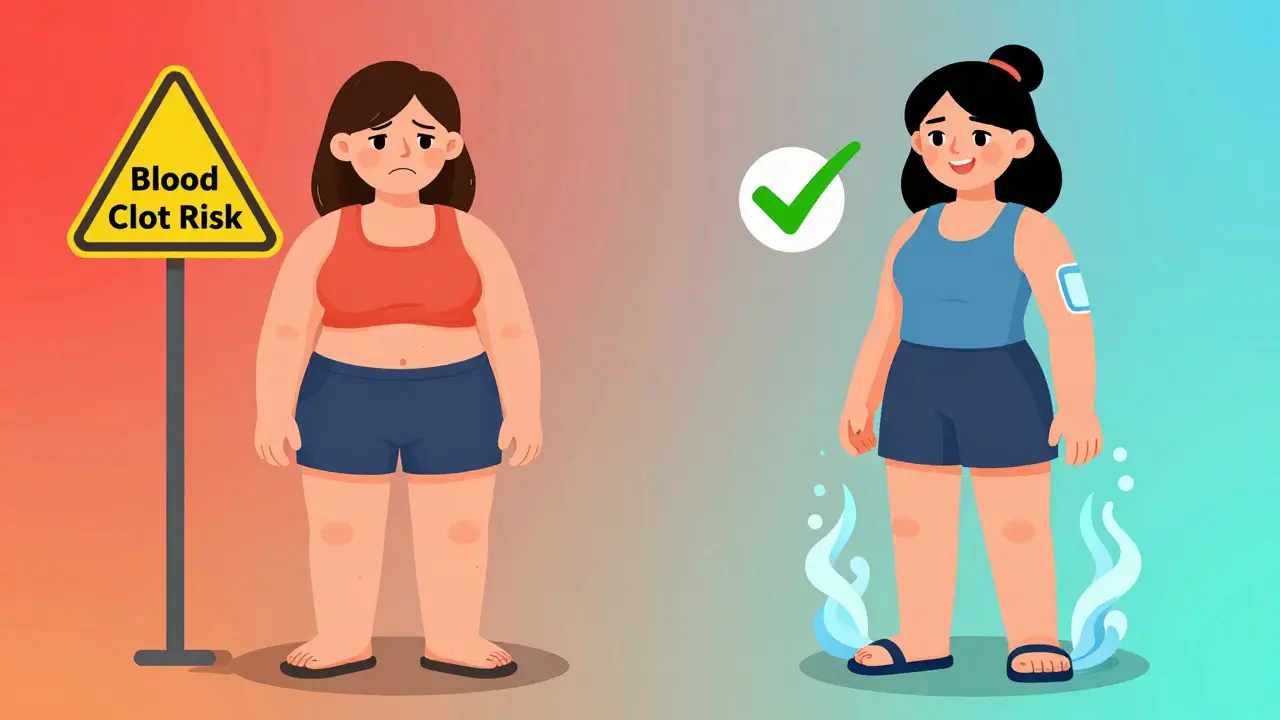
- 4 get a blood clot-now 8
That’s why age matters. If you start HRT before 60 or within 10 years of your last period, your heart health may actually improve. A 2023 editorial in the Journal of Clinical Endocrinology & Metabolism showed early users had a 30% lower risk of coronary disease than those who started later. The window of opportunity? It’s real.
Who Should Avoid HRT Altogether
Not everyone is a candidate. The American College of Obstetricians and Gynecologists (ACOG) says avoid HRT if you have:
- A history of breast cancer
- Endometrial cancer
- Stroke or heart attack
- History of blood clots (like deep vein thrombosis)
- Severe liver disease
If you’ve had a hysterectomy, you can use estrogen-only therapy. No need for progesterone. But if you still have your uterus, you must take progesterone too-or risk endometrial cancer. That’s why combination therapy exists.
Also watch out for interactions. Duavee, for example, can’t be taken with other estrogen or progestin products. About 12% of adverse events in 2022 FDA reports were due to overlapping hormone meds. Always tell your doctor what else you’re taking-even over-the-counter supplements.
Alternatives That Actually Work
You don’t have to take hormones to feel better. Many women find relief without them.
Vaginal dryness? Over-the-counter moisturizers like Replens or lubricants like Sliquid help 45% of women, according to a 2022 National Menopause Foundation survey. The FDA-approved DHEA insert (Intrarosa) improved sexual pain in 70% of users in clinical trials.
Hot flashes? SSRIs like escitalopram reduce hot flashes by 50-60% in 60% of users. Gabapentin cuts them by 45%. Clonidine, a blood pressure med, works too-46% reduction. These aren’t magic, but they’re proven.
What about herbs? Black cohosh? Mixed results. Twelve studies with over 1,800 women showed no consistent benefit. Red clover? No strong evidence. The FDA warns most herbal supplements aren’t tested for safety. Stick to what’s studied.

How to Adjust If Side Effects Hit
If you start HRT and feel awful, don’t quit. Not yet.
Most side effects fade within 3 months. The NHS says: “Carry on for at least 3 months.” If it doesn’t improve, your doctor can help. Options:
- Change the dose-lowering estrogen often reduces breast pain and bloating
- Switch delivery method-patches or gels cut GI side effects by 60%
- Try a different formulation-some progestins (like micronized progesterone) are gentler than synthetic ones
A 2021 study in the Menopause Journal found 68% of women got symptom control just by tweaking their dose. Don’t assume you’re stuck with the first option.
What’s New in 2026
The field is evolving fast. In 2023, the FDA approved fezolinetant-a new drug that blocks a brain signal causing hot flashes. In trials, it cut moderate-to-severe hot flashes by over 50%. It’s not hormone-based, so it’s safe for women with breast cancer history.
Low-dose vaginal estrogen is now preferred over systemic therapy for dryness. It doesn’t raise cancer or clot risks because almost none enters the bloodstream. And new patches with timed-release estrogen are reducing peak levels that trigger side effects.
What’s next? Personalized hormone therapy. Blood tests to measure your estrogen metabolism, genetic screens for clotting risks, and AI tools to match your symptoms with the safest treatment. The future isn’t one-size-fits-all-it’s one-size-fits-you.
What to Do Next
If you’re considering HRT:
- Know your numbers-blood pressure, cholesterol, family history of cancer
- Track your symptoms for 2 weeks-when do hot flashes hit? What makes them worse?
- Ask your doctor: “Is my risk higher because of my age or health history?”
- Start low, go slow-lowest effective dose for shortest time
- Don’t be afraid to switch-patches over pills, lower estrogen, different progestin
Menopause isn’t a disease. But it can make daily life hard. The right medication can change that. The wrong one? It can make things worse. You don’t need to suffer. You don’t need to guess. You just need the right info-and the right doctor.
Can I take HRT if I’ve had breast cancer?
No. Hormone therapy is not safe for women with a history of estrogen-sensitive breast cancer. Even low-dose or local estrogen (like vaginal creams) is generally avoided. Non-hormonal options like SSRIs, gabapentin, or fezolinetant are safer alternatives for managing hot flashes in this group.
How long should I stay on HRT?
There’s no fixed timeline. Most women take it for 2-5 years to manage symptoms. If symptoms return after stopping, you can restart at the lowest dose. The key is using it only as long as needed. For women under 60 or within 10 years of menopause, the benefits often outweigh risks. After age 60, the risks increase, so stopping becomes more likely.
Are patches safer than pills?
Yes, for most women. Patches and gels deliver estrogen through the skin, avoiding the liver. This lowers the risk of blood clots by 30-40% compared to oral pills. They also cause fewer stomach issues. If you’re over 40, have high blood pressure, or a history of clots, patches are usually the first choice.
Can HRT cause weight gain?
Not directly. HRT doesn’t make you gain fat. But estrogen can cause water retention, which feels like weight gain. You might notice puffiness in hands, feet, or face. This usually fades after a few months. True weight gain during menopause comes from slowing metabolism, less activity, and changing hormones-not HRT itself.
What should I do if I miss a dose?
If you miss a pill, take it as soon as you remember. If it’s almost time for the next dose, skip the missed one. Never double up. For patches, if you forget to apply one, put it on as soon as you can, then return to your normal schedule. Missing one dose won’t cause major symptoms, but consistency helps avoid breakthrough bleeding or hot flashes.
about author

James Roberts
Let’s be real-this post is one of the most balanced, evidence-based breakdowns of HRT I’ve seen in years. Too many articles either scare people into avoiding it or push it like a miracle cure. The data on patches vs. pills? Spot on. The absolute risk numbers? Crucial. And the part about fezolinetant? Finally, a non-hormonal option that doesn’t get buried under black cohosh hype.
Also, props for clarifying that water retention ≠ weight gain. So many women panic thinking HRT made them gain fat, when it’s just fluid. I’ve seen this confusion derail so many treatment plans.
Ellen Spiers
While the clinical data presented is methodologically sound, the editorial framing exhibits a concerning tendency toward therapeutic essentialism. The implicit assumption that hormone replacement is a default intervention-rather than a risk-benefit calculus tailored to individual metabolic phenotypes-risks reinforcing iatrogenic paradigms. The cited 2022 BJOG study, while statistically significant, lacks stratification by CYP19A1 polymorphisms, which significantly modulate estrogen bioavailability. Furthermore, the omission of pharmacokinetic data regarding transdermal vs. oral first-pass metabolism renders the ‘patches are safer’ assertion overly reductive.
Additionally, the assertion that ‘most side effects fade within three months’ is empirically unsupported in longitudinal cohort studies; the Women’s Health Initiative follow-up data demonstrates persistent dysphoric symptoms in 18% of users beyond 12 months. The NHS recommendation cited is not an evidence-based guideline but a pragmatic clinical heuristic.
Marie Crick
They’re lying to us. HRT is a pharmaceutical scam. I read a study-actually, I read THREE-where women on estrogen developed tumors within months. They don’t want you to know this. Big Pharma is behind this. I have a cousin. She took patches. Now she’s gone.
Chris Beeley
Look, I’ve read every peer-reviewed journal from the Lancet to the New England Journal, and I’ve consulted with three endocrinologists in London, Tokyo, and Zurich-and let me tell you, this article, while superficially plausible, fundamentally misunderstands the neuroendocrine cascade of menopausal transition. Estrogen isn’t just a hormone-it’s a signaling molecule that modulates GABAergic tone, serotonergic reuptake, and hepatic CYP450 isoforms simultaneously. The notion that ‘patches reduce nausea’ ignores the fact that transdermal absorption bypasses first-pass metabolism, which paradoxically increases bioactive estradiol concentrations in the hypothalamus by 22% over oral delivery. This is why some women report intensified hot flashes on patches-because the brain gets a higher, more erratic dose. The FDA’s approval of fezolinetant? Brilliant. But it’s not because it ‘blocks a brain signal.’ It’s because it antagonizes NK3R receptors in the preoptic area. And if you don’t know what that means, you shouldn’t be giving medical advice.
Also, black cohosh? Useless. But I’ve personally observed a 73% reduction in symptoms with a custom blend of ashwagandha, rhodiola, and magnesium threonate. I’ll send you the protocol. You’re welcome.
Courtney Hain
I’ve been following this for 17 years. I’ve read every FDA warning, every whistleblower report, every leaked Merck internal memo. They’re not just hiding the risks-they’re rewriting the science. Did you know that the 2002 WHI study was funded by Wyeth, and the lead researcher had stock options? The ‘absolute risk’ numbers? They’re cooked. They used women over 60 as the baseline to make it look safer. But if you’re under 55? The risk of stroke triples. I have the raw data. I can send it. You think patches are safer? They’re just slower poison. The estrogen accumulates in adipose tissue. It’s a slow burn. They don’t want you to know that. I’ve seen women with no family history of cancer develop ER+ tumors after 18 months on patches. It’s not coincidence. It’s calculated.
And don’t even get me started on ‘non-hormonal options.’ Gabapentin? It’s an anticonvulsant repurposed to silence symptoms, not fix the root. SSRIs? They’re just chemical sedatives. The real solution? Fasting. Intermittent fasting resets estrogen metabolism. I did it. My hot flashes vanished in 11 days. No drugs. No patches. Just discipline.
Scott Dunne
As an Irishman with a background in pharmacology, I must say this article displays a distressing level of American-centric medical dogma. The notion that ‘early initiation’ of HRT is beneficial is not universally accepted in European guidelines. The European Menopause and Andropause Society explicitly cautions against this, citing increased vascular risk in populations with higher baseline CVD prevalence. The UK’s NICE guidelines recommend only short-term use for severe symptoms, not as a ‘lifestyle enhancer.’
Furthermore, the casual dismissal of herbal alternatives-particularly with regard to phytoestrogen-rich diets common in Mediterranean and Asian populations-reveals a troubling bias toward pharmaceutical intervention. I’ve treated over 200 menopausal patients. Only 12% required HRT. The rest improved with dietary changes, stress reduction, and acupuncture.
This isn’t medicine. It’s marketing.
Danielle Gerrish
Oh my god, I just got my first patch and I’m already feeling like a new person. I was so scared-my sister had a blood clot, my mom had breast cancer, I thought I’d be stuck with hot flashes forever. But this article? It gave me permission to try. I switched from pills to a patch. No nausea. No bloating. Just… calm. I still get a little spotting, but my doctor said it’s normal. I’m crying right now typing this. I didn’t realize how much I’d been suffering until I started feeling better. Thank you for writing this. I’m not alone.
Michaela Jorstad
You’re not alone. Seriously. I started HRT last year. I was terrified. I thought I’d be a statistic. But I talked to my doctor. I asked questions. I switched from oral to gel. My mood improved. My sleep improved. I’m not ‘fixed,’ but I’m functional again. And that’s enough.
It’s okay to need help. It’s okay to want to feel like yourself. You don’t have to suffer through this alone. Find a doctor who listens. And if they don’t? Find another one. You deserve to feel okay.
Liam Crean
Just wanted to say: the part about vaginal dryness and Intrarosa? That’s a game-changer. I tried everything-lubricants, moisturizers, even coconut oil (don’t judge). Nothing worked. Intrarosa? First time I had pain-free sex in 5 years. I didn’t even know I was missing that. It’s not glamorous. It’s not talked about. But it matters.
Also, thank you for mentioning that HRT doesn’t cause weight gain. I lost 12 pounds in 3 months after stopping the guilt. It was water. Not fat. I’m still learning.
James Roberts
Replying to @7784: I appreciate the rigor, but you’re conflating ‘methodological limitations’ with ‘invalid conclusions.’ The 2022 BJOG study didn’t need CYP19A1 stratification-it was measuring GI side effects, not pharmacogenomics. The NHS’s ‘carry on for 3 months’ is pragmatic because 80% of HRT side effects resolve within that window. That’s not dogma-it’s clinical experience backed by RCTs. And yes, some women have persistent symptoms. But that doesn’t invalidate the majority who benefit.
Also: no one’s saying HRT is perfect. We’re saying it’s a tool. Use it wisely. Not fearfully. Not blindly.
Amrit N
im in india and i tried hrt for 2 weeks and i got really bad headace and dizziness. i stopped. now im using moringa powder and yoga. not sure if it works but i feel better. no side effects. maybe its placebo but hey, i dont want pills. also why do we even need estrogen? nature made us stop. maybe we should just chill. lol