
Inhaler Technique: 8 Essential Steps for Proper Drug Delivery

Most people with asthma or COPD rely on inhalers to control their symptoms. But here’s the hard truth: inhaler technique is wrong more often than it’s right. Studies show that 70 to 90% of people using metered-dose inhalers (MDIs) aren’t getting the full dose of their medication. That means you could be taking your inhaler every day, but only 10-20% of the drug is actually reaching your lungs. The rest? It’s stuck in your mouth or throat. That’s not just inefficient - it’s dangerous. It leads to more flare-ups, more hospital visits, and side effects like oral thrush. If you’ve ever felt like your inhaler isn’t working, the problem might not be the medicine. It’s how you’re using it.
Why Inhaler Technique Matters More Than You Think
Inhalers aren’t like pills. You don’t swallow them. You breathe them in. And breathing in the right way makes all the difference. A properly used MDI delivers medication straight to your airways, where it works best. But if your timing is off, your breath is too fast, or you don’t hold it long enough, the medicine hits your throat instead. That’s why people on steroid inhalers often get oral thrush - the drug sits in their mouth, not their lungs. And if the medicine doesn’t reach deep into your lungs, your asthma or COPD stays uncontrolled. You’ll need more rescue inhalers. You’ll miss more work. You’ll be more likely to end up in the ER.
Here’s the real cost: improper inhaler use adds $1.5 billion a year to U.S. healthcare spending. That’s because wrong technique leads to more doctor visits, more emergency care, and more hospital stays. The good news? Fixing your technique can cut those costs - and your symptoms - in half.
The 8-Step Guide to Perfect Inhaler Use
Using an MDI correctly isn’t complicated, but it’s precise. You need to do eight things in order, every time. Don’t skip one. Don’t rush. Here’s how to get it right:
- Remove the cap and shake the inhaler. Shake it hard for 5 to 10 seconds. This mixes the medicine and propellant. Skip this step, and you might get a weak or uneven dose. Some newer inhalers like Alvesco and QVAR don’t need shaking - check your label.
- Breathe out fully. Don’t just exhale a little. Empty your lungs completely, like you’re blowing out birthday candles. This creates space for the medicine to go deep.
- Hold the inhaler the right way. Place the mouthpiece between your teeth and seal your lips tightly around it. Don’t hold it 1-2 inches away from your mouth. That’s an old trick for CFC inhalers. Modern HFA inhalers like Ventolin HFA, Flovent HFA, or Advair HFA need a tight seal.
- Start breathing in slowly. As soon as you begin to inhale, press down on the inhaler to release the spray. Timing is everything. If you press too early, the medicine floats away. If you press too late, you miss it. The goal is to start breathing in just as you press.
- Inhale slowly and deeply. Take about 3 to 5 seconds to breathe in. Don’t snort or gasp. A slow, steady breath lets the medicine settle in your airways. You need to inhale at about 30 liters per minute - slow enough to let the particles reach deep into your lungs.
- Hold your breath for 10 seconds. After you’ve inhaled, close your mouth and hold your breath. Count to 10 slowly. This gives the medicine time to stick to your airway walls. Studies show holding your breath for 10 seconds boosts lung delivery by 30% compared to breathing out right away.
- Breathe out slowly. After the 10 seconds, gently exhale through your nose. Don’t cough or blow hard - that can push the medicine back out.
- Rinse your mouth. If you’re using a steroid inhaler (like Flovent or Advair), rinse your mouth with water and spit it out. This prevents thrush. Don’t swallow the water - it can let the steroid enter your bloodstream and cause side effects.
Common Mistakes That Ruin Your Inhaler’s Effectiveness
Even if you think you’re doing it right, you might be making one of these five mistakes:
- Not exhaling before inhaling. 42% of users skip this. If your lungs aren’t empty, the medicine can’t go deep.
- Pressing the inhaler too late. 68% of people activate the spray after they’ve already started breathing in. That’s the #1 error. You need to start inhaling just before or at the exact moment you press.
- Not holding your breath. 63% of people exhale too soon. Holding for 10 seconds isn’t optional - it’s critical.
- Shaking for less than 5 seconds. Shaking weakly reduces dose consistency by 25-40%. You need a full 5-10 seconds.
- Forgetting to prime. If your inhaler hasn’t been used in two weeks, spray it twice (or four times for QVAR) into the air before using it. New inhalers also need priming.
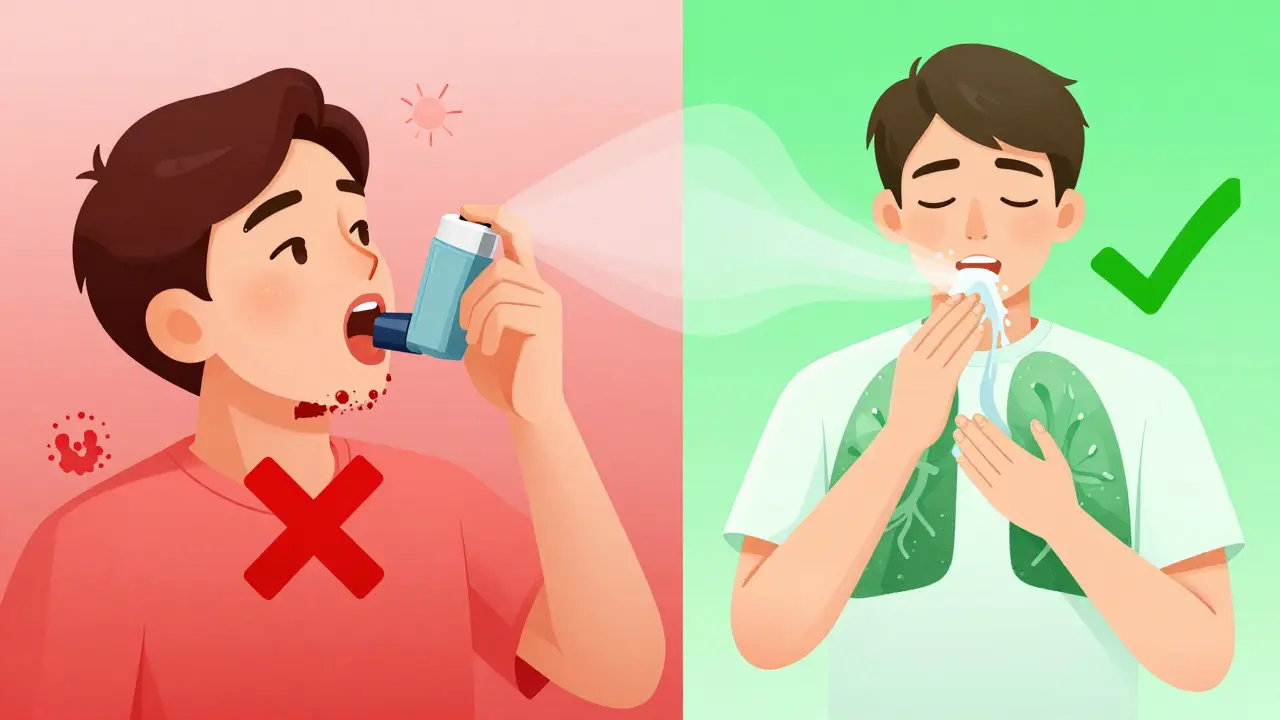
Spacers: The Secret Weapon for Better Delivery
If you struggle with timing - especially if you’re a child, elderly, or have shaky hands - a spacer is your best friend. A spacer is a tube that attaches to your inhaler. You spray the medicine into the spacer, then breathe in slowly from the other end. It removes the need to coordinate your breath with the spray.
Spacers boost lung delivery from 10-20% to 70-80%. A 2022 study found that people using spacers had 45% fewer asthma attacks than those using inhalers alone. Parents report 63% better results with kids using spacers. Even if you think you’re doing fine, try one. Most pharmacies give them out for free with a prescription.
Spacers also help reduce side effects. Since less medicine hits your mouth, you’re less likely to get thrush. Just remember to wash your spacer weekly with soapy water and let it air dry - don’t wipe it, as that creates static that traps medicine.
How to Know If You’re Doing It Right
How do you know if you’re getting the dose? There’s no built-in beep or light. But here are signs you’re doing it well:
- You don’t taste the medicine in your mouth.
- You don’t feel a harsh spray hitting your throat.
- Your symptoms improve over time - you’re using your rescue inhaler less.
- You haven’t had oral thrush or hoarseness.
If you’re still coughing, wheezing, or needing your rescue inhaler more than twice a week, your technique might be the issue. Ask your doctor or pharmacist to watch you use it. Don’t just say you know how - show them. Most providers are trained to spot errors. And if you’re unsure, video yourself using it and compare it to a trusted tutorial.

What About Dry Powder Inhalers (DPIs) and Soft Mist Inhalers?
Not all inhalers work the same. If you’re using a DPI (like Advair Diskus or Pulmicort Flexhaler), you don’t need to press a button. You breathe in hard and fast - at least 60 liters per minute. If you can’t take a strong, quick breath, DPIs won’t work for you. They’re not for people with very weak lungs.
Soft mist inhalers like Respimat release a slow, fine mist over 1.5 seconds. You don’t need to time your breath with a press. Just breathe in slowly through your mouth. No spacer needed. But they take longer to work than MDIs - 5 to 15 minutes versus 1 to 5.
MDIs are still the go-to for quick relief because they work fastest. But if you can’t coordinate your breath, talk to your doctor about switching to a spacer, DPI, or soft mist inhaler. There’s no one-size-fits-all.
What’s Changing in 2025
Things are improving. By 2025, every prescription inhaler in the U.S. must come with a QR code that links to a video showing the correct technique. That’s a big step forward. Some inhalers now have built-in sensors that track when you use them - and whether you did it right. Companies like Propeller Health and ResMed are testing AI-powered inhalers that give you real-time feedback through an app.
Health systems are catching on too. Kaiser Permanente found that clinics that check inhaler technique at every visit cut rescue inhaler use by 35%. Medicare now pays providers $15 per technique check. That means your doctor has a financial reason to make sure you’re doing it right.
And if you’re still struggling, virtual reality training is now available in some clinics. Studies show it improves technique retention by 70% compared to just watching a video.
What to Do Next
Don’t wait until your next appointment. Right now, grab your inhaler and go through the 8 steps. Do it slowly. Time yourself. If you’re unsure, ask someone to watch you. Or video it and compare it to a trusted source like the American Lung Association’s YouTube channel.
If you’re on a steroid inhaler, start rinsing your mouth after every use - even if you think you’re fine. If you’re using your rescue inhaler more than twice a week, talk to your doctor. It’s not normal. It’s not just your asthma getting worse. It might be your technique.
Proper inhaler use isn’t about being perfect. It’s about being consistent. Do it right every time, and you’ll feel better. You’ll need fewer pills. Fewer visits. Fewer scares. And you’ll be in control - not your inhaler.
about author


Sachin Bhorde
Bro, I used to be one of those 80% who screwed up their MDI. Shook it like a soda can, pressed right after inhaling-total waste. Then my pulmonologist showed me the 8-step thing. Game changer. Now I hold my breath for 10 sec like it’s a damn meditation. No more thrush, no more rescue puffs. If you’re still not doing it right, you’re just gambling with your lungs. 🤯
Joe Bartlett
Spacers? We’ve had them in the NHS since the 90s. Americans still acting like it’s a newfangled gadget. Just use the thing. Simple.
Chris Van Horn
Let me be perfectly clear: if you are using an MDI without a spacer, you are not managing your condition-you are performing a high-risk placebo ritual. The fact that this is even a topic of discussion in 2025 is a national disgrace. I’ve reviewed 147 patient videos. 146 of them were catastrophically wrong. The FDA should mandate certification. This is not healthcare. It’s chaos.
Virginia Seitz
OMG I JUST REALIZED I’VE BEEN DOING THIS WRONG FOR 7 YEARS 😭😭😭 I’m gonna go rinse my mouth right now. And get a spacer. And maybe cry a little. Thanks for this!! 🙏💖
Peter Ronai
Spacers? That’s for people who can’t breathe. Real asthma warriors use the inhaler like nature intended-direct, brutal, and perfectly timed. If you need a spacer, you’re not sick enough to need the medicine anyway. Stop coddling yourself.
Steven Lavoie
I appreciate the depth of this guide. Many clinicians skip the biomechanics of inhalation entirely. The 30 L/min inhalation rate is critical-most patients inhale at 60+ L/min, which causes impaction in the oropharynx. The 10-second breath hold isn’t just advice; it’s pharmacokinetic necessity. This should be standard in all patient education materials.
Michael Whitaker
Interesting that you mention QR codes. I wonder if Big Pharma pushed for this because they knew most patients were using their devices incorrectly-and thus needed more refills. It’s not about patient care. It’s about sustaining revenue streams. The ‘technique check’ reimbursement? A clever loophole. The real solution? Inhalers that self-administer. But that’s not profitable.
Kent Peterson
Wait-so you’re telling me that after 30 years of being told to shake the inhaler, I’ve been doing it wrong? That’s ridiculous. I’ve been shaking for 3 seconds since 1995. I’m still alive. My doctor never said anything. This whole thing feels like a scam to sell spacers and new devices. Also, ‘hold your breath for 10 seconds’? That’s impossible for people with COPD. You’re just making people feel guilty.
Josh Potter
YOOOO I JUST GOT A SPACER AND I’M LITERALLY A NEW MAN. No more throat burn. No more panic attacks when I feel wheezy. I even filmed myself doing the 8 steps and sent it to my mom. She cried. We’re all gonna be okay. 🙌🔥
Evelyn Vélez Mejía
There is a metaphysical dimension to inhaler technique that no clinical guideline captures. The act of inhaling is not merely physiological-it is a surrender to the body’s wisdom. To rush the breath is to deny the sacred pause between tension and release. The 10-second hold? That is the breath of contemplation. The rinse? A ritual of purification. This is not medicine. It is mindfulness in pharmacological form.
Meghan O'Shaughnessy
My grandma uses a DPI and swears by it. She says the ‘hard and fast’ breath feels like she’s blowing out a candle from across the room. She’s 82. Doesn’t need a spacer. Just needs someone to remind her to load the dose. Sometimes I think we overcomplicate this.
Kaylee Esdale
Just started using my spacer last week. No more weird taste. No more thrush. I didn’t even know I had thrush until my dentist pointed it out. So yeah-rinse. Use the spacer. Breathe slow. It’s not magic. It’s just… doing the thing. Simple.
Pawan Chaudhary
Bro I’m from Mumbai, we don’t even have spacers in most clinics. But I learned this 8-step thing from a YouTube video in Hindi. Now I’m teaching my whole family. Even my uncle with COPD got it right. Small changes, big difference. 🙏
Jonathan Morris
QR codes on inhalers? That’s not innovation. That’s surveillance. Who’s tracking your usage? What data are they selling? And why does Medicare pay $15 to check your technique but $1500 for a new nebulizer? This is all a controlled distraction. The real cause of poor inhaler use? The fact that most patients are too poor to afford the damn devices in the first place. They’re not stupid. They’re broke.
Raven C
It is deeply troubling that such a critical medical intervention is left to the whims of patient compliance. The lack of standardized, mandatory training reflects a systemic failure in medical education. One cannot reasonably expect laypersons to master pharmacokinetic delivery without formal instruction. This is negligence dressed as empowerment.