
How Medications Enter Breast Milk and What It Means for Your Baby
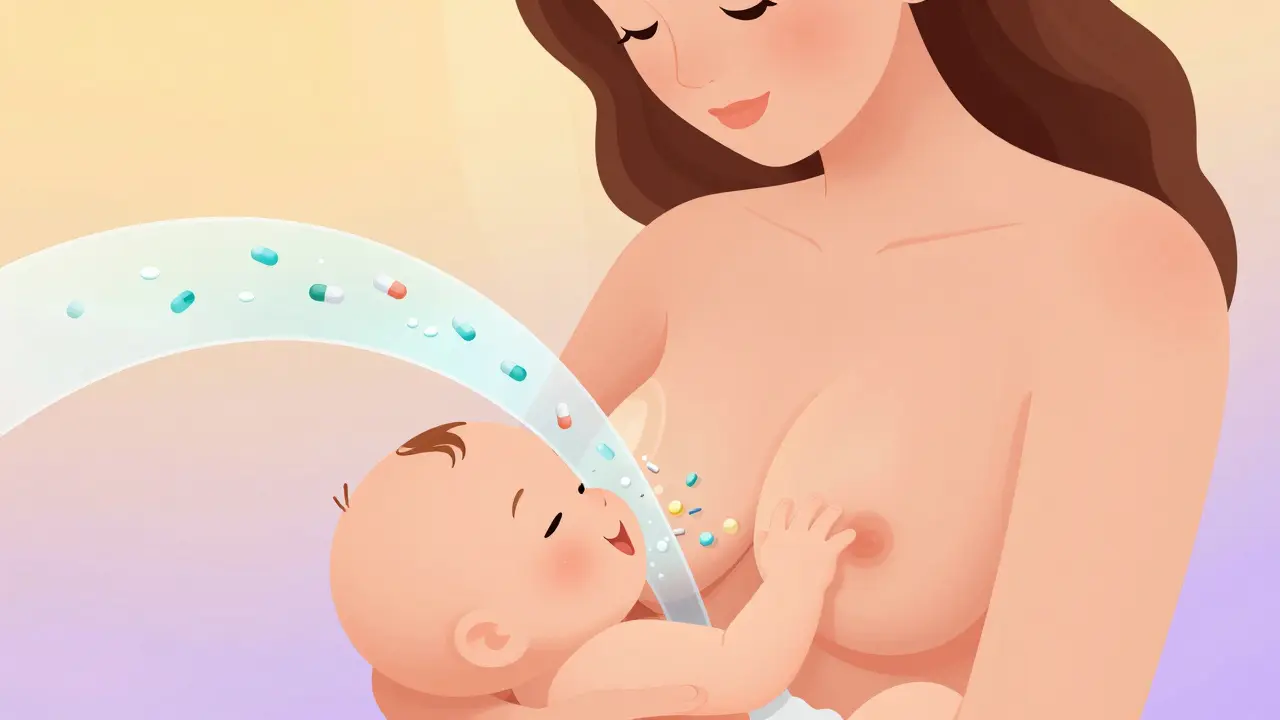
When you’re breastfeeding, every pill, injection, or drop you take doesn’t just affect you. It can end up in your breast milk-and then in your baby. That’s a scary thought for many new moms. But here’s the truth: medications in breast milk are far more common-and far safer-than most people realize. Most drugs pass into milk in tiny, harmless amounts. The real question isn’t whether medicine gets into milk. It’s how much, which ones, and what you should do about it.
How Do Medications Even Get Into Breast Milk?
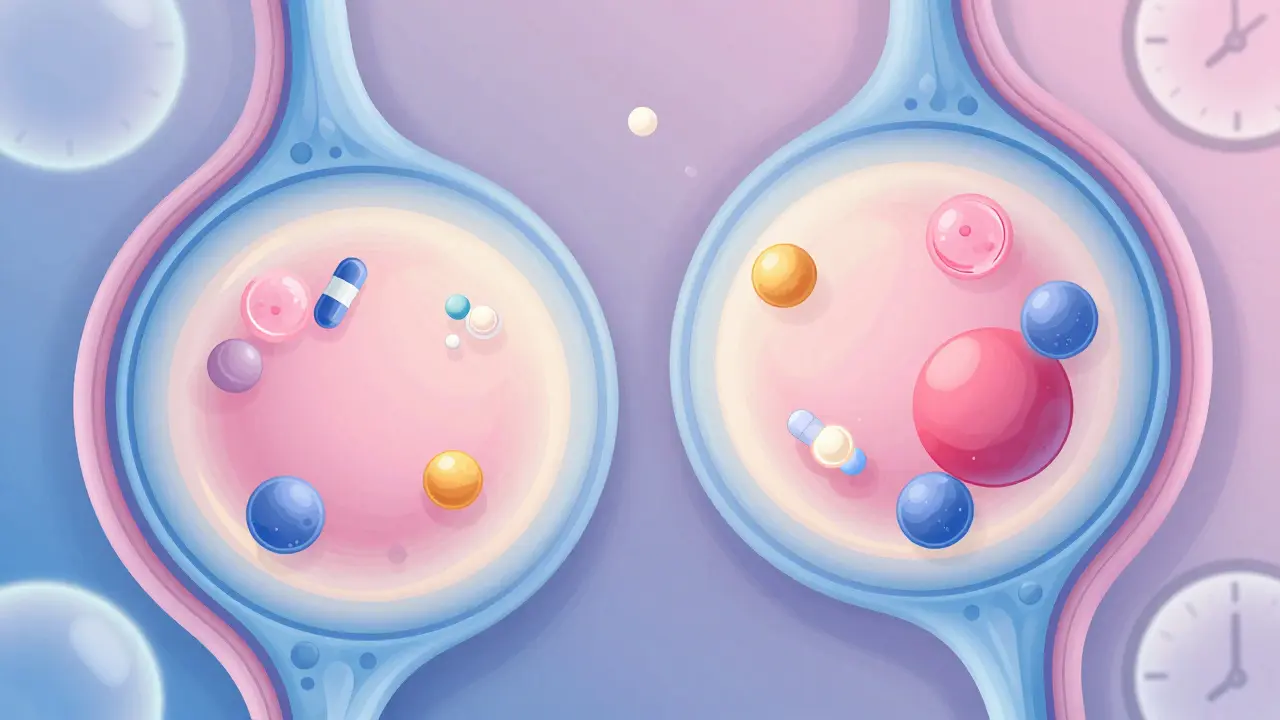
Breast milk isn’t just filtered blood. It’s made inside tiny sacs in the breast called alveoli. These sacs are lined with cells that pull substances from the mother’s bloodstream to build milk. Most drugs slip into milk the same way water does-through passive diffusion. That means they move from where there’s more of them (your blood) to where there’s less (your milk), following a natural flow.
About 75% of medications enter this way. The rest use special transport systems in the cell walls. Some drugs, like nitrofurantoin or acyclovir, are carried in by specific protein pumps. Others, like lithium, are small enough to slip through easily. Molecular weight matters a lot. Anything heavier than 800 daltons-like heparin, which weighs 15,000-barely makes it into milk. But small molecules, like sertraline (286 daltons) or ibuprofen (206 daltons), cross freely.
Lipid solubility is another big factor. Fatty drugs, like diazepam, love to slip through cell membranes. That’s why diazepam can reach milk concentrations twice as high as in your blood. Water-soluble drugs, like gentamicin, barely make a splash-less than 10% of your dose shows up in milk.
Then there’s protein binding. If a drug sticks tightly to proteins in your blood-like warfarin, which is 99% bound-it can’t float freely to enter milk. That’s why warfarin transfers less than 0.1%. But sertraline, which is 98.5% bound, still gets through. Why? Because even a tiny fraction of a high-dose drug can add up.
And here’s something most people don’t know: your milk is slightly more alkaline than your blood. That traps weakly basic drugs-like amitriptyline or fluoxetine-inside the milk, making concentrations 2 to 5 times higher than in your blood. This is called ion trapping. It’s not dangerous in most cases, but it’s why some antidepressants need closer watching.
When Is Transfer the Highest?
Right after birth, your body is still adjusting. For the first 4 to 10 days, the cells lining your milk sacs aren’t fully sealed. Tiny gaps-10 to 20 nanometers wide-let through larger molecules, including some antibodies and medications. That’s why some drugs transfer more easily in those early days.
After day 10, those gaps close. Milk becomes more selective. That’s good news. It means after the first week, your baby’s exposure drops sharply for most medications. But it also means timing matters. If you take a drug right after feeding, your body has 3 to 4 hours to clear it from your bloodstream before the next feed. That can cut infant exposure by 30 to 50%.
For long-acting drugs-like diazepam, which can stay in a newborn’s system for up to 100 hours-this timing becomes critical. If you take a high dose daily, the drug can build up in your baby. That’s why doctors recommend checking infant serum levels if you’re on more than 10 mg of diazepam per day. Levels above 50 ng/mL can cause drowsiness or poor feeding.
What Medications Are Safe? What Should You Avoid?
Not all drugs are created equal. Experts use a simple ranking system to help you decide:
- Level 1 (Safest): No detectable transfer or no effect on infants. Examples: insulin, heparin, most penicillins, ibuprofen, acetaminophen.
- Level 2 (Usually Safe): Minimal transfer, rare side effects. Examples: sertraline, fluoxetine, amoxicillin, loratadine.
- Level 3 (Use With Caution): Some risk, monitor baby. Examples: lithium, certain SSRIs at high doses, codeine.
- Level 4 (Probably Unsafe): Known adverse effects. Examples: cyclosporine, chemotherapy drugs.
- Level 5 (Contraindicated): Absolute avoidance. Examples: radioactive iodine-131, bromocriptine, some antivirals.
Here’s the good news: 87% of commonly prescribed medications fall into Level 1 or 2. That means if you’re on a standard antibiotic, painkiller, or antidepressant, you’re likely fine. Sertraline, the most prescribed antidepressant for breastfeeding moms, transfers at just 1-2% of your dose. Most babies show no symptoms.
But watch out for these red flags:
- High-dose estrogen birth control: More than 50 mcg of ethinyl estradiol can cut your milk supply by 40-60% in just 72 hours. Progesterone-only pills are safer.
- Codeine: Your body turns it into morphine. Some moms metabolize it too fast, flooding breast milk with morphine. Babies can stop breathing. Avoid it.
- Radioactive scans: A VQ scan with Tc-99m needs 12-24 hours of pumping and dumping. FDG-PET scans? Usually safe to keep breastfeeding.
- Bromocriptine: Used to stop lactation. If you accidentally take it, you’ll lose your milk supply in 5 days.
What About Antidepressants and Mental Health?
Depression during breastfeeding is common-and dangerous if left untreated. Stopping your meds because you’re afraid of your baby getting them? That’s a bigger risk than the meds themselves.
Sertraline is the gold standard. It’s been studied in thousands of breastfeeding mothers. Infant exposure is low. Side effects? Less than 10% of babies show mild fussiness or sleep changes. Only 5% show poor feeding. None show serious toxicity.
Fluoxetine? Longer half-life. Can build up. Avoid if your baby is premature or has liver issues. Paroxetine? Low transfer, but can cause withdrawal symptoms if stopped suddenly.
The European Medicines Agency warns about serotonin syndrome in rare cases. But the data is thin-only a handful of case reports. The InfantRisk Center, which tracks over 2,500 drugs, still rates sertraline as Level 2. If you’re stable on an SSRI before birth, staying on it is almost always safer than switching or stopping.
How Do You Know If Your Baby Is Affected?
Most babies show no signs. But watch for these subtle changes:
- Unusual sleepiness or difficulty waking to feed
- Poor feeding or sucking
- Excessive fussiness or crying
- Rash or diarrhea (rare, usually with antibiotics)
If you notice any of these, don’t panic. Call your pediatrician. They can check your baby’s feeding patterns and, if needed, test blood levels. For SSRIs, many experts recommend checking serum levels at 2 weeks postpartum if you’re on a higher dose. Levels above 10% of your therapeutic dose are a signal to adjust.
And here’s the most important thing: don’t stop your meds without talking to your doctor. Untreated depression, anxiety, or high blood pressure can hurt you-and your baby-more than any medication.
What’s New in 2026?
Things are changing fast. Since 2023, the FDA now requires all new drugs to include breastfeeding data on their labels. That’s a big deal. Ten years ago, most labels just said “unknown safety.” Now, you’ll see specific transfer rates, infant exposure levels, and recommendations.
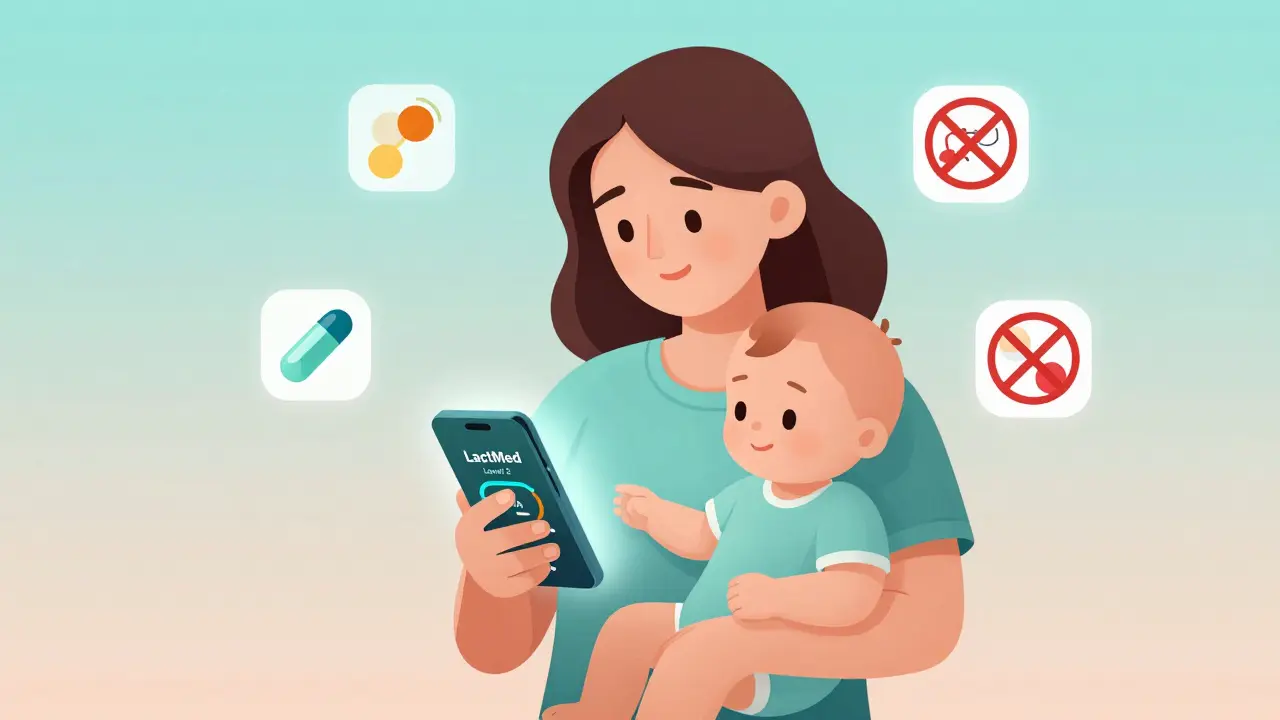
The InfantRisk Center’s LactMed app (version 3.2) uses AI to analyze 12 pharmacokinetic factors-molecular weight, protein binding, pKa, half-life-and gives you a real-time risk score. It’s free, updated daily, and trusted by hospitals across the U.S. and UK.
And in 2025, the NIH-funded MOMS study will release definitive safe limits for 50 priority medications. That means we’ll finally have hard numbers-not just opinions-on what’s safe for babies.
Bottom Line: You Can Breastfeed and Take Medication
Eighty-three percent of U.S. moms start breastfeeding. But nearly half stop early-often because they’re scared of their meds. The truth? Only 1-2% of medications truly require you to stop breastfeeding. For the other 98-99%, you just need to know which ones, how much, and how to time them.
Take your meds after you feed. Avoid high-dose estrogen pills. Don’t use codeine. Stick to sertraline over fluoxetine if you need an antidepressant. And if you’re unsure? Use the LactMed app or call your pharmacist. You don’t have to choose between being a healthy mom and feeding your baby. You can do both.
about author

Annette Robinson
Just wanted to say this post saved me. I was terrified to take my sertraline after my daughter was born, thinking I’d be poisoning her. Turns out, she’s been fine-sleeping great, feeding well. I didn’t know about the timing trick-taking meds right after nursing. That alone cut my anxiety in half. Thank you for the clear, science-backed info.
Also, the LactMed app? Installed it the same day. Best decision ever.
Kristina Felixita
OMG YES!! I was so scared to take my ibuprofen for cramps-like, I’d cry just holding the pill-until I read this. Turns out it’s like, barely even in the milk?? I feel like such a dumb mom for panicking. Also, diazepam levels?? Wild. I didn’t know my anxiety meds were basically ghosting my baby. Thanks for not making me feel guilty!!
Also, pro tip: I started taking mine right after the 2am feed and my little one slept 5 hours straight. Magic.
christy lianto
Let me be real-this isn’t just about meds. It’s about trust. Trust in your body. Trust in science. Trust that you’re not a monster for needing help. You think you’re failing by taking a pill? No. You’re failing by NOT taking it and letting depression steal your joy. Your baby needs YOU-alert, present, alive. Not a ghost in a nursing chair.
Stop letting fear make decisions for you. Sertraline isn’t poison. It’s permission to be a whole mom. And if your doctor says it’s safe? Then it’s safe. Don’t let random Reddit threads or your mother-in-law’s 1987 wisdom override a decade of clinical data. You’ve got this.
And if you’re on codeine? Stop. Immediately. No debate. Your baby’s breathing is not a gamble.
Manish Kumar
There’s a deeper metaphysical layer here, you know? The body as a vessel-blood and milk as twin rivers flowing from the same source. The pharmaceutical molecule, a foreign traveler, slips through the membranes like a thought through the mind-uninvited, yet inevitable. We fear contamination, but what is contamination but change? Nature does not judge substances; it only flows. The real question isn’t whether the drug enters the milk-but whether we, as mothers, have the courage to accept that we are never fully separate from our children. Even in our pills, we remain connected. This is not contamination. It is communion.
Perhaps the real medicine is not in the tablet, but in the surrender to this truth.
Aubrey Mallory
Stop saying ‘most drugs are safe.’ That’s lazy language. Safe for whom? The 98%? What about the 2% of babies who are CYP2D6 ultra-rapid metabolizers? Or the preemies with immature livers? Or the ones with undiagnosed metabolic disorders? You’re normalizing risk by saying ‘it’s fine.’
Here’s what’s actually responsible: individualized risk assessment. Not blanket statements. Not ‘use LactMed’ as a magic wand. If you’re on an SSRI and your baby is under 3 weeks old? Get a serum level. Period. No ‘probably.’ No ‘usually.’ This isn’t a blog post-it’s a neonatal health issue. We need better guidelines, not reassurance.
Dave Old-Wolf
So wait-so if I take a pill after I feed, the baby gets less? That’s it? That’s the whole trick?
And ibuprofen is fine? I thought that was bad for babies. I’ve been avoiding it for months. Just took one today after feeding. Felt weird, but good weird?
Also, what’s ‘dalton’? Is that a person? I think I heard that on a show once.
Prakash Sharma
Western medicine thinks it knows everything. But in India, we’ve been nursing while taking turmeric, ashwagandha, and herbal decoctions for centuries. No apps. No daltons. No FDA. Just wisdom passed down. Now you’re scared of a little sertraline? You’ve forgotten how to trust your body. Modern science is useful-but don’t let it make you weak. Our mothers didn’t have LactMed. They had instinct. And they raised strong children.
Maybe the problem isn’t the medicine. Maybe it’s the fear.
Donny Airlangga
I’m a dad. I didn’t know any of this. My wife was crying last week because she thought she had to stop breastfeeding to stay on her meds. I read this out loud to her. She just hugged me and said, ‘Thank you for caring enough to look this up.’
So thank you-for writing this. Not just for moms. For dads too.