
Patient Information vs Healthcare Provider Information: How Label Differences Affect Your Care
Medical Term Translator
How this tool works
Enter medical terms you've seen in your health records to get plain language explanations. This helps you understand what your provider means when they use clinical terms.
Enter a medical term to see a plain language explanation here.
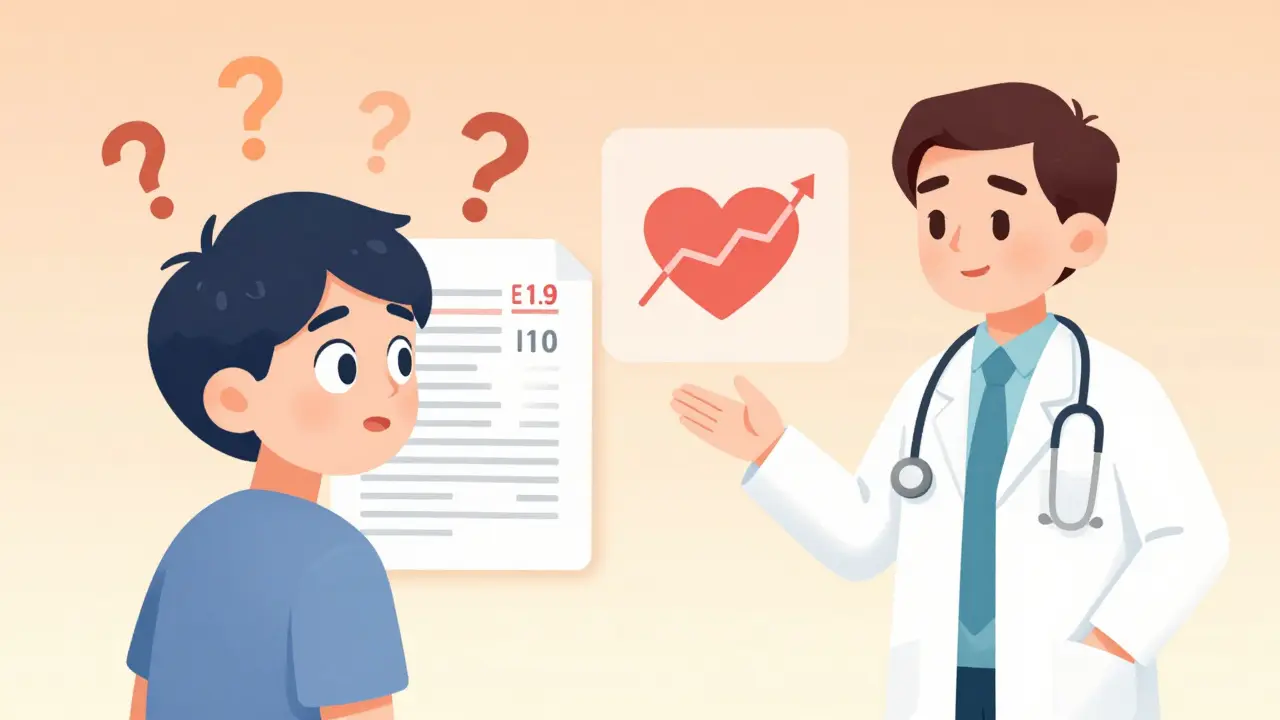
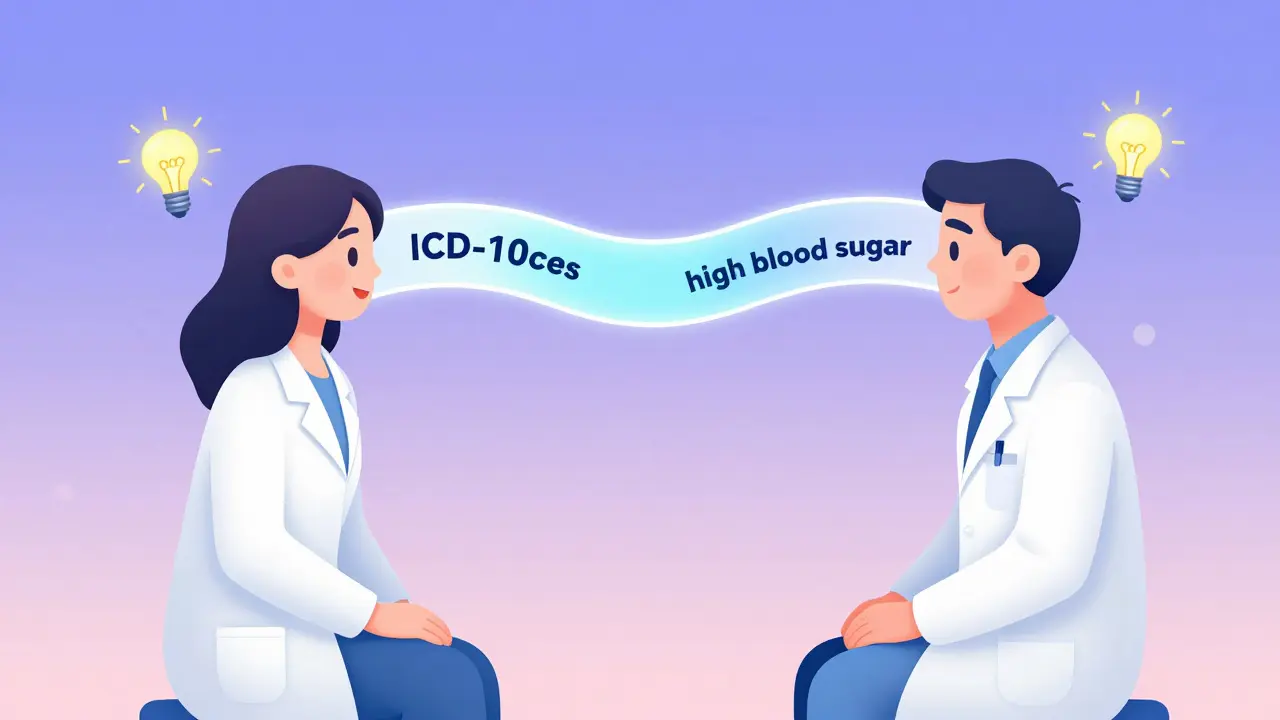
Have you ever read your medical record and felt like it was written in another language? You might see "Type 2 Diabetes Mellitus, E11.9" and wonder why your doctor didn’t just say "high blood sugar." Meanwhile, your provider sees that same code and thinks, "Patient’s glucose levels are out of range." Two people. One chart. Totally different meanings.
This isn’t just a misunderstanding-it’s a systemic gap that affects your safety, your trust, and even whether you take your meds. The labels used by healthcare providers and the way patients describe their own health don’t just differ-they often clash in ways that lead to confusion, missed appointments, and dangerous mistakes.
Why Your Doctor’s Notes Don’t Sound Like You
Healthcare providers rely on standardized systems to document care. The most common are ICD-10 codes for diagnoses and CPT codes for procedures. These aren’t just abbreviations-they’re precise, legal, and billing-ready language. For example, "hypertension" becomes ICD-10 code I10. That’s efficient for insurance claims and population health tracking. But to you, "hypertension" might just mean "my head feels weird when I wake up."A 2019 study in the Journal of General Internal Medicine found that 68% of patients didn’t understand common medical terms. Forty-two percent didn’t know "hypertension" meant high blood pressure. Sixty-one percent couldn’t define "colitis." Meanwhile, providers assume these terms are basic. They’re not. They’re jargon.
Patients describe symptoms in stories: "I’m always tired," "My feet feel numb," "I wake up sweating." Providers turn those stories into codes: "Fatigue, R53.83," "Peripheral neuropathy, G62.9." The meaning gets flattened. The emotion gets lost. And the connection? Broken.
What Happens When Labels Don’t Match
The consequences aren’t theoretical. On patient forums like PatientsLikeMe, someone wrote: "My doctor wrote ‘poorly controlled DM’ in my chart. I thought it meant I was a bad person, not that my blood sugar was high." That’s not a typo. That’s a communication failure with real emotional weight.When patients don’t understand their records, they avoid care. A 2022 American Medical Association survey showed 57% of patients felt confused by terms in their medical notes. Thirty-two percent skipped follow-ups because of it. That’s not just inconvenience-it’s risk. Missed screenings, delayed treatments, worsening conditions.
Providers aren’t blameless. A 2023 Medscape survey found 64% of doctors spend 15 to 30 minutes per visit just explaining terms. That’s a third of a typical 15.7-minute appointment, according to MGMA data. Time spent decoding labels is time not spent treating.
How the System Is Trying to Fix This
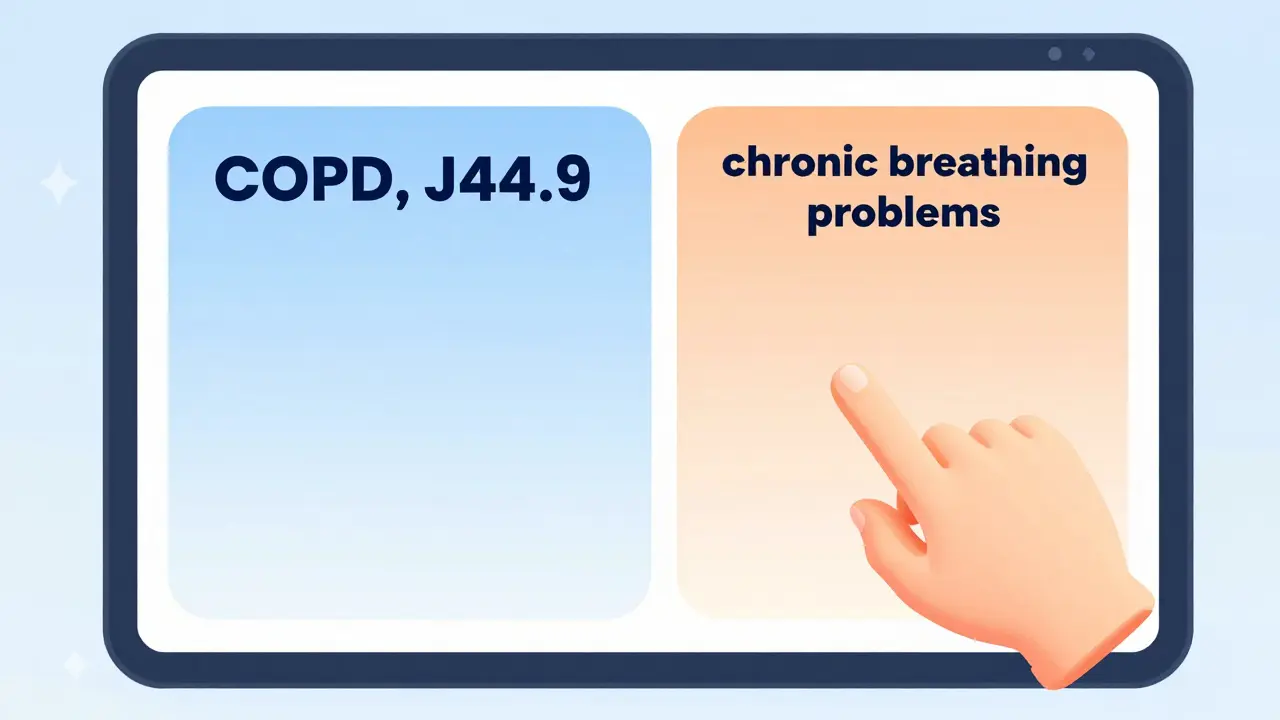
The problem isn’t new, but the push to fix it is stronger than ever. The 21st Century Cures Act of 2016 required providers to give patients access to their clinical notes-no filters. That meant millions of people suddenly saw terms like "depression, F32.9" or "COPD, J44.9" without explanation.Some health systems responded by rewriting notes for patients. Kaiser Permanente’s "Open Notes" program, running since 2010, now covers 2.7 million people. Their 2021 report showed a 27% drop in patient confusion and a 19% rise in medication adherence. Mayo Clinic’s pilot program translated clinical terms into plain language-"myocardial infarction" became "heart attack"-and cut patient confusion by 38%.
Now, new tools are emerging. The WHO’s ICD-11, rolled out globally in 2022, includes patient-friendly descriptions alongside official codes. HL7 FHIR, the modern data standard used by 78% of major U.S. health systems, lets EHRs show both clinical and plain-language versions side by side. And AI is stepping in: Google’s Med-PaLM 2 can convert clinical notes into plain language with 72.3% accuracy-close, but not yet good enough for clinical use.
What You Can Do Right Now
You don’t have to wait for the system to catch up. Here’s what works:- Ask for plain language. After your doctor says "hypertension," say: "Can you say that in words I’ll understand?"
- Use the teach-back method. After they explain something, repeat it back: "So you’re saying I need to take this pill twice a day because my blood pressure is too high?"
- Read your notes. If you have access to MyChart or another patient portal, look at your records. If something doesn’t make sense, write it down and ask at your next visit.
- Bring a friend. A second set of ears helps. Someone else might catch a term you missed.
These aren’t just tips-they’re tools for safety. A JAMA Internal Medicine study found teach-back reduces miscommunication by 45%. That’s not small. That’s life-changing.
What Providers Are Learning
Health Information Management (HIM) professionals-certified experts who manage medical records-are now trained to bridge this gap. They spend over 1,200 hours learning both coding systems and communication techniques. Their job isn’t just to enter data. It’s to make sure the data makes sense to the person it’s about.Some clinics now use "plain language" templates in their EHRs. Instead of typing "asthma exacerbation," a provider selects "flare-up of breathing problems." The system auto-converts the code behind the scenes for billing, but the patient sees clear language.
It’s not perfect. Time is still tight. Documentation is still burdened by insurance rules. But the shift is real. Patient experience scores now affect hospital payments. CMS added questions about communication clarity to its HCAHPS survey in 2018. Hospitals that score low on patient understanding lose money.
The Bigger Picture
This isn’t just about words. It’s about power. For decades, medical language was a barrier to keep patients out. Now, it’s being dismantled-not because it’s easy, but because it’s necessary.The goal isn’t to dumb down medicine. It’s to make it accessible. You don’t need to know ICD-10 codes. But you should understand what your diagnosis means, why your meds matter, and what your body is telling you.
The future of care isn’t just better technology. It’s better communication. And it starts with you asking: "What does that mean?"
Why do doctors use medical terms instead of plain language?
Doctors use medical terms because they’re standardized, precise, and required for billing, insurance, and legal documentation. Systems like ICD-10 and CPT codes ensure everyone-from hospitals to insurers-uses the same language. But that doesn’t mean those terms should be used with patients. The goal is to use plain language in conversations and patient-facing documents while keeping codes for administrative use.
Can I ask my doctor to rewrite my medical record in plain language?
Yes. You have the right to understand your health information. Ask your provider to explain terms in simple language during your visit. Many clinics now offer patient-friendly versions of notes automatically. If yours doesn’t, request a plain-language summary in writing. Some providers will add a note to your chart explaining your preferred terms.
What’s the difference between ICD-10 and patient-friendly labels?
ICD-10 is a global coding system with over 70,000 diagnosis codes used for billing and data tracking. Each code corresponds to a specific condition-like E11.9 for "Type 2 Diabetes Mellitus without complications." Patient-friendly labels are plain-language descriptions like "high blood sugar" or "diabetes." The same condition has two names: one for the system, one for you. New EHRs are starting to show both side by side.
Do patient portals like MyChart help with understanding medical terms?
Yes, but only if they’re designed well. About 41% of healthcare organizations now modify clinical notes for patient readability, according to the ONC. MyChart and similar portals can show plain-language summaries, but not all do. Check if your portal has a "plain language" toggle or a glossary. If not, ask your provider’s office if they offer it.
How can I tell if my provider is communicating clearly?
If you leave your appointment feeling confused, unsure what to do next, or afraid to ask more questions, the communication isn’t working. A good provider will check your understanding by asking you to repeat back instructions (teach-back method). They’ll avoid jargon unless they explain it. If you’re still unsure, it’s okay to say: "I want to make sure I got this right-can you say it one more time in different words?"
What’s Next
By 2027, experts predict 60% of electronic health records will include real-time translation from clinical terms to plain language. That means your doctor might type "hypertension," and your phone will show "high blood pressure"-without you having to ask.That’s not science fiction. It’s the next step in making healthcare human again. The system is changing. But you don’t have to wait. Start today. Ask. Clarify. Repeat. Your health depends on it.
about author

Andy Heinlein
Man, I just read my MyChart notes last week and nearly cried. They said 'anxiety disorder, F41.9' and I thought I was being labeled some kind of crazy person. Then my sister said, 'Dude, that just means you get overwhelmed.' I felt so much better. Why does it have to be so hard to just understand your own body?
Todd Nickel
It's fascinating how the medical establishment has weaponized terminology as a gatekeeping mechanism under the guise of precision. The ICD-10 system, while functionally efficient for administrative workflows, creates a linguistic chasm between clinical reality and patient experience. The fact that 68% of patients don't comprehend basic diagnostic labels speaks not to patient ignorance, but to systemic negligence in translational communication. The convergence of semantic clarity and healthcare equity isn't optional-it's a bioethical imperative. When 'hypertension' becomes 'high blood pressure' in the patient-facing interface, we're not dumbing down medicine; we're democratizing it. The real inefficiency isn't in explaining terms-it's in the downstream costs of non-adherence, missed appointments, and iatrogenic distress caused by opaque documentation.
Austin Mac-Anabraba
Let’s be honest: patients who can’t understand ‘hypertension’ shouldn’t be trusted to manage their own health. If you can’t handle basic medical vocabulary, maybe you shouldn’t be the one making decisions about insulin dosages or blood pressure meds. This isn’t about ‘accessibility’-it’s about lowering standards to accommodate ignorance. The system isn’t broken; you’re just too lazy to learn a few terms. ICD codes exist for a reason: precision matters. If you can’t keep up, don’t blame the doctors.
Phoebe McKenzie
THIS IS WHY PEOPLE DIE. I had a cousin who died because she thought 'diabetic neuropathy' meant she had a bad foot fungus. She didn’t take her meds for six months because she thought the doctor was saying her feet were just 'tired.' And now she’s gone. And you’re sitting here talking about 'precision' like it’s some kind of sacred cow. Stop hiding behind codes. Stop pretending jargon is professional. It’s cruel. It’s negligent. And if your doctor still says 'F32.9' instead of 'depression,' fire them. That’s not medicine-that’s emotional abuse wrapped in a clipboard.
Heather Josey
As a nurse practitioner who works in primary care, I’ve seen firsthand how plain-language notes transform patient outcomes. We implemented a template in our EHR last year that auto-translates 'COPD exacerbation' to 'flare-up of breathing trouble'-and within three months, our refill adherence jumped 22%. Patients aren’t asking for dumbed-down care-they’re asking to be treated like humans. The teach-back method isn’t a gimmick; it’s the single most effective tool we have. And yes, it takes time. But saving one life makes up for 20 extra minutes. This isn’t a trend-it’s the future of care.
Donna Peplinskie
Just wanted to add-here in Canada, we’ve been doing patient-friendly notes for over a decade now, and it’s made such a difference. My mom, who’s 72 and doesn’t read much, finally understood her 'heart failure' diagnosis when her chart said 'your heart is tired and can’t pump well.' She started taking her meds. She asked questions. She lived longer. It’s not about dumbing down-it’s about opening up. And honestly? If we can make medical info accessible to elders, immigrants, and people with low literacy, we can make it accessible to everyone. Why wouldn’t we?
Olukayode Oguntulu
Ah, the Western obsession with linguistic democratization as a panacea. How quaint. The ICD-10 system is a product of epistemological rigor-a linguistic architecture forged in the fires of clinical empiricism. To reduce 'peripheral neuropathy' to 'numb feet' is not empowerment; it is epistemic colonialism. You mistake clarity for simplicity, and simplicity for truth. The patient who cannot grasp the semantic weight of 'E11.9' is not the victim of a flawed system-they are the product of an educational collapse. The real issue isn't the code-it's the erosion of intellectual discipline in the populace. Let them learn. Or let them suffer. Either way, the code remains immutable. Truth does not bend to comfort.
Ann Romine
My grandmother is from Vietnam and doesn’t speak English. Last year, she saw her note that said 'depression, F32.9' and thought she was being called 'crazy' by the hospital. I had to translate it to her in Vietnamese: 'Your heart is heavy, and the medicine can help.' She cried. Then she took her pills. I’m not asking for a revolution-I’m asking for a translation button. It shouldn’t be this hard to understand your own body.