
Clostridioides difficile: Understanding Antibiotic-Associated Diarrhea and How to Prevent It
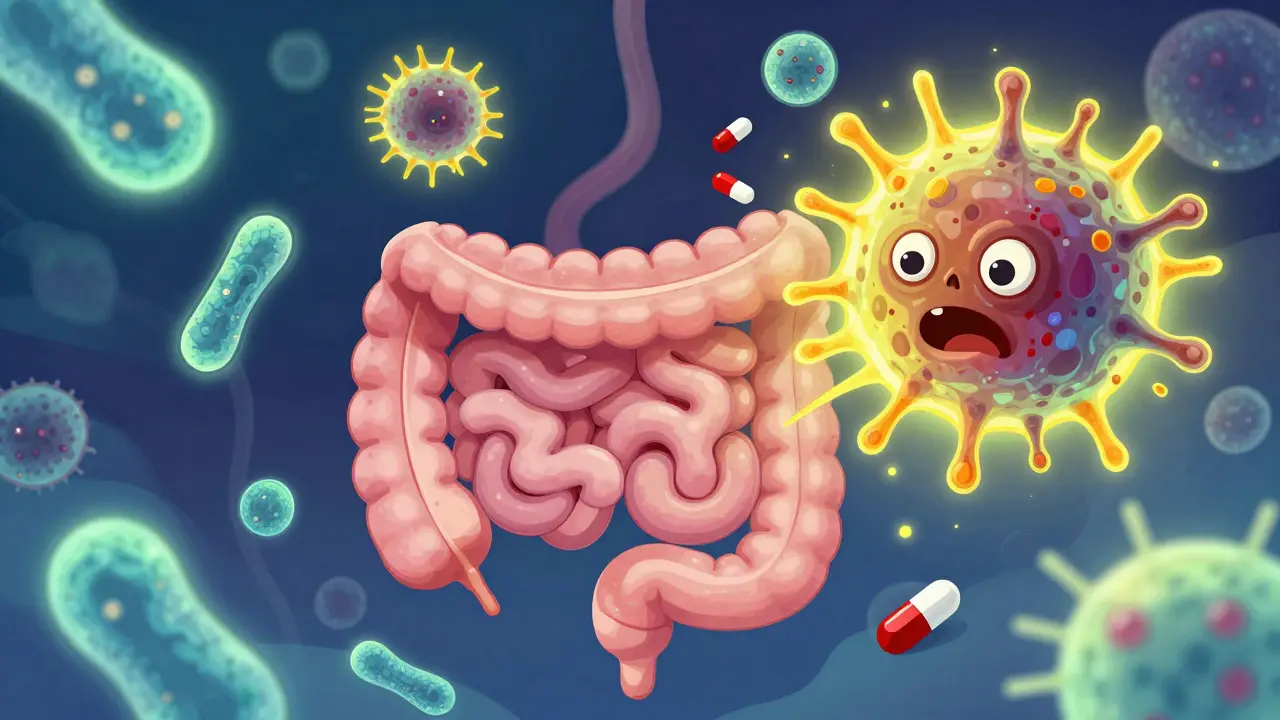
When you take an antibiotic, you expect it to fix the infection. But for some people, the very drug meant to help ends up causing something far worse: severe, watery diarrhea that doesn’t go away. This isn’t just a bad stomach bug. It’s often caused by Clostridioides difficile, or C. diff - a bacteria that takes over when antibiotics wipe out the good bugs in your gut.
Every year in the U.S., nearly half a million people get sick from C. diff. About 12,800 die from it. And it’s not just hospitals anymore. More than 40% of cases now happen in people who never set foot in a hospital. If you’ve been on antibiotics recently - especially clindamycin, ciprofloxacin, or cephalosporins - and you’ve had three or more loose stools a day, you need to think about C. diff. It’s not rare. It’s common. And it’s preventable.
How C. diff Takes Over Your Gut
Your intestines are home to trillions of bacteria. Most of them are harmless, even helpful. They help digest food, make vitamins, and keep bad bugs in check. But when you take antibiotics - especially broad-spectrum ones - you don’t just kill the infection. You also kill off the good bacteria. That’s when C. diff gets its chance.
C. diff doesn’t cause problems on its own. It’s already in your gut, quietly living there. But when the balance shifts, it multiplies like crazy. It produces two powerful toxins: Toxin A and Toxin B. These toxins chew through the lining of your colon, causing inflammation, swelling, and diarrhea. In severe cases, it leads to pseudomembranous colitis - patches of dead tissue and pus that form on the colon wall. That’s when you start having fever, rapid heartbeat, belly pain, and sometimes even bowel perforation.
The timing is tricky. Symptoms usually show up 5 to 10 days after starting antibiotics. But they can hit as early as day one or as late as two months after you finish the course. That’s why many people miss the connection. They think it’s just a side effect of the meds, or a stomach virus. But if you’re on antibiotics and your diarrhea doesn’t improve, don’t brush it off.
Who’s at Highest Risk?
Not everyone who takes antibiotics gets C. diff. But certain people are far more vulnerable.
- People over 65: They make up 80% of all cases. Their immune systems are weaker, their gut flora less resilient, and they’re more likely to be on multiple drugs.
- Those with inflammatory bowel disease (IBD): Crohn’s or ulcerative colitis increases your risk by over four times. Their gut is already inflamed - C. diff just makes it worse.
- People who’ve had recent surgery: Especially bowel surgery. The disruption to the gut lining gives C. diff a direct path to colonize.
- Long hospital stays: Each extra day in the hospital raises your risk by about 1.5%. Hospitals are hotspots because C. diff spores survive for months on surfaces - bed rails, toilets, call buttons, even stethoscopes.
- Those on multiple antibiotics: The more types you take, and the longer you take them, the higher your risk. Fluoroquinolones, clindamycin, and carbapenems are the biggest culprits.
And here’s the scary part: up to 15% of healthy adults carry C. diff in their gut without symptoms. That’s asymptomatic colonization. They don’t get sick, but they can spread it. That’s why infection control matters so much.
Diagnosis Isn’t Always Clear
Testing for C. diff isn’t as simple as a rapid strep test. Many labs use a two-step process because single tests can miss the mark.
The first step is usually a test for glutamate dehydrogenase (GDH). It’s sensitive - it catches most cases. But it can’t tell if the bacteria are producing toxins. So if GDH is positive, they follow up with either a toxin test or a nucleic acid amplification test (NAAT). The toxin test checks for active disease. The NAAT finds the bacteria’s DNA - even if it’s not making toxins.
That’s why doctors can’t rely on lab results alone. You might test positive but feel fine. That’s colonization. Or you might have classic symptoms but test negative - especially if you’ve already started treatment. That’s why clinical judgment matters. If you’re on antibiotics and have watery diarrhea, fever, and cramps? C. diff is likely - even if the test says no.
Severe cases are defined by a white blood cell count over 15,000, low albumin (under 3 g/dL), or signs of shock. These patients need urgent care - sometimes surgery.

Treatment Has Changed - A Lot
Here’s something most people don’t know: metronidazole is no longer the go-to drug for C. diff. It used to be. But in 2021, major guidelines from the Infectious Diseases Society of America (IDSA) and the American College of Gastroenterology completely flipped the script.
Now, the first-line treatment is fidaxomicin. Taken as 200 mg twice a day for 10 days, it’s more expensive than vancomycin, but it cuts recurrence rates by nearly half. Why? Because it stays mostly in the gut. It doesn’t wipe out the rest of your microbiome like vancomycin does.
Vancomycin (125 mg four times a day for 10 days) is still an option - especially if fidaxomicin isn’t available. But it’s no longer the best choice.
Metronidazole? It’s been dropped from first-line use. Studies show it fails more often. It’s only used now in very mild cases when other drugs aren’t an option.
For people who keep getting sick - recurrent C. diff - the answer isn’t more antibiotics. It’s fecal microbiota transplant (FMT). Yes, you read that right. FMT uses stool from a healthy donor to restore the gut’s natural balance. It works in 85-90% of cases. That’s way better than antibiotics, which only work in 40-60% of recurrent cases. The FDA now allows FMT under an enforcement discretion policy for patients who’ve had at least two recurrences.
And now there’s something even newer: SER-109. Approved by the FDA in April 2023, it’s a purified spore-based treatment made from donor stool. It’s not a transplant - it’s a capsule. In clinical trials, it prevented recurrence in 88% of patients over eight weeks. It’s expensive, but it’s a breakthrough.
Prevention: The Real Game-Changer
Treatment is important. But prevention? That’s where the real victory lies.
The #1 thing you can do? Don’t take antibiotics unless you really need them. That’s not just advice - it’s science. Antibiotic stewardship programs in hospitals have cut C. diff rates by 25-30%. That means doctors are thinking twice before prescribing. They’re choosing narrow-spectrum drugs when possible. They’re avoiding antibiotics for viral infections - like colds or flu - that don’t respond to them anyway.
And if you’re in the hospital? Ask about contact precautions. Are you in a private room? Are staff wearing gowns and gloves? Are surfaces being cleaned with EPA-registered disinfectants - specifically those on List K? Regular cleaners won’t kill C. diff spores. Only bleach-based or hydrogen peroxide products do.
Hand hygiene matters. Alcohol-based hand sanitizers? They don’t kill C. diff spores. Soap and water? That’s what you need. Especially after using the bathroom or before eating.
What about probiotics? You’ve probably heard they help. But the latest Cochrane review - looking at 39 trials with over 9,000 people - found no clear benefit for preventing C. diff. The American College of Gastroenterology explicitly advises against using them for this purpose. They might help with general antibiotic-associated diarrhea, but not C. diff specifically.

The Hidden Cost
C. diff isn’t just a health problem. It’s a financial one. In the U.S., it costs the healthcare system nearly $4.8 billion a year. That’s hospital stays, testing, isolation rooms, repeat treatments, and long-term care for people who keep getting sick.
And recurrence? That’s the real killer. One in five patients will have another episode. Half of those will have a third. Each recurrence makes the next one harder to treat. That’s why the focus now isn’t just on curing the current infection - it’s on stopping the next one.
That’s why fidaxomicin, FMT, and SER-109 aren’t just new drugs - they’re new strategies. They’re not about killing bacteria. They’re about rebuilding your gut.
What You Can Do Right Now
If you’re on antibiotics:
- Ask your doctor: Is this really necessary? Is there a narrower-spectrum option?
- Watch for diarrhea. Don’t wait for it to get bad. Tell your provider if you have three or more loose stools a day.
- Wash your hands with soap and water - not sanitizer - especially after the bathroom.
- Don’t take probiotics hoping to prevent C. diff. They won’t help.
- If you’ve had C. diff before, let your doctor know. They’ll need to be extra cautious with future antibiotic choices.
If you’re visiting someone in the hospital:
- Wash your hands before and after.
- Follow any isolation signs - gowns, gloves, no touching surfaces.
- Don’t bring food or drinks unless approved. C. diff spores can hitch a ride on packaging.
C. diff is a silent threat. It doesn’t care if you’re young or old, fit or frail. It only cares if your gut is unbalanced. And antibiotics - even the right ones - can create that imbalance.
The good news? We know how to stop it. We just have to use that knowledge - before it’s too late.
about author

Gloria Ricky
I got C. diff after my last round of amoxicillin and honestly? I thought it was just a stomach bug. Took me three days to even mention it to my doctor. When they said "it's C. diff" I almost cried. Don't ignore diarrhea just because you're on antibiotics. Seriously. Talk to someone. You're not overreacting.
Stacie Willhite
My grandma had three recurrences. She was so weak after the third one. We didn't know about FMT until her nurse mentioned it. Now she's doing amazing. I wish more people knew how life-changing this treatment can be. It's not magic, but it feels like it.
Jason Pascoe
Interesting breakdown. I'm from Australia and we're seeing similar trends here-non-hospital cases are rising fast. The real kicker? People still think hand sanitizer is enough. I've had to explain to my sister-in-law that soap and water is non-negotiable when C. diff is in the house. It's not about being paranoid-it's about survival.
Sonja Stoces
LOL so now we're supposed to trust "fecal transplants"?? Like, come on. Next they'll be selling "gut juice" on Amazon. And SER-109? That's just fancy poop in a pill. I'm not taking antibiotics but I'm not gonna swallow someone else's poop either. #GutGross
Kristin Jarecki
The clinical guidance updates regarding fidaxomicin and the withdrawal of metronidazole as first-line therapy represent a significant evolution in infectious disease management. The evidence base supporting microbiome-sparing interventions is now robust, and clinical inertia in adopting these protocols remains a systemic challenge. I encourage all practitioners to review the 2021 IDSA/ACG guidelines in full.
Vamsi Krishna
You think C. diff is bad? Try living in a slum with no clean water and no antibiotics at all. People die from dysentery every day and no one writes articles about it. You rich Americans got your fancy pills and poop transplants while kids in Lagos are drinking dirty water and dying of dehydration. This is all just first-world whining with a fancy medical gloss. #FirstWorldProblems
christian jon
I CAN'T BELIEVE THIS IS STILL HAPPENING!! WHY ARE HOSPITALS STILL USING REGULAR CLEANERS?!?!?!?!?!! I SAW A NURSE WIPING DOWN A BED RAIL WITH A WET WIPES AND THEN SHE WENT TO TOUCH THE PATIENT'S HAND!! THAT'S A CRIME!! AND PROBIOTICS? ARE YOU KIDDING ME? I HAVE A FRIEND WHO TOOK PROBIOTICS FOR 6 MONTHS AND STILL GOT C. DIFF!! THIS IS A SYSTEMIC FAILURE!! WE NEED TO BAN ANTIBIOTICS IN ANIMAL FEED TOO!!
Pat Mun
I used to work in a hospital pharmacy and I can tell you - the real problem isn't just the antibiotics. It's the culture. Doctors get pressured to prescribe. Patients expect a pill for everything. Insurance won't cover the expensive tests. And nobody wants to wait. So they give amoxicillin for a cough that's probably viral. Then, two weeks later, the patient shows up with bloody diarrhea and a 15,000 WBC count. We knew this was coming. We warned them. But no one listens until someone dies. And then? We move on. It's heartbreaking.
Sophia Nelson
This whole thing is just fearmongering. People are dying from antibiotics? No. People are dying from being lazy and not washing their hands. Also, why is everyone so obsessed with poop? FMT? SER-109? It's just a placebo with a fancy name. I've had diarrhea after antibiotics 5 times. Never C. diff. Stop scaring people.
Steve DESTIVELLE
The gut is not a machine. It is not a pipeline. It is a living ecosystem. When we disrupt it with chemicals we call antibiotics we do not fix the illness. We create a vacuum. The void is filled not by healing but by chaos. C. diff is not the enemy. It is the messenger. The real disease is our arrogance. We believe we can control life with pills. But life does not obey. Life adapts. And when we ignore the wisdom of the body we become the disease.
steve sunio
i read this and thought 'this guy just wants money'... FMT? SER-109? they just want you to pay for the same thing you can get from your cousin who just had a colonoscopy. and probiotics? lol. they are just sugar and dead bacteria. hospitals are profit machines. and this article? it's just another way to sell you more pills. #conspiracy
Ojus Save
I had C. diff after a round of cipro. I didn't even know what it was until my mom googled it. She made me go to the ER. I was so embarrassed. But honestly? The real lesson? Don't wait. If you're on antibiotics and your butt is on fire? Go. Don't be cool about it. I almost didn't. Don't make my mistake.
Reggie McIntyre
This is why I always ask my doctor: 'Is this antibiotic really necessary?' I used to take them for every sniffle. Now? I don't. I drink tea. I rest. I let my body fight. And guess what? I haven't been sick in two years. Not even a cold. My gut feels like a happy little forest now. No toxins. No chaos. Just peace. And yes, I wash my hands with soap. Every. Single. Time.
Carla McKinney
The fact that metronidazole was ever considered first-line treatment is a disgrace to evidence-based medicine. This article is dangerously incomplete. It omits the 2023 Cochrane meta-analysis on vancomycin dosing regimens and completely ignores the rising incidence of fidaxomicin resistance in rural clinics. Also, the claim that '40% of cases are community-acquired' is misleading - many are linked to prior hospital exposure, not true community transmission. Misinformation is more dangerous than the disease itself.
Alyssa Williams
I used to think C. diff was just a hospital thing. Then my sister got it after a dental antibiotic. She was fine one day. The next? In the ER. Now she’s on fidaxomicin and doing great. I told everyone I know: if you’re on antibiotics, watch for diarrhea. Don’t wait. Don’t ignore. And wash your hands. Not with sanitizer. With soap. Water. 20 seconds. Like you’re singing Happy Birthday. Twice. That’s how we stop this.