
Basal-Bolus Insulin Dosing: How to Calculate and Adjust for Better Blood Sugar Control

Getting your blood sugar right isn’t just about taking insulin-it’s about matching it to your life. That’s where basal-bolus insulin comes in. It’s not a one-size-fits-all shot. It’s two types of insulin working together: one slow and steady to keep your glucose stable between meals and overnight, and another fast-acting to handle food and high readings. This method is the gold standard for people with type 1 diabetes, and it’s also used when type 2 diabetes can’t be controlled with pills or basal insulin alone.
Why Basal-Bolus Works Better Than Other Insulin Regimens
Think of your body’s natural insulin rhythm. Even when you’re not eating, your pancreas releases a tiny amount of insulin to keep your liver from dumping too much glucose. That’s basal insulin. When you eat, your body releases a quick burst to deal with the carbs. That’s bolus insulin. Basal-bolus therapy mimics this exactly.
Compare that to premixed insulin, which combines both types in fixed ratios. You’re stuck with whatever dose comes in the pen-even if you skip a meal or eat a bigger dinner than usual. Basal-bolus gives you control. You can take more insulin for a pizza night or skip it entirely if you’re fasting. Studies show people on basal-bolus lower their A1c by 0.4% more than those on premixed insulin, and by 1.0-1.5% more than those on basal-only insulin.
But there’s a trade-off. You’ll need 4-5 injections a day instead of 1-2. You’ll need to count carbs. You’ll need to check your blood sugar before every meal. That’s why it’s not for everyone. If you have trouble remembering doses, shaky hands, or cognitive challenges, this system can feel overwhelming. But for those who can manage it, the payoff is clear: fewer highs, fewer lows, and better long-term health.
How to Calculate Your Total Daily Insulin Dose
Before you start dosing, you need to know your total daily insulin requirement (TDIR). The most common formula used by clinics is 0.5 units per kilogram of body weight. For example, if you weigh 70 kg (about 154 pounds), your TDIR is 35 units per day. But this isn’t set in stone. Some people need as little as 0.4 units/kg, others up to 1.0 units/kg, depending on insulin resistance, activity level, and how long they’ve had diabetes.
There’s also a simpler way if you’re more comfortable with pounds: divide your weight in pounds by 4. So a 160-pound person would start with 40 units total per day. That’s your starting point. From there, you split it into basal and bolus.
The ADA and EASD guidelines recommend splitting it 50/50. So if your TDIR is 40 units, 20 units go to basal insulin (taken once or twice daily), and 20 units go to bolus insulin (split across meals). For most people, that means 5-8 units per meal, depending on what you eat.
Starting and Adjusting Basal Insulin
Your basal insulin keeps your blood sugar steady when you’re not eating. The goal is to keep your fasting glucose between 80 and 130 mg/dL. Most people start with 10 units of long-acting insulin (like glargine, detemir, or degludec) at bedtime or in the morning. Then, every 2-4 days, you check your fasting numbers. If they’re above 130, increase your basal dose by 2 units. If they’re below 80, hold off and talk to your provider.
Don’t rush this. It can take weeks to find the right basal dose. A common mistake is adjusting too fast or blaming your food when your basal is too low. If your blood sugar is high every morning, your basal is probably too low. If you’re dropping low in the middle of the night, it’s likely too high.
Some people find their basal needs change with the seasons, stress, or illness. That’s normal. Your body isn’t a machine-it adapts. The key is tracking patterns, not single readings.

Calculating Bolus Doses: Carbs and Corrections
Now for the mealtime insulin. Bolus insulin has two jobs: cover the carbs you eat and fix high blood sugar. To do both, you need two numbers: your insulin-to-carb ratio and your correction factor.
For the carb ratio, use the 500 Rule. Take your TDIR and divide it into 500. So if your TDIR is 50 units, 500 ÷ 50 = 10. That means 1 unit of insulin covers about 10 grams of carbs. If you’re eating 60 grams of carbs, you’d take 6 units. Simple. But accuracy matters. If you guess your carbs by 15 grams, your dose will be off. Use a food scale, app, or carb book to get better.
For correction, use the 1700 Rule for rapid-acting insulin. Take your TDIR and divide it into 1700. So for a 50-unit TDIR, 1700 ÷ 50 = 34. That means 1 unit of insulin lowers your blood sugar by about 34 mg/dL. If your reading is 200 and your target is 120, you’re 80 points high. 80 ÷ 34 ≈ 2.3 units. Round to 2 or 2.5, depending on your comfort.
Some providers use a simpler correction factor: 1 unit per 25 mg/dL above target. That’s easier to remember, though less precise. The point isn’t perfection-it’s consistency. Pick one method and stick with it.
When Basal-Bolus Falls Short
Not everyone succeeds with basal-bolus. About 42% of new users need extra help beyond their initial training, according to the American Association of Diabetes Educators. The biggest hurdles? Carbohydrate counting and fear of low blood sugar.
People often skip bolus doses because they’re unsure how many carbs are in their meal. Or they’re afraid to take correction insulin because they’ve had a bad low before. That’s why education is critical. Certified Diabetes Care and Education Specialists (CDCES) are trained to walk you through this. Studies show patients who work with CDCES have 37% better outcomes.
Another issue is exercise. Physical activity can drop your blood sugar for hours after. If you’re going for a run or lifting weights, you might need to reduce your bolus or eat extra carbs. This isn’t taught enough. Talk to your provider about how to adjust for activity. Keep a log: what you ate, your dose, your activity, and your blood sugar. Patterns will emerge.
And let’s be real: some people just don’t like the burden. Taking 5 shots a day, checking glucose 6 times, logging everything-it’s exhausting. That’s why newer tools like continuous glucose monitors (CGMs) and hybrid closed-loop systems (like Tandem’s Control-IQ) are changing the game. They automatically adjust basal insulin based on real-time glucose readings, reducing guesswork. But even with tech, you still need to bolus for meals. The basics still matter.
Real Stories, Real Results
One user on the American Diabetes Association’s forum said: “I went from an A1c of 8.5% to 6.7% in six months after switching to basal-bolus. But it took me three months just to learn how to count carbs without crying.” Another Reddit user wrote: “I’ve been on it for two years. Still second-guess my doses before dinner. But I’d never go back.”
The T1D Exchange Registry found that 78% of people on basal-bolus say their overall control improved. But 45% say the treatment burden is a major stressor. The people who stick with it? They’re the ones who get support-whether it’s from a diabetes educator, a supportive partner, or a tight-knit online community.
It’s not about being perfect. It’s about being consistent. Miss a dose? Adjust tomorrow. Eat too many carbs? Use your correction factor. Your body will tell you what it needs-if you’re listening.
What’s Next for Basal-Bolus Therapy
The future isn’t about more injections-it’s about smarter tools. In 2025, Novo Nordisk is launching insulin icodec, a once-weekly basal insulin that could cut daily injections down to one. Hybrid closed-loop systems are already showing a 2.1-hour increase in time-in-range compared to traditional basal-bolus. That’s huge.
But even with all the tech, the core principles haven’t changed. You still need to know your numbers. You still need to match insulin to food. You still need to understand how your body responds. The tools just make it easier.
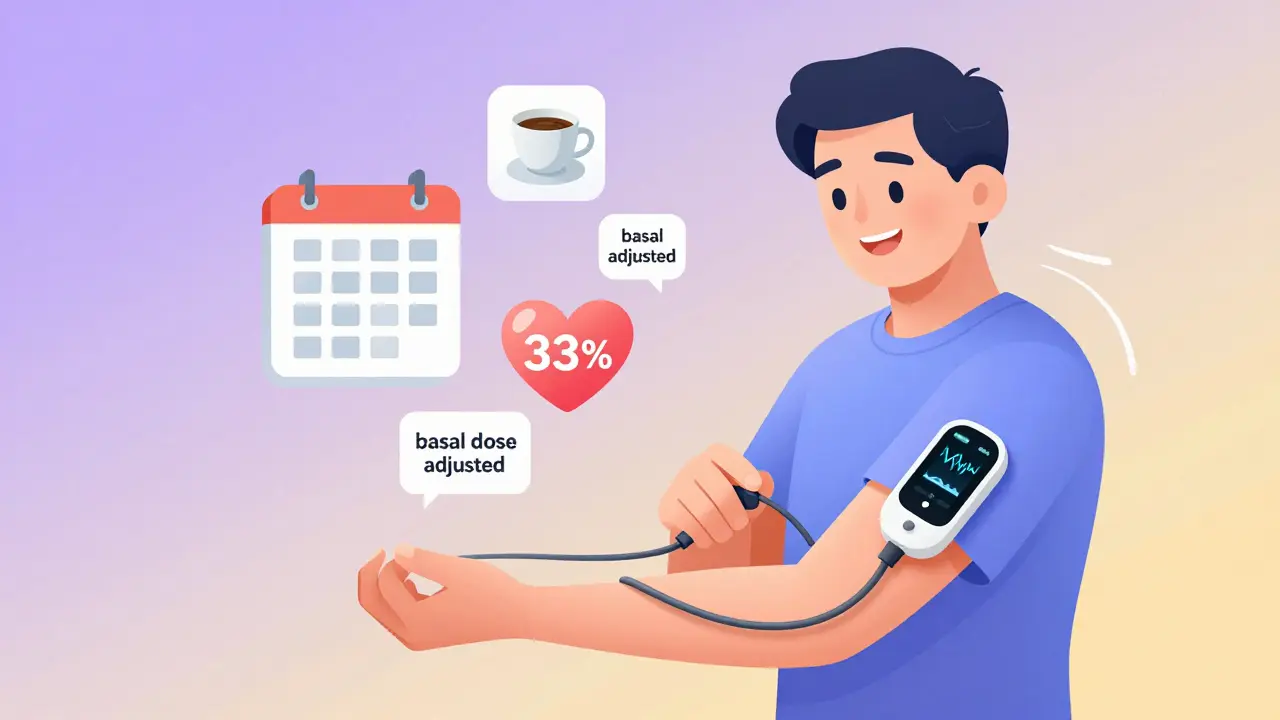
And long-term? The DCCT follow-up study from 2023 showed that people who stuck with intensive insulin therapy-mostly basal-bolus-had 33% lower risk of heart disease over 30 years. That’s not just about glucose numbers. That’s about living longer, healthier, and freer from complications.
Basal-bolus isn’t easy. But for the right person, it’s the most powerful tool we have.
What’s the difference between basal and bolus insulin?
Basal insulin is long-acting and works slowly over 12-24 hours to keep your blood sugar steady between meals and overnight. Bolus insulin is rapid-acting and taken at mealtimes to cover the carbs you eat and correct high blood sugar. Together, they mimic how a healthy pancreas works.
Can I use basal-bolus insulin if I have type 2 diabetes?
Yes. If you’re on oral meds or basal insulin alone and still can’t reach your A1c goal, your provider may recommend adding bolus insulin. This is especially true if your blood sugar spikes after meals. Basal-bolus is often used when type 2 diabetes has progressed and your body needs more precise insulin control.
How often should I check my blood sugar with basal-bolus therapy?
At minimum, check before each meal and at bedtime. That’s 4-5 times a day. If you’re adjusting doses, you may also check 2 hours after meals to see how your bolus worked. Many people use continuous glucose monitors (CGMs) now, which give real-time readings and trends without fingersticks.
What if I forget to take my bolus insulin before eating?
If you realize within 15-20 minutes after eating, you can still take your full dose. After that, it’s riskier-your blood sugar may spike higher. In that case, take half your bolus and monitor closely. Never skip your basal insulin, even if you miss a meal. Basal insulin is your foundation.
Is basal-bolus therapy expensive?
Yes, in the U.S., insulin costs can average $550 per month out-of-pocket. Basal and bolus insulins are both needed, so the cost is higher than single-insulin regimens. Many people rely on patient assistance programs, insurance, or generic insulins like NPH or regular insulin to reduce costs. Talk to your provider about affordable options.
What to Do Next
If you’re starting basal-bolus, don’t try to learn everything at once. Focus on one thing at a time. First, nail your basal dose-get your fasting numbers steady. Then, pick one meal to practice carb counting and bolusing. Once that feels comfortable, move to the next meal. Use a logbook or app to track your doses, food, and numbers. Look for patterns over days, not hours.
Find a certified diabetes educator. They’re not just teachers-they’re problem solvers. They’ve seen what works and what doesn’t. And if you’re feeling overwhelmed, you’re not alone. The hardest part isn’t the math-it’s the mental load. Give yourself grace. Progress, not perfection, is the goal.
about author

Henriette Barrows
Just wanted to say this post saved my sanity. I was terrified of starting basal-bolus, but the way you broke down the 500 and 1700 rules made it click. I’ve been doing it for 3 months now and my A1c dropped from 8.1 to 6.9. Not perfect, but I’m finally sleeping through the night without panic checks.
Jim Rice
Everyone acts like basal-bolus is the holy grail, but have you talked to someone who actually has to work a 12-hour shift and can’t check their glucose every 90 minutes? This system is a luxury for people who don’t have real lives.
Sharleen Luciano
Let’s be honest - if you’re still using the 500 Rule without adjusting for insulin sensitivity variation across the day, you’re basically flying blind. Most endocrinologists I’ve trained use dynamic carb ratios and time-dependent correction factors now. The 1700 Rule is a 1990s relic. If you’re not using a CGM with predictive algorithms, you’re not doing basal-bolus - you’re doing insulin roulette.
And don’t get me started on people who think NPH is ‘affordable’ - it’s a nightmare for nocturnal hypoglycemia. Degludec is the only basal that doesn’t have a midnight crash. If your provider is still pushing glargine without discussing peakless options, they’re not keeping up.
Also, the ‘one meal at a time’ advice? Cute. Real people don’t eat in isolation. You need to model meal interactions, protein effects, and delayed gastric emptying. If you’re not using an app with AI-based bolus suggestions, you’re wasting your time.
Alex Ronald
Just wanted to add - if you’re struggling with carb counting, try the ‘hand method’ for a while. Fist = 45g carbs, palm = 30g, cupped hand = 15g. It’s not perfect, but it’s way better than guessing. I’ve helped dozens of patients get from ‘I don’t know what’s in my food’ to ‘I can eyeball this now.’ It’s not about precision, it’s about consistency.
And if you’re afraid of lows, start with a 50% correction factor until you build confidence. You don’t have to hit it dead-on the first time.
Teresa Rodriguez leon
I’ve been on basal-bolus for 11 years. I’ve had 3 DKA episodes because I was too scared to bolus. I’ve cried in grocery stores trying to read nutrition labels. I’ve missed my daughter’s birthday because I was in the ER. And now I’m supposed to feel grateful because someone wrote a nice article? This isn’t therapy. This is a prison with insulin.
Aliza Efraimov
Every single person who says ‘basal-bolus is the gold standard’ forgets one thing - access. I work with a clinic in rural Alabama. Half our patients can’t afford CGMs. Two-thirds can’t get insulin without a 3-month wait. The ‘500 Rule’ is useless if you’re choosing between insulin and rent. This post reads like a brochure for people who’ve never had to ration.
Real talk: the real gold standard is someone who listens. Not a formula. Not an app. A person who says, ‘Let’s figure out what works for YOU.’ That’s what changes lives.
Nisha Marwaha
As a certified diabetes educator in Mumbai, I’ve seen patients adapt basal-bolus with astonishing creativity. One woman uses a cycle rickshaw to transport her insulin vials in a cooler. Another calculates carb ratios using local spices - turmeric reduces postprandial spikes, so she reduces bolus by 10% on dal-heavy days. Technology helps, but human ingenuity? That’s the real innovation.
Also, in India, we often use regular insulin for bolus because it’s cheaper and available. It’s slower, yes - but it’s still effective if timed right. Don’t assume U-100 rapid-acting is the only way.
Amy Cannon
While I appreciate the comprehensive nature of this exposition on the physiological and pharmacological underpinnings of basal-bolus insulin therapy, I must respectfully submit that the implicit assumption of patient autonomy and cognitive capacity may be overly optimistic in the context of socioeconomic and psychological stressors that frequently coexist with type 1 and advanced type 2 diabetes.
For instance, the notion that one can ‘track patterns over days’ presupposes not only access to glucose monitoring devices, but also uninterrupted sleep, stable housing, and absence of cognitive fatigue - conditions not universally available. Furthermore, the reliance on digital apps for carb counting may inadvertently exclude elderly or low-literacy populations, despite their willingness to adhere.
It is my humble observation that the most successful interventions are those that integrate community health workers, peer support, and simplified, culturally-adapted tools - not merely more precise mathematical models.
Also, i think the 1700 rule is kinda outdated. my doc just told me to use 1 unit per 25. simpler. and i like simple.
Himanshu Singh
Hey this is realy helpful! I just startet basal-bolus last week and i was so scare. I thought i was gonna mess up my sugar all the time. But now i use the 500 rule and its workin good. I still forget to bolus sometimes but i try. Also i use my phone to log everyting. Thanks for the tips!
Jasmine Yule
Jim - I hear you. My husband works swing shift and basal-bolus is brutal for him. But we found a workaround: he takes his basal at 10 PM and 8 AM, and he boluses only for meals he actually eats - even if it’s 3 AM. He uses a CGM with alerts, so he doesn’t have to wake up to check. It’s not perfect, but it’s sustainable. You’re not failing because your life doesn’t fit the textbook. You’re adapting.
Greg Quinn
It’s funny - we treat insulin like it’s a magic wand, but it’s really just a tool that responds to our choices. The real question isn’t ‘how do I dose better?’ It’s ‘how do I live better with this?’ I’ve seen people with perfect A1cs who are miserable. And others with 8.5s who are thriving. The numbers don’t tell the whole story.
Maybe the goal isn’t to master the math. Maybe it’s to stop seeing your body as a problem to be fixed.
Lisa Dore
To everyone who’s scared - you’re not alone. I started basal-bolus after my son was diagnosed. I cried every night for two weeks. But I joined a Reddit group, and one woman sent me a voice note saying, ‘I did this with my toddler. You got this.’ That’s what kept me going. It’s not about being perfect. It’s about showing up. Even if you mess up. Especially if you mess up.
Manan Pandya
Nisha, your point about cultural adaptation is vital. In my practice, I’ve seen patients in Punjab use jaggery instead of sugar - and adjust their bolus accordingly. It’s not about Western standards. It’s about matching therapy to lived reality. Also, I always tell patients: if you miss a bolus, don’t panic. Just take half now and monitor. Never double up later - that’s how lows become emergencies.
Paige Shipe
Let’s not romanticize this. Basal-bolus is a burden. It’s expensive. It’s exhausting. It’s emotionally draining. And yet, people who don’t do it die young. The fact that we call this ‘gold standard’ is a moral failure. We have a system that forces people to choose between insulin and food. And then we pat ourselves on the back because someone got their A1c down.
This isn’t medicine. It’s survival.